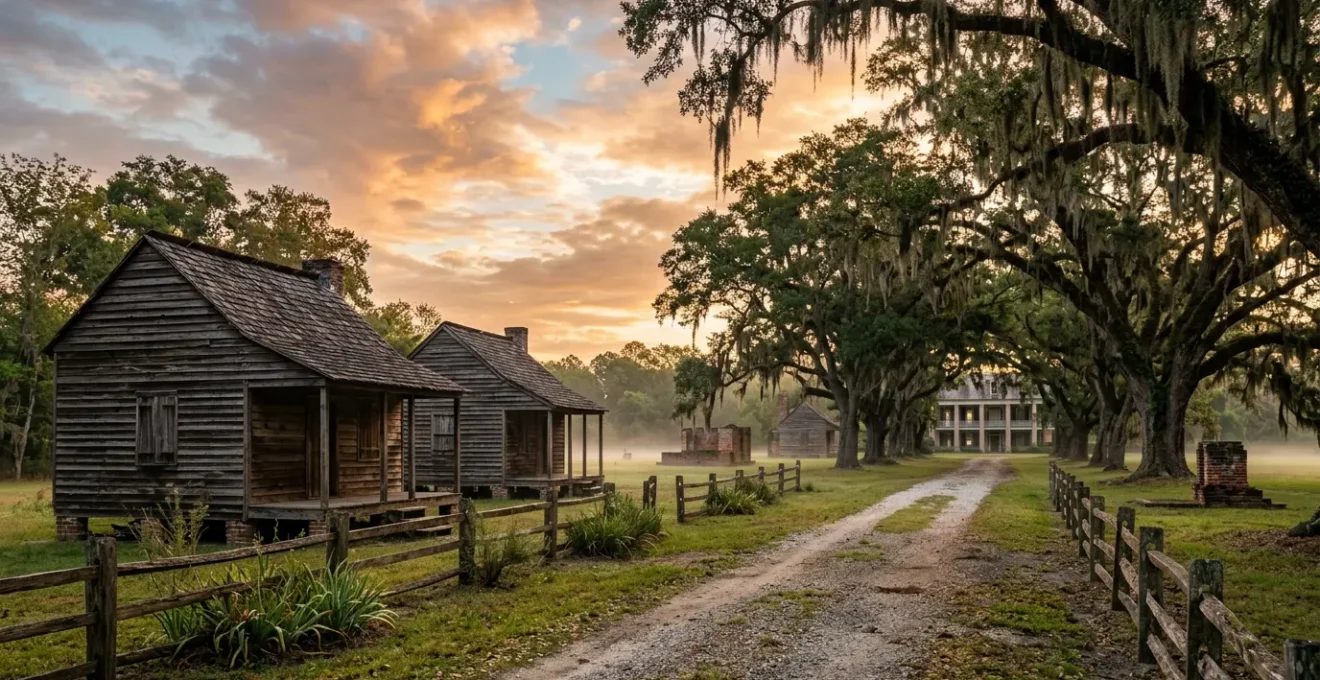
Most historical tourism in the US South presents a romanticised fiction; to find the truth, you must become a historical detective, not a passive tourist.
- Sanitised narratives are driven by economic models that prioritise weddings and events over historical accuracy.
- The key is to actively deconstruct the stories presented by examining language, gift shops, and the sources guides use.
Recommendation: Before booking any tour, use the research tools and vetting questions in this guide to verify that the site is committed to an honest portrayal of its entire history, including the lives of the enslaved.
There is a peculiar sense of dissatisfaction that often follows a visit to a grand antebellum plantation in the American South. You walk through opulent rooms, admire the manicured gardens, and perhaps hear tales of genteel society, yet a crucial element feels conspicuously absent. The very foundation of this wealth—the forced labour, suffering, and resilience of enslaved people—is frequently relegated to a footnote, if mentioned at all. For the educated traveller from the UK, accustomed to a different engagement with difficult histories, this can feel less like a historical experience and more like participating in a theme park of sanitised nostalgia.
The common advice is to “read a book before you go” or “look for tours that mention slavery.” This, however, is insufficient. It places the burden of knowledge on you without providing the tools to challenge the polished narratives you will inevitably face. The issue is not just about finding the “right” tour; it’s about developing a critical framework to see through the historical façade wherever you go. This guide is not a simple list of destinations. It is an argument for a new kind of travel—one rooted in historical forensics and narrative deconstruction.
Instead of passively consuming stories, we will explore how to actively dissect them. The true challenge isn’t just acknowledging the brutality of slavery; it’s understanding the modern economic and cultural systems that perpetuate its erasure. This is not about shunning these sites, but about learning to visit them with open, critical eyes. It’s about transforming your role from that of a simple tourist into an active witness to a more complete, and therefore more honest, version of history.
This article will provide you with an academic toolkit to achieve this. We will examine the language of denial used on tours, analyse gift shops as historical texts, and compare different types of historical sites. We will then equip you with methods for pre-visit research and for planning a journey that is not only educational but also respectful and ethically conscious, particularly when engaging with the powerful legacy of the Civil Rights Movement.
Summary: Beyond the Mint Juleps: A Guide to the Unvarnished Reality of US Colonial Heritage
- Why Many Famous Plantation Tours Completely Ignore the Brutal Reality of Slavery?
- The Souvenir Mistake That Accidentally Supports Sanitised Historical Narratives
- Living History Villages or Academic Museums: Which Presents a Truer Colonial Picture?
- How to Research the True Origins of Historical Estates Before Buying Tickets?
- When to Book Private Historical Walking Tours for a More Nuanced Discussion?
- Why the Civil Rights Trail Demands a Completely Different Mindset to Standard Tourism?
- Why Ignorance of Local Traditions Quickly Turns Tourists into Unwelcome Targets?
- How to Plan a Respectful Civil Rights Educational Journey Through the Deep South?
Why Many Famous Plantation Tours Completely Ignore the Brutal Reality of Slavery?
The primary reason for the erasure of slavery at many historical sites is not accidental ignorance; it is a deliberate economic strategy. These locations often function less as museums and more as profitable hospitality venues. As Amy Potter, a scholar at Georgia Southern University, notes, “Commercialized plantation sites tout luxury inns, Halloween ghost tours, wine and bourbon tastings, strawberry festivals, and plantation weddings, their biggest moneymaker.” The brutal reality of forced labour is fundamentally incompatible with the romantic fantasy being sold to wedding parties and weekend tourists. The narrative is curated to maximise profit, and the history of enslavement is bad for business.
This creates a landscape of “curatorial silence,” where the focus is on architecture, silverware, and the lavish lifestyles of the enslavers. At Houmas House in Louisiana, a site once transformed into what was called a “Disneyland for adults,” a 2024 Equal Justice Initiative report notes that 800 Black people were enslaved, a fact often eclipsed by its modern identity as a luxury resort. This romanticisation can reach absurd levels. One visitor reported a guide at the Hofwyl-Broadfield Plantation in Georgia mentioning that “in the holiday season, one of our volunteers comes dressed as Vivian Leigh,” the fictional heroine of Gone with the Wind, thereby blending historical fact with cinematic fantasy.
This deliberate narrative is reinforced by the language guides use. Learning to spot these euphemisms is the first step in your historical forensics work. Be alert for terms that diminish the violence of enslavement:
- Euphemisms: Pay attention if guides use words like “servants” or “workers” instead of the accurate term “enslaved people.”
- False Intimacy: Note the use of “our family” or “the estate” to create a sense of connection with the enslavers, not the enslaved.
- Minimisation: Challenge claims that enslaved people were treated “like family,” a common trope used to downplay systemic brutality.
- Misdirection: Be aware when tours focus exclusively on architecture and antique furniture, using objects to distract from human lives.
Understanding these economic and linguistic tactics allows you to see past the polished surface and recognise the deliberate construction of a sanitised, and therefore false, history. The absence of truth is not an oversight; it’s a feature of the business model.
The Souvenir Mistake That Accidentally Supports Sanitised Historical Narratives
Your work as a historical detective does not end when the guided tour concludes. In fact, one of the most revealing spaces at any historic site is the gift shop. Souvenirs are not neutral objects; they are a physical manifestation of the site’s official narrative. By choosing what to sell, a museum or plantation makes a clear statement about what and who it deems important. Buying a mint julep cup or a romanticised novel about the antebellum South is not just a purchase; it is a financial vote for a whitewashed version of history.
The gift shop is where the economic underpinnings of the heritage industry become most visible. These spaces are designed to generate revenue that sustains the site, and the products offered are a direct reflection of what the management believes visitors want to buy. Often, this means a celebration of the enslaver’s lifestyle rather than a commemoration of the enslaved. This “souvenir mistake”—unwittingly funding a sanitised narrative—is one of the most common ways tourists support the very historical erasure they may wish to condemn.
To avoid this, you must perform a “gift shop autopsy,” a critical examination of the products on offer. This framework turns you from a consumer into a critical analyst, helping you to assess the institution’s true priorities.
Your Action Plan: The Gift Shop Autopsy
- Points of Contact: Inventory the books on sale. Are narratives by Black historians and formerly enslaved people prominently displayed, or is the selection dominated by cookbooks and Civil War generals?
- Collecte: Examine the crafts and replicas. Do they celebrate the luxury of the “big house” (e.g., silver patterns, fine china) or the craftsmanship and culture of the enslaved (e.g., basket weaving, ironwork)?
- Cohérence: Check the food and drink items. Is the focus on romantic signifiers like mint julep mixes and plantation-branded bourbon, or are there products that connect to the agricultural labour of the enslaved?
- Mémorabilité/émotion: Look for materials dedicated to memorialisation. Are there books, pamphlets, or items that explicitly honour the names and lives of the enslaved individuals who lived and died on the property?
- Plan d’intégration: Identify the donation options. Can you contribute directly to the preservation of slave quarters or to research projects on enslaved families, or do all donations go into a general fund?
By asking these questions, you can quickly gauge whether a site is genuinely committed to a complete history or is merely using its past as a backdrop for a commercial enterprise. A gift shop that fails this autopsy reveals an institution that profits from nostalgia while silencing the voices of the oppressed.
Living History Villages or Academic Museums: Which Presents a Truer Colonial Picture?
When seeking an authentic historical experience, travellers are often faced with a choice between two distinct models: the “living history” site, with its costumed interpreters, and the traditional academic museum, with its glass cases and artifacts. Each approach has inherent strengths and weaknesses, and understanding them is key to deconstructing the narrative presented. Neither is inherently superior; rather, they are different tools for understanding the past, and both require critical engagement from the visitor.
Living history sites, like Colonial Williamsburg, aim for emotional immersion. By using first-person narratives and recreating daily life, they can make the past feel immediate and human. However, they run the risk of romanticisation. The scripts can be sanitised, and the focus on atmosphere can sometimes overshadow hard facts about violence, disease, and oppression. An academic museum, conversely, prioritises factual accuracy through primary sources and physical evidence. Its strength lies in the authenticity of its artifacts—the tangible remnants of people’s lives.
The trade-off is that museums can feel sterile and disconnected from the human experience. The very objects that provide irrefutable proof of a life, like the tools or shackles seen above, can feel emotionally distant behind glass. The ideal approach for the historical detective is to use the strengths of one model to question the other. As a recent analysis of plantation tours highlights, the most progressive sites are now blending these approaches, using artifacts to ground the immersive stories.
The following table provides a framework for how to critically approach each type of institution.
| Aspect | Living History Sites | Academic Museums |
|---|---|---|
| Primary Tool | Immersive atmosphere through costumed interpreters | Physical artifacts and documented evidence |
| Strengths | Emotional engagement through first-person narratives | Factual accuracy through primary sources |
| Limitations | Risk of romanticized scripts and sanitized narratives | Can feel disconnected from human experience |
| Best Practice | Question interpreters about violence and resistance | Gather names, dates, specific events for verification |
Ultimately, a truer picture of the past emerges not from choosing one type of site over the other, but from synthesising the information from both. Use the emotional connection from a living history story to seek out the hard evidence in a museum, and use the documented facts from a museum to challenge and question the narratives presented by costumed interpreters.
How to Research the True Origins of Historical Estates Before Buying Tickets?
The most effective way to avoid a sanitised historical experience is to conduct your own research before you even purchase a ticket. In the digital age, a wealth of primary source documents are available online, allowing you to perform your own “historical forensics” and vet a site’s commitment to the truth. This proactive approach empowers you to move beyond marketing slogans and brochures and assess a plantation or historic estate based on actual evidence. A site that is transparent about its history will often make these resources easy to find.
The goal of this pre-visit research is twofold. First, it is to ascertain the scale and nature of enslavement at a particular location. How many people were enslaved? What kind of labour did they perform? Second, it is to see if the site itself acknowledges this history in its public-facing materials. A plantation’s website that focuses exclusively on its beautiful gardens while its historical records reveal hundreds of enslaved individuals is a major red flag. Conversely, a site like the Whitney Plantation, the only museum in Louisiana with an exclusive focus on slavery, puts this history at the very forefront of its identity.
You do not need to be a professional historian to conduct this research. Many university and public history projects have made vast archives accessible to the public. Here are the key steps for your digital investigation:
- Slave Trade Databases: Search the Trans-Atlantic Slave Trade Database (SlaveVoyages.org) for records of ships and the origins of enslaved people brought to the region you are visiting.
- Plantation Records: Use the same database to find specific records related to the plantation you intend to visit, which can sometimes include inventories listing enslaved individuals by name and role.
- University Projects: Look for digital history projects at universities in the state you’re visiting (e.g., University of Virginia, University of North Carolina). They often have digitised primary documents.
- Census Records: Search historical US census records (many are available online), which listed enslaved populations, to get a sense of the scale of enslavement on an estate or in a county.
- Slave Narratives: Look up the Federal Writers’ Project slave narratives from the 1930s, where thousands of formerly enslaved people gave first-hand accounts of their lives.
Spending an hour on this research can tell you more about a site’s true history than a dozen of its own brochures. It allows you to arrive not as a passive consumer of a curated story, but as an informed observer equipped with names, dates, and facts, ready to ask pointed and meaningful questions.
When to Book Private Historical Walking Tours for a More Nuanced Discussion?
While large, commercial plantation tours often default to a sanitised narrative, smaller, private historical walking tours can offer a powerful antidote. These tours, frequently led by independent historians, graduate students, or community activists, are often more flexible and dedicated to a more nuanced and honest discussion of the past. The smaller group size allows for genuine dialogue, and the guides are typically less constrained by a corporate-approved script. However, “private” or “small” does not automatically mean “accurate.” Vetting the guide and the tour company is just as critical here as it is with a large estate.
The key advantage of a private tour is the opportunity for direct, in-depth conversation. You can ask the difficult questions that might be brushed aside in a larger group. This is also where you can directly inquire about terminology. A guide’s choice to use the term “enslaved people” versus “slaves” is a critical indicator of their historical perspective. “Enslaved people” is the term preferred by most modern historians because it emphasizes the humanity of the individuals and frames slavery as a condition imposed upon them, rather than an inherent identity. A guide who cannot or will not explain their choice of words may not be equipped to handle the topic with the necessary depth and respect.
Before booking, use this litmus test of questions to gauge the quality and focus of the tour:
- Primary Sources: “What are your primary historical sources for the narratives you share about the enslaved people of this area?”
- Guide Training: “How do your guides receive training on discussing the brutalities of enslavement?”
- Terminology: “Do you use the term ‘enslaved people’ or ‘slaves’ in your tour, and could you explain why?”
- Focus: “Roughly what percentage of the tour is dedicated to the lives and experiences of the enslaved versus the lives of the enslavers?”
- Credentials: “Are your guides professional historians, graduate students, or seasonal staff?”
A guide or company that welcomes these questions is likely to be a reliable source. The impact of such an experience can be profound. As one visitor to a more historically-grounded tour at Mount Vernon stated, “The tour opened some uncomfortable truths and gave me a better understanding of the caste system of white society. The stories emphasized both the humanity and brutal realities of the people who were enslaved.” This is the goal: not comfort, but a deeper, more truthful understanding.
Why the Civil Rights Trail Demands a Completely Different Mindset to Standard Tourism?
As your journey through American history moves from the colonial era and the antebellum South into the 20th century, the landscape of remembrance shifts dramatically. Following the U.S. Civil Rights Trail is not an extension of typical tourism; it requires a fundamental change in mindset from that of a sightseer to that of an active witness. These are not just “attractions.” They are sites of profound struggle, trauma, and resilience, many of which are within living memory. Visiting the Edmund Pettus Bridge in Selma, Alabama, or the Lorraine Motel in Memphis, Tennessee, is not about consuming history, but about bearing witness to it.
The trail itself is a curated collection of places that were pivotal to the fight for social justice. As the official organization describes it, the U.S. Civil Rights Trail is a collection of over 100 landmarks, including churches, courthouses, and schools across 15 states, that were battlegrounds in the 1950s and 1960s. Unlike plantations, which were sites of oppression, many of these locations were sites of liberation and resistance. They represent not the power of the enslaver, but the courage of the activist. This distinction is crucial.
Approaching these spaces requires reverence and reflection. This is not a place for casual selfies, but for quiet contemplation of the sacrifices made. The goal is to understand the connection between these historical struggles and the ongoing fight for racial justice today. These are not relics of a distant past; they are foundational to understanding contemporary American society. Michelle Lanier, a director of North Carolina’s State Historic Sites, captured this sentiment perfectly when she said, “We are the stewards of spaces that can offer answers. There’s a grand healing that I think is attempting to emerge through our nation’s greatest wound.”
Therefore, your approach should be one of humility and a desire to listen. Listen to the local guides, many of whom have personal or family connections to the events. Listen to the silence in a rebuilt church that was once bombed. This journey is an education and a pilgrimage, not a vacation. It demands an emotional and intellectual engagement far deeper than what is required for standard historical tourism.
Why Ignorance of Local Traditions Quickly Turns Tourists into Unwelcome Targets?
While the grand narratives of slavery and civil rights are the focus of a historical journey, a crucial layer of understanding comes from observing the present-day cultural landscape. The American South is not a monolith, and the way a town or community grapples with its history is written in plain sight—if you know how to read the signs. Ignorance of these local traditions and contemporary tensions can not only lead to a superficial understanding but can also mark you as an oblivious outsider. Learning to “read the cultural temperature” is an essential skill for any respectful and insightful traveller.
This means paying attention to the subtle and not-so-subtle symbols that populate the public square. A town’s choice of monuments, for example, speaks volumes. Is the most prominent statue in the town square a tribute to a Confederate general or a memorial to local civil rights heroes? This is not just a historical decoration; it is a statement of the community’s present-day values. The presence and condition of Black-owned businesses, the flags flown on private properties, and even the way locals talk about the past are all data points for your analysis.
Your role as a respectful visitor is to observe and learn, not to judge or intervene. This is especially true when visiting sacred spaces, which include not only churches but also sites of racial terror, such as lynching memorials. These are places of mourning that demand the utmost reverence. Here is a brief guide to reading the cultural temperature:
- Public Monuments: Make a mental note of who is celebrated in public spaces. The prevalence of Confederate memorials versus civil rights monuments is a clear indicator of the town’s dominant historical narrative.
- Local Businesses: Actively seek out and support Black-owned businesses. Note their location and condition relative to other establishments in the town.
- Visual Cues: Watch for contemporary political signs, from Black Lives Matter posters in windows to Confederate flags on bumpers. These are direct expressions of current community sentiment.
- Local Language: Listen to how local people, from tour guides to shopkeepers, discuss history. Do they use euphemisms for slavery? Do they speak of the Civil Rights Movement as a completed event or an ongoing struggle?
By engaging in this quiet observation, you move beyond the official tourist trail and begin to understand the living, breathing, and often-conflicted reality of the American South. This sensitivity is what separates a tourist from a thoughtful traveller.
Key Takeaways
- Historical sanitisation is an economic choice; romanticised narratives are more profitable than brutal truths.
- You must become an active “historical detective,” using pre-visit research and on-site analysis to deconstruct the stories you are told.
- The Civil Rights Trail is not tourism; it is an act of witnessing that requires a mindset of reverence, reflection, and respect.
How to Plan a Respectful Civil Rights Educational Journey Through the Deep South?
Planning a journey along the Civil Rights Trail is an exercise in conscious and ethical tourism. Unlike a standard holiday, every choice—from where you sleep to where you eat—carries weight and has an economic and social impact. The most powerful way to honour the legacy of the Civil Rights Movement is to ensure your travel budget directly supports the communities that are the custodians of this history. This means intentionally planning your itinerary around Black-owned businesses.
This approach transforms your trip from a passive educational tour into an active investment in economic justice, a core goal of the Civil Rights Movement itself. It requires more planning than simply booking the most convenient chain hotel or grabbing a meal at a familiar franchise, but the rewards are a deeper, more authentic connection to the places you visit. You are not just learning about history; you are participating in its living legacy.
The journey can be emotionally and intellectually demanding. Sites like the National Civil Rights Museum at the Lorraine Motel, the most visited civil rights landmark in America, powerfully connect past struggles to contemporary justice movements. It is essential to build time for rest and reflection into your itinerary. Do not try to cram too many heavy experiences into a single day. The goal is deep engagement, not just checking sites off a list. Here is a practical framework for planning your journey:
- Accommodation: Research and book rooms at Black-owned hotels or B&Bs in key cities like Montgomery, Selma, and Birmingham.
- Dining: Seek out restaurants featured in historical guides like the “Green Book,” which once helped Black travellers navigate a segregated America. Many modern guides to Black-owned eateries are available online.
- Shopping: Purchase books about the movement and its leaders from Black-owned bookstores along your route.
- Tours and Guides: Hire tour guides directly from local Black historical societies or community-based organizations.
- Donations: Support the museums and cultural centres you visit with direct donations to their preservation funds.
To truly commit to this form of travel, the next step is to apply this critical framework. Begin researching your potential destinations now, challenge the comfortable narratives, and plan a journey that seeks truth over comfort.