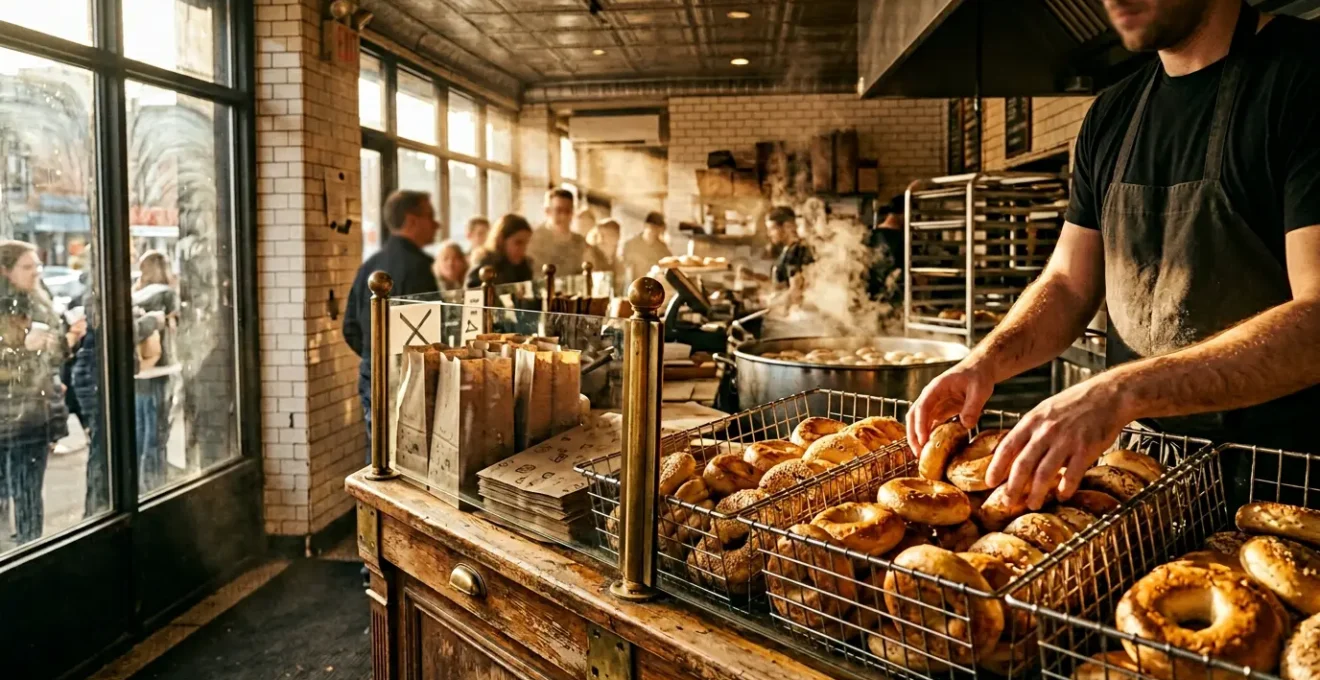
Contrary to popular belief, the secret to a real New York bagel isn’t a famous name, but mastering a local ritual.
- The unique mineral content of NYC tap water is scientifically key to the bagel’s texture, making true authenticity location-dependent.
- Toasting a fresh bagel is the ultimate tourist mistake; the real test of quality is a crisp, un-toasted crust.
Recommendation: Prioritise timing over location. Arrive at a neighbourhood bakery during the “Golden Hour” (6-7 AM) for a bagel that requires no toasting and reveals the true New York experience.
Listen up. You’re in New York, you’ve just woken up, and you’re staring down the barrel of a sad, £15 continental breakfast at your hotel. You came here for the real deal, for that iconic food experience, and that starts with a proper New York bagel. But you’ve heard the horror stories: long queues, rude staff, and the crushing disappointment of a glorified bread roll. The internet will give you a list of the same five famous bakeries, sending you straight into a tourist scrum where authenticity has been replaced by volume and merchandise.
They’ll tell you it’s “all about the water” or that you should “order lox and cream cheese.” These are half-truths, the kind that keep you on the outside looking in. Getting a real bagel here isn’t a simple transaction; it’s a cultural ritual. It’s an exchange built on unwritten rules, a test of local knowledge that happens in under ten seconds. The goal isn’t just to eat a bagel, but to get the subtle, approving nod from the counterman—the sign that you get it. You’re not just another tourist to be processed.
Forget everything you think you know. We’re not going to talk about the most famous spots. Instead, this guide is about decoding that ritual. We’ll cover the science, the etiquette, and the language, so you can walk into any real neighbourhood deli, from the Upper West Side to deep in Brooklyn, and order with the quiet confidence of a local. This is about securing a piece of authentic New York, a hand-rolled, perfectly chewy, steaming hot circle of perfection. This is about bagel integrity.
To truly understand what makes this experience unique, we need to explore every facet of the ritual. This guide breaks down the essential knowledge, from the very chemistry of the dough to the final, satisfying bite, ensuring you avoid the common pitfalls and taste the city’s true culinary soul.
Summary: Your Guide to Finding Authentic New York Bagels (and Avoiding the Tourist Traps)
- Why Genuine New York Tap Water Makes Their Bagels Scientifically Impossible to Copy?
- The Toasting Error That Instantly Identifies You as a Clueless Tourist in New York
- Classic Lox or Whitefish Salad: Which Traditional Filling Provides the Real Experience?
- How to Shout Your Order Correctly in a Crowded Brooklyn Deli Queue?
- When to Visit Neighbourhood Bakeries to Get the Freshest Morning Bake?
- Deep Dish or New York Slice: Which Historic Pizza Must You Try First?
- Gluten-Free Bread or Lettuce Wraps: Which Alternative Saves Your Burger?
- How to Experience Authentic US Culinary Heritage Without Spending £100 per Meal?
Why Genuine New York Tap Water Makes Their Bagels Scientifically Impossible to Copy?
Let’s get one thing straight: the “it’s the water” line isn’t a myth, it’s chemistry. For generations, bakers have sworn by it, and science backs them up. New York City’s tap water is famously “soft,” meaning it has a low concentration of minerals like calcium and magnesium. This is crucial because these minerals can toughen the gluten in dough. The city’s water allows the gluten strands to stretch just enough, creating that legendary chewiness that defines a real bagel, distinct from a simple bread roll.
The difference is not trivial. Research shows that New York’s water contains significantly lower mineral levels than the national average; one study notes 13.5 mg of calcium per liter versus a national average of 50.6 mg/L. This specific chemical profile results in a crust that is glossy and thin, yet strong enough to yield with a slight crackle, revealing a dense, moist, and elastic interior. It’s a texture that bagels made elsewhere simply cannot replicate without artificial water treatment.
Case Study: Recreating the Elixir 1,700 Miles Away
The importance of this water chemistry is so profound that some bakers go to extraordinary lengths to copy it. Josh Pollack, a baker in Denver, was so obsessed with achieving true bagel authenticity that he spent nearly a year testing water from across the NYC area. He then contracted a filtration company to build a system for his shop, Rosenberg’s Bagels, that re-mineralizes Denver’s water to precisely match the chemical signature of New York’s. This Herculean effort proves that the water isn’t just a charming story; it is the foundational element of bagel integrity.
This is why, for a true purist, a bagel’s authenticity is tied to its geography. It’s not just a recipe; it’s a product of a unique urban ecosystem. Any bagel baked outside this hydro-geological sweet spot is, at best, a respectable imitation. It might look the part, but it will never feel the same.
The Toasting Error That Instantly Identifies You as a Clueless Tourist in New York
Now for the most common tourist “tell”: asking for a fresh bagel to be toasted. This request is a cardinal sin in any self-respecting bagel shop. Why? Because a perfectly fresh bagel—one that is still warm from the oven—has a complex, multi-layered texture. It has a glossy, slightly crisp exterior skin that gives way to a chewy, dense interior. Toasting obliterates this delicate structure, turning it into a uniform, crunchy piece of toast. It’s an insult to the baker’s craft and a public declaration that you don’t know what you’re doing.
The only time toasting is acceptable is when the bagel is no longer fresh. If you’re buying a bagel in the late afternoon, or a day-old one for a discount, toasting is a necessary act of resuscitation. It revives the texture and brings back some warmth. But during the morning rush, when bagels are being churned out by the hundred, they are at their peak. To toast one then is to ruin it. In fact, some of the city’s most revered institutions, like Absolute Bagels, don’t even own a toaster. Their silence on the matter is the loudest statement of all.
Look at the structure. A true bagel has a blistered, shiny crust, an elastic layer just beneath it, and a soft, airy crumb. This is the holy trinity of bagel texture. Toasting effectively steamrolls this complexity into a single, monotonous crunch. You wouldn’t ask a Michelin-star chef to microwave your steak, and you don’t ask a master baker to toast a fresh bagel. It’s the same principle: don’t destroy the art.
Classic Lox or Whitefish Salad: Which Traditional Filling Provides the Real Experience?
Once you have your perfect, un-toasted bagel, the next decision is the filling. The default tourist order is “lox and cream cheese.” There is nothing wrong with this; it’s a classic for a reason. High-quality, silky, salt-cured salmon (lox) paired with cream cheese is a sublime experience. However, it’s just the beginning. To truly order like an insider, you need to understand the hierarchy of fillings.
The real connoisseur’s choice, the one that gets you the counterman’s nod, is often the whitefish salad. It’s less photogenic than vibrant pink lox, but its flavour is deeply rooted in New York’s Jewish deli heritage. As the food experts at Something Curated note, it’s a true insider’s pick:
A good bet at almost any bagel place is whitefish salad, the delicious, spreadable marriage of smoked whitefish and mayo.
– Something Curated NYC Food Guide, Ultimate Bagel Guide NYC
Choosing whitefish salad signals a deeper appreciation for the deli tradition. It shows you’re not just there for the Instagram photo, but for the authentic taste. The key is to ensure it’s made in-house—a good deli will have its own proprietary recipe, a jealously guarded blend that is the pride of the establishment. The difference between house-made and pre-packaged is night and day.
The following table, based on an analysis from a recent food guide, breaks down the cultural and culinary differences between these two iconic choices.
| Aspect | Classic Lox | Whitefish Salad |
|---|---|---|
| Visual Appeal | Instagram-worthy translucent slices | Less photogenic spreadable mixture |
| Cultural Depth | The iconic introduction for newcomers | The old-school connoisseur’s choice |
| Flavor Profile | Pure, delicate cured salmon | Rich blend of smoked fish and mayo |
| Price Point | Premium ($15-25 per sandwich) | More affordable ($8-12 per sandwich) |
| Authenticity Test | Quality of fish and thinness of slice | Made in-house vs. pre-packaged |
How to Shout Your Order Correctly in a Crowded Brooklyn Deli Queue?
The environment of a New York bagel shop during the morning rush is organized chaos. The queue moves fast, the counter staff are multitasking, and there is an unspoken expectation of efficiency. Hesitation is the enemy. To navigate this, you must have your order formulated in your head before you reach the counter. There is a simple, three-part structure that works every time.
The formula is: Bagel Type + Toasting Status + Filling. That’s it. It should be a single, clear, concise sentence. For example: “Everything, not toasted, with scallion schmear.” Or: “Poppy, toasted, with plain cream cheese.” This clarity is a sign of respect for the process and for everyone else in the queue. According to established NYC deli etiquette, the entire exchange should take less than 10 seconds from greeting to complete order. There is no time for “ums,” “ahs,” or “what do you recommend?”
Once you master the basic script, you can move on to more advanced lingo:
- “Scooped out”: If you find the bread-to-filling ratio too high, you can ask for your bagel “scooped out.” The counterman will remove some of the soft interior bread, creating more space for the cream cheese or salad. This is a very local move.
- Specify your salmon: While “lox” is the generic term, you can specify “Nova” for Nova Scotia salmon, which is cold-smoked and less salty than traditional lox.
- “On the side”: If you’re taking the bagel to go and want to preserve its integrity, you can ask for the cream cheese or “schmear” to be put in a separate container.
Mastering this simple syntax is the key to unlocking a smooth, successful transaction. It turns a potentially intimidating experience into an empowering one, earning you that quiet respect from behind the counter.
When to Visit Neighbourhood Bakeries to Get the Freshest Morning Bake?
Location is important, but timing is everything. The difference between a good bagel and a transcendent one can be a matter of minutes. The ultimate goal is to get a bagel so fresh it’s still radiating warmth from the oven. This requires strategic timing. Forget the famous Midtown spots with queues snaking around the block; the best experiences are often found at unassuming neighbourhood bakeries, provided you show up at the right moment.
There are two key windows for peak freshness. According to NYC bakery production schedules, the absolute best time is the “Golden Hour,” between 6 and 7 AM. This is when the first major batches of the day are coming out of the ovens, destined for the morning commuters. The bagels are hot, pliable, and at their textural peak. The second window is the “Silver Hour,” from 9 to 10 AM, when bakeries push out another large batch to handle the mid-morning rush. Arriving during these times almost guarantees a bagel that needs no toasting.
If you’re unsure, you can perform a quick sensory check before you even order. A truly fresh bagel has distinct characteristics that are easy to spot once you know what to look for. Use this checklist to become your own freshness expert.
Your Quick-Check for Bagel Freshness
- Visual Check: The crust should have a slight, glossy sheen and be covered in small, tight blisters. A dull, dry surface means it’s old.
- Aroma Check: Lean in. A fresh bagel emits a distinctly malty, slightly yeasty aroma. If it smells like nothing, it’s been sitting for hours.
- Touch Test (if possible): If there’s a bin you can access, gently press a bagel. It should have a slight give before the crust resists, then spring back. If it’s rock-hard or completely soft, move on.
- Temperature Test: The most obvious sign. You can often feel the radiant heat coming off the bins of fresh bagels. Warmth is the ultimate indicator of a recent bake.
- Condensation Check: Look at the windows of the shop. On a cool morning, a bakery in full production will often have steamy, condensed windows—a sure sign that the ovens are firing.
By prioritizing a neighbourhood spot during the Golden Hour and using these sensory clues, you bypass the tourist traps and engage with the bagel culture on its own terms. You’re not just a customer; you’re a participant who understands that the best things in life are fresh.
Deep Dish or New York Slice: Which Historic Pizza Must You Try First?
Now that you’ve mastered the art of the bagel, don’t let your guard down. New York is filled with other culinary tourist traps, and a primary one revolves around pizza. Many visitors arrive with a vague notion of “American pizza,” often lumping the New York slice and the Chicago deep-dish into the same category. This is a fundamental error. They are not just different styles; they are different philosophies, serving entirely different purposes.
The New York slice is street food, designed for a city in motion. It’s large, thin, and pliable enough to be folded in half, creating a pocket of molten cheese and sauce that can be eaten on the go. It’s a 10-minute meal, a quick, democratic pleasure available on almost every corner. Its crust is crisp yet chewy, a testament to the high-gluten flour and the hot, unforgiving deck ovens in which it’s cooked. It’s about speed, efficiency, and flavour delivery.
Chicago deep-dish, on the other hand, is a sit-down commitment. It’s a culinary event, not a snack. Baked in a high-sided pan, it’s more of a pie, with a thick, buttery crust, a dense layer of cheese on the bottom, and a chunky tomato sauce on top. You eat it with a knife and fork, and it demands at least an hour of your time. As one food critic put it, “A NY slice is a 10-minute, on-the-go meal designed for walking. Deep dish is a 60-minute+, sit-down, knife-and-fork commitment.” When in New York, trying to find “good” deep-dish is like trying to find a good Philly cheesesteak—you’re in the wrong city. Embrace the local specialty: the slice is king here.
Gluten-Free Bread or Lettuce Wraps: Which Alternative Saves Your Burger?
Another common pitfall for the discerning eater in the US is the burger. While a classic burger on a potato roll is an American art form, navigating the world of “healthier” alternatives can be treacherous. If you’re looking to skip the traditional bun, you’ll be faced with options that often compromise the entire structural and flavour integrity of the meal. The two most common culprits are the gluten-free (GF) bun and the lettuce wrap.
The gluten-free bun is almost always a mistake. Lacking the protein structure of gluten, these buns are often dry, crumbly, and have a sandy texture. They disintegrate upon contact with the burger’s juices, leading to a catastrophic structural failure. You end up with a messy pile that requires a fork anyway. The lettuce wrap is an even more fragile option. While it provides a fresh crunch, it offers zero structural support and acts as a slippery conduit for sauce and grease to run down your hands. It’s a valiant but ultimately doomed effort.
So what’s the solution for someone avoiding a traditional bun? The insider’s move is to ask for a “bowl burger” or “burger bowl.” This deconstructs the burger, placing the patty and all the toppings (cheese, bacon, onions, pickles) over a bed of greens or simply in a bowl. This approach preserves all the flavour, eliminates the mess, and sidesteps the disappointment of subpar bun alternatives entirely. It respects the ingredients instead of forcing them into a failing system.
This matrix evaluates the most common burger alternatives, showing a clear winner for maintaining the integrity of the meal.
| Option | Structural Integrity | Flavor Contribution | Messiness Factor |
|---|---|---|---|
| GF Bun | 2/5 – Often crumbly | 1/5 – Usually dry | High – Falls apart |
| Lettuce Wrap | 1/5 – Very fragile | 3/5 – Fresh crunch | Very High – Drips |
| Portobello Caps | 3/5 – Holds better | 4/5 – Adds umami | Medium – Can be juicy |
| Bowl Burger | 5/5 – No structure needed | 5/5 – All flavor intact | Low – Fork friendly |
Key Takeaways
- Embrace the Ritual: Getting a real bagel is about understanding a local culture of timing, language, and chemistry, not just visiting a famous shop.
- Freshness Over Fame: A hot bagel from an unknown neighbourhood spot at 7 AM is infinitely better than a cold one from a world-famous bakery at noon. Never toast a fresh bagel.
- Order with Confidence: Use the “Bagel + Toasting Status + Filling” formula for a fast, clear order that marks you as an insider. Consider whitefish salad for the true connoisseur’s choice.
How to Experience Authentic US Culinary Heritage Without Spending £100 per Meal?
The final, and perhaps largest, myth to bust is that experiencing authentic American food has to be an expensive, fine-dining affair. The soul of this country’s cuisine is not found in its Michelin-starred restaurants, but in its diners, its food trucks, its delis, and its ethnic enclaves. True culinary heritage is often democratic, affordable, and accessible—if you know where to look.
One of the best strategies is to tap directly into the wholesale and community traditions. For example, the legendary Acme Smoked Fish in Greenpoint, Brooklyn, has been supplying the city’s delis since 1906. While their products are premium-priced in stores, every Friday morning they open their warehouse to the public for “Fish Friday,” selling the same high-quality smoked fish at wholesale prices. This isn’t just a bargain; it’s a direct connection to the city’s food supply chain, a century-old tradition that most tourists will never see.
Beyond specific events, a budget-conscious strategy is your best tool for authentic discovery. Here are some proven methods to eat like a king without breaking the bank:
- Explore Ethnic Enclaves: Skip the tourist-centric areas and head to neighbourhoods where culture thrives. Visit Jackson Heights in Queens for world-class South American and South Asian food, or Arthur Avenue in the Bronx for the city’s most authentic Italian experience.
- Leverage the Lunch Special: Many of the city’s most acclaimed (and expensive) dinner restaurants offer prix-fixe lunch menus at a fraction of the cost, often 40-60% less. It’s the same kitchen, the same chefs, but at a far more accessible price point.
- Follow the Food Trucks: Food trucks are the incubators of culinary innovation in New York. They offer cutting-edge, chef-driven food at street-level prices. Track down the ones with the longest queues of locals.
- Embrace Diner and Bodega Culture: A classic American diner offers hearty, all-day breakfast and comfort food staples for under $15. And never underestimate the bodega (corner store), where you can build a high-quality sandwich or meal for a few dollars.
By shifting your focus from formal restaurants to these grassroots food systems, you don’t just save money—you gain a more genuine, diverse, and memorable taste of American culinary life.
Your quest for authentic food is the best way to explore the city. Apply these principles, stay curious, and you’ll not only eat well, but you’ll connect with the true, living heritage of New York. Start by exploring the side streets of your own temporary neighbourhood.