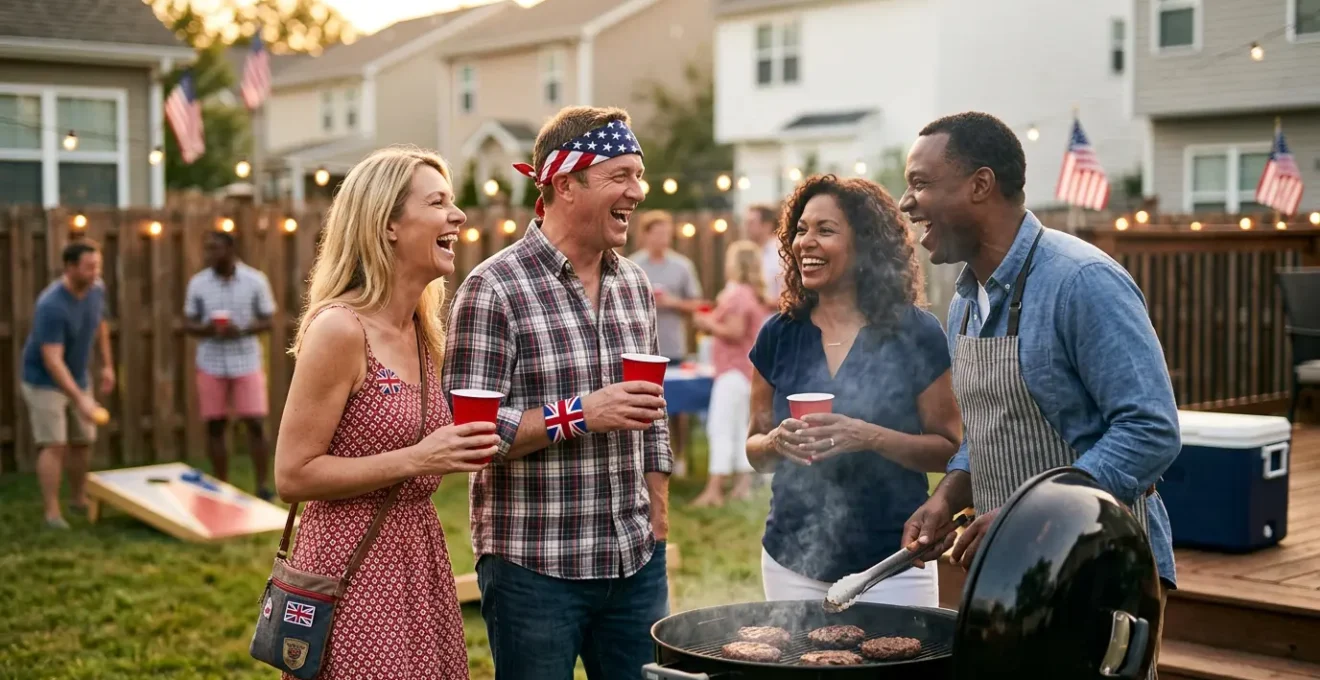
The historical awkwardness of celebrating July 4th as a British tourist isn’t the real problem; it’s the lack of a playbook for the holiday’s complex social logistics. The key to genuinely enjoying America’s biggest party isn’t to ignore your background but to understand the unwritten rules of participation. This guide moves beyond simply telling you to “have fun” and instead provides a strategic map to navigate everything from crowded fireworks and beach laws to securing that coveted barbecue invitation, turning you from a hesitant observer into a welcome guest.
There’s a certain irony, isn’t there? Planning a trip to the United States in early July, only to realize your holiday coincides with a massive, nationwide celebration of… well, of kicking your ancestors out. As a British tourist, the Fourth of July can feel like being invited to a party where you’re the punchline. The usual advice is to just “join the fun” or “wear red, white, and blue,” but that ignores the core of the unease. It’s not about lingering historical bitterness; it’s about not knowing the rules to a game everyone else has been playing their whole lives. You want to participate, but you don’t want to be the awkward cousin who doesn’t understand the inside jokes.
But what if the key to an awkward-free Independence Day isn’t ignoring the history, but mastering the modern reality of the holiday? Here’s a secret: for most Americans, the day is less about 1776 and more about the official, explosive start of summer. The patriotism is the theme of the party, not a test of allegiance. The real challenge for a visitor isn’t ideology, it’s logistics. Navigating the crowds, the unwritten social codes, and the vast regional differences is what separates a stressful ordeal from an unforgettable cultural experience.
This guide is your insider brief from a friendly American host. We’ll skip the platitudes and get straight to the practical strategies. We will dissect the common traps tourists fall into, from logistical nightmares at major events to the subtle social cues you need to land an invitation to an authentic backyard barbecue. By the end, you’ll have a clear playbook for how to move from the sidelines to the center of the celebration, respectfully and with confidence.
To help you plan your perfect, awkward-free holiday, we’ve broken down the essential strategies and warnings. This guide will walk you through the key decisions and cultural nuances to ensure you make the best memories.
Summary: How Should British Tourists Celebrate Independence Day Without Feeling Awkward?
- Why Major City Firework Displays Often Turn into Logistical Nightmares for Tourists?
- The Beach Drinking Error That Leads to Immediate Fines on the Fourth of July
- Small Town Parades or Big City Fireworks: Which Offers Better July 4th Memories?
- How to Secure an Invitation to an Authentic Suburban American Barbecue?
- When to Claim Your Public Park Picnic Spot Before the Local Crowds Arrive?
- How to Adapt Your Behaviour Quickly When Moving from Liberal to Conservative States?
- The Late-Night Subway Mistake That Puts Unwary Tourists in Extreme Danger
- Why Ignoring US Regional Variances Can Result in Unexpected Legal Trouble for Tourists?
Why Major City Firework Displays Often Turn into Logistical Nightmares for Tourists?
The first instinct for any tourist is to head to the biggest, most famous fireworks show, like those in New York, Washington D.C., or Chicago. The photos look incredible, a sky bursting with colour over iconic landmarks. The reality, however, is often a chaotic ordeal that locals have learned to avoid. Think of it less as a delightful show and more as a military-style operation. You’ll spend hours claiming a tiny patch of grass, often in sweltering heat, only to have your view blocked. The real nightmare, however, begins the moment the show ends.
You, along with hundreds of thousands of others, will surge towards public transport or gridlocked streets simultaneously. This mass exodus is not just slow and frustrating; it can be dangerous. Streets near viewing areas are often closed to cars, forcing you into packed trains and buses. Furthermore, the festive atmosphere can lead to increased risks. Data from the NHTSA shows that the holiday is one of the deadliest on the roads, and an analysis of 25 years of data confirms that 40% of traffic fatalities on July 4th involve alcohol. This highlights the heightened danger, even if you’re not the one driving.
To avoid the worst of it, you must think like a local. Arrive hours before sunset to secure a spot, but choose one with a clear exit path, not the most central view. Use public transit, but plan to stay put for at least an hour after the finale to let the first wave of crowds disperse. Better yet, look for alternative viewing spots—a rooftop bar, a friend’s apartment, or a designated viewing area in a neighbouring town that offers shuttles. The goal is to watch the fireworks, not to spend three hours in a human traffic jam.
Ultimately, the most spectacular display can leave the worst memories if you haven’t planned your entry and, more importantly, your exit strategy with precision.
The Beach Drinking Error That Leads to Immediate Fines on the Fourth of July
A sunny Fourth of July, a cooler packed with cold drinks, and the sound of waves—it sounds like the American dream. For an unsuspecting tourist, however, this idyllic scene can quickly turn into a costly legal headache. The most common mistake visitors make is assuming that because it’s a party, the usual rules don’t apply. When it comes to alcohol on public beaches, the rules not only apply but are often enforced with extra zeal during the holiday weekend.
Most public beaches in the U.S. have strict “no alcohol” policies. Police patrols on foot, ATVs, and even boats are common, and they are actively looking for violations. Being a tourist will not get you a pass; ignorance of the law is no excuse. Fines can be steep, ranging from $50 to over $500, and a citation can put a serious damper on your holiday. The classic giveaway is drinking directly from beer or wine bottles. While some locals might try to get away with it using discreet cups, it’s a risky gamble for a visitor unfamiliar with the local enforcement climate.
The intensity of enforcement is no small matter. Consider the cautionary tale of Folly Beach in South Carolina. After a massive brawl on the Fourth of July, the city, which was once known for its liberal alcohol policy, was forced to implement an emergency ban. According to a report by a local law firm, a third of all arrests on the beach were alcohol-related, demonstrating how quickly a community’s tolerance can evaporate during a major holiday. This is a powerful reminder that local rules are not suggestions. Before you pack your cooler, do a quick search for “[Beach Name] alcohol policy.” If in doubt, stick to soft drinks on the sand and save the celebratory beer for a licensed beachfront bar.
This isn’t about being a killjoy; it’s about being smart. A moment of carelessness can lead to an expensive and embarrassing encounter that you’ll remember for all the wrong reasons.
Small Town Parades or Big City Fireworks: Which Offers Better July 4th Memories?
As a visitor, you’re faced with a fundamental choice: do you go for the epic scale of a big city celebration or the intimate charm of a small-town event? While the giant, televised fireworks shows have their allure, the most authentic and welcoming experiences are often found far from the urban core. The small-town Fourth of July parade is an American institution, and for a Brit looking to understand the holiday, it’s an unparalleled cultural immersion.
Unlike the passive experience of watching fireworks, a parade is interactive. You’re not one in a crowd of 100,000; you’re one of a few hundred people lining a main street. Children will be scrambling for candy thrown from floats. You’ll see local high school bands, veterans’ groups, and volunteer firefighters showing off their shiniest engine. It’s a showcase of community pride, not corporate sponsorship. The level of direct social interaction is infinitely higher. It’s easy to strike up a conversation with the family next to you, and your British accent will likely make you a minor celebrity for the morning.
The real magic, as some travel experts note, happens in the hour immediately following the parade. The entire town often convenes in a central park or square for a community barbecue, live music, and games. This is your golden opportunity for genuine connection. While big city events are defined by crowd control and anonymous observation, these smaller gatherings are built on conversation and shared experience. The logistics are also far more manageable, as this comparison shows:
| Aspect | Small Town Parade | Big City Fireworks |
|---|---|---|
| Crowd Management | Open movement, easy parking | Controlled entry/exit points, public transit required |
| Participation Level | Interactive – catching candy, talking to locals | Passive observation from designated zones |
| Best Social Opportunity | Post-parade gathering in town square | Pre-show picnic setup hours early |
| Typical Wait Time | 30-60 minutes early arrival | 2-4 hours for prime viewing spots |
Choosing a small town doesn’t mean you have to miss out on fireworks. Nearly every town will have its own display, and while it might not be as vast, you’ll be able to park easily, sit comfortably, and leave without a three-hour traffic jam. For a visitor, the trade-off is clear: sacrifice spectacle for soul.
You might not get the same photo for your Instagram, but you’ll leave with a far richer story and a genuine feel for the fabric of American community life.
How to Secure an Invitation to an Authentic Suburban American Barbecue?
Let’s be honest, this is the holy grail. More than any parade or firework display, the backyard barbecue is the heart of the Fourth of July. It’s where families and friends gather, where the real, unscripted celebration happens. But as a tourist, you can’t just buy a ticket. An invitation is something you have to earn through a bit of social savvy. The good news is, Americans are often incredibly welcoming, and your status as a British visitor is your secret weapon.
First, you must understand the American fascination with British culture. Lean into your identity. Don’t try to blend in; your accent and your perspective are interesting. In the days leading up to the 4th, become a temporary regular at a local “third place”—a neighborhood coffee shop, a friendly pub, or a craft brewery. Be open, smile, and be prepared to answer questions about life back home. This is where you might strike gold. When someone asks what you’re doing for the Fourth, your honest answer—”We’re not sure yet, we’d love to experience a real American celebration”—is the perfect opening.
If you secure an invitation, being a good guest is crucial. Never arrive empty-handed. Bringing a British dessert like a trifle or a pack of premium British biscuits is a brilliant move; it’s a gesture of cultural exchange. Offer to help, but don’t get in the way. Most importantly, participate enthusiastically. Join in the “cornhole” (bean bag toss) game, even if you’re terrible. Ask questions about the food. Compliment the host. As British expat Jenny Hollander shared about her experience, the key is to embrace the spirit of the day:
I live in the States, and I’ve always quite enjoyed joining in on celebrating America’s independence from, well, people like me. I buy all this American flag apparel — sunglasses, T-shirts — and get really into it.
– Jenny Hollander, Bustle
Her advice is golden: your enthusiastic participation is a sign of respect and appreciation that Americans will love. They don’t expect you to feel patriotic about their independence; they’re just happy you’re there to share their party. Your effort to join in, rather than any feigned patriotism, is what will make you a truly welcome guest.
This proactive social approach might feel unnatural or forward, but in the context of American hospitality, it’s often the very thing that gets you invited to the table.
When to Claim Your Public Park Picnic Spot Before the Local Crowds Arrive?
If a private barbecue invitation proves elusive, the next best thing is to create your own celebration in a public park. Many towns and cities host free concerts and fireworks in their parks, making them a hub of activity. However, claiming a piece of this prime real estate requires a strategic understanding of American park-going culture. You can’t simply show up at 6 PM with a blanket and expect a good spot. By then, you’ll be relegated to a postage-stamp-sized patch of dirt behind the portable toilets.
The timing of your arrival depends on your objective. If you want a prime spot with a grill and shade, you need to mount a “Dawn Patrol.” This means arriving by 7 or 8 AM. A single person can go early, lay down a few blankets to mark a larger-than-needed territory (a classic American move), and hold the fort until the rest of the party arrives. This is serious commitment and probably overkill for most tourists.
A much smarter strategy for a visitor is the “Afternoon Shift.” Arrive between 2 and 3 PM. By this time, families with very young children who arrived at dawn are starting to pack up. You can swoop in and inherit a fantastic spot without having spent all day in the sun. The most crucial piece of equipment you can bring is a pop-up canopy for shade. It’s more important than the food or the drinks for ensuring comfort over a long day. Also, bring a social icebreaker like a frisbee or a set of cornhole bags. It signals you’re there to have fun and can lead to impromptu games with neighboring picnic groups.
Once your spot is secured, you become part of the park’s social fabric. People will be friendly. You’ll likely be offered food, have kids and dogs run through your area, and get into conversations with your “neighbors” for the day. It’s a more democratic, DIY version of the suburban barbecue and offers a fantastic slice-of-life view of American families at leisure.
By playing the game of park real estate strategically, you can create a comfortable and festive home base from which to enjoy the day’s celebrations.
How to Adapt Your Behaviour Quickly When Moving from Liberal to Conservative States?
One of the biggest mistakes a foreign visitor can make is treating the United States as a single, monolithic culture. The social and political climate can change dramatically just by crossing a state line. What is perfectly acceptable conversation in Boston, Massachusetts, might be considered rude or provocative in rural Alabama. For a British tourist navigating the country around the Fourth of July—a holiday that amplifies patriotic and political expression—this “regional code-switching” is a vital survival skill.
As one British observer noted, “Americans are already super patriotic on a normal day, I consider the 4th of July to be the equivalent of turning it up to 11.” This heightened atmosphere means you need to be a keen observer of your surroundings. The political divide between liberal (“blue”) and conservative (“red”) areas is not just about voting; it manifests in everyday life. Learn to read the environmental cues. Are you seeing more Gadsden (“Don’t Tread on Me”) flags or more Pride flags? Is there a church on every corner? These are quick indicators of the local community’s prevailing values.
In more conservative areas, you may find that strangers are more likely to engage you in conversation, but the range of “safe” topics is narrower. It’s wise to avoid initiating discussions on sensitive American issues like gun control, healthcare, or past elections. If someone else brings it up, having a polite deflection script is a good idea. A simple, “Oh, that’s fascinating. As a visitor, I’m really just trying to learn about the culture,” can gracefully steer the conversation elsewhere. In contrast, in more liberal urban centers, you might find people are more reserved initially but more open to debating these very topics once a conversation starts.
Your Quick Cultural Awareness Checklist
- Observe flag types displayed: Gadsden flags vs Pride flags indicate local climate
- Notice church sign density as an indicator of community values
- Adjust conversation topics – avoid gun control, healthcare comparisons
- Prepare polite deflection scripts to exit political discussions
- Match the local pace of customer service interactions
This isn’t about being inauthentic; it’s about being a respectful and situationally aware guest. Your goal is to have a positive cultural exchange, not to solve America’s political divisions during your holiday.
By paying attention and adjusting your approach, you can navigate these diverse social landscapes smoothly and avoid unnecessary friction.
The Late-Night Subway Mistake That Puts Unwary Tourists in Extreme Danger
After the last firework has faded, the final encore of the concert has played, and the park has emptied, a new set of challenges begins. The journey back to your hotel can be one of the most hazardous parts of the Fourth of July experience, especially in a major city. The combination of massive crowds, altered public transit schedules, and alcohol-fueled revelry creates a perfect storm for tourist missteps.
The sheer volume of people moving at once is staggering. The American Automobile Association (AAA) regularly tracks holiday travel, and their predictions often highlight the scale of the migration; for a recent July 4th week, they noted that 61 million people would be traveling by car, a figure that doesn’t even account for the millions using public transit in cities. This crush of humanity makes normally safe systems feel chaotic. Your biggest mistake would be to assume things will run as normal. Holiday schedules are often different, with some lines running more frequently and others shutting down earlier than usual. Always use a real-time transit app to check the status before you even swipe your card to enter the system.
In this chaotic environment, your situational awareness is your best defense. A critical rule for late-night subway travel, especially on a hectic night, is to never enter an empty subway car when other cars are packed. There is always a reason a car is empty—it could be a biohazard, a broken AC, or, most worrisomely, an unstable individual. Locals know to avoid it, and so should you. Squeeze into a crowded car; there is safety in numbers. Additionally, the crowded platforms are a risk. Stand well back from the edge, as the surge of a crowd when a train arrives can be powerful and dangerous. The party isn’t truly over until you are safely back in your room, and letting your guard down during the transit phase is a mistake you can’t afford to make.
By staying alert, planning ahead with real-time data, and following a few simple safety rules, you can ensure your final memory of the night is a positive one.
Key takeaways
- The most memorable Fourth of July experiences often happen at smaller, community-focused events like town parades, not at massive, logistically difficult city fireworks displays.
- Your status as a British tourist is a social asset; lean into it to start conversations that can lead to coveted invitations to authentic backyard barbecues.
- Understanding and respecting hyper-local laws, especially regarding public alcohol consumption, and adapting your behavior to regional political climates are crucial for an enjoyable, trouble-free holiday.
Why Ignoring US Regional Variances Can Result in Unexpected Legal Trouble for Tourists?
The “United States” is, in many ways, a collection of 50 different countries, each with its own quirks and, most importantly for a tourist, its own laws. Assuming that a rule that applies in one state (or even one city) will apply in the next is a fast track to fines or worse. This is never more true than with laws governing public behavior and alcohol, which are a minefield of contradictions and local exceptions.
Let’s take the simple act of having a beer in a park. As detailed in a case study of state-by-state alcohol laws, the rules are wildly inconsistent. A review on the topic points out that in parts of Texas like South Padre Island, you can drink publicly, while in Minnesota, simply having an unsealed container in your car can be a serious offense. This isn’t a simple red-state/blue-state divide. Even within a single state, laws can vary. In Georgia, you can famously walk the streets of Savannah with a drink in hand, but try that in Atlanta, and you’ll quickly attract the wrong kind of attention.
For a British tourist accustomed to more uniform national laws, this patchwork quilt of regulations can be bewildering. It extends beyond alcohol to things like cannabis legality, traffic laws (rules for turning on a red light differ), and even sales tax, which varies by state and city. The Fourth of July, with its focus on public gatherings and celebration, simply increases the chances of you inadvertently breaking one of these hyper-local rules. The key takeaway is to never assume. Before you engage in any legally ambiguous activity—from setting off a firecracker to carrying a drink from a bar to the street—take two minutes to search for the specific laws of the city and state you are in. It’s a small investment of time that can save you from a huge, holiday-ruining hassle.
Ultimately, treating every new state line as an international border when it comes to laws is the safest and smartest way to navigate the complexities of the USA.
Frequently Asked Questions about Celebrating July 4th as a Tourist
Can tourists claim ignorance of local alcohol laws?
No, tourists are subject to the same rules as residents and can face penalties for violations. Claiming you didn’t know the law is not a valid legal defense in the United States, so it’s essential to research local ordinances beforehand.
Do open container laws apply in parked cars?
Yes, in most jurisdictions, open container laws apply to the entire passenger area of a vehicle, regardless of whether it is moving or parked. An open bottle of alcohol in a parked car can still lead to a fine or citation.
Are there beaches where alcohol is completely unrestricted?
This is extremely rare. Even in the few “alcohol-friendly” beach areas, there are almost always restrictions on glass containers, public intoxication, and specific hours during which consumption is allowed. “Unrestricted” is almost never the case.