In summary:
- The fastest way out is often not the most obvious; use the free MIA Mover train to exit the terminal’s high-surcharge zone before calling a rideshare.
- Never accept a ride from someone soliciting in the terminal. Always use the app’s ‘Triple-Check’ method: verify the plate, car model, and driver’s face before entry.
- Car rental queues are a major time-sink. Join a free loyalty programme (like Hertz Gold) before you travel to bypass the counters entirely.
- During cruise ship ‘crunch times’ (weekend middays), road traffic to South Beach can double. Check Google Maps; the Metrorail might be faster.
Touching down at Miami International Airport after a nine-hour flight with the family in tow should feel like the start of an adventure. Instead, for many British travellers, it’s the beginning of a stressful ordeal. You’re exhausted, the humidity hits you like a wall, and all you want is to get to your hotel smoothly. The immediate options—taxis, app-based rides, rental cars—seem straightforward, but this is where the holiday can take a costly and time-consuming wrong turn.
Most guides will list your transport choices, but they fail to mention the hidden systems and common traps that can turn a 30-minute transfer into a two-hour nightmare. The truth is, the most convenient-looking option is often the worst. This isn’t just about choosing between Uber and a yellow cab; it’s about understanding the airport’s layout, its pricing zones, its peak traffic flows, and the scams that specifically target tired, international visitors.
But what if the key wasn’t simply choosing a service, but knowing how to ‘hack’ the airport’s own system to your advantage? This guide is your insider briefing. It’s designed to give you the situational awareness of a local, turning chaos into a clear, step-by-step plan. We will deconstruct the common mistakes, reveal the strategies to bypass queues and avoid surcharges, and provide a safety-first framework for every decision, ensuring your Florida holiday begins with peace of mind, not panic.
The following sections provide a complete framework for navigating your arrival and departure at MIA. We’ll cover everything from securing safe transport and avoiding rental car queues to timing your return flight perfectly.
Contents: Your Miami Airport Escape Plan
- How to Find Reliable Ground Transportation at Miami International Without Being Overcharged?
- The Unlicensed Taxi Trap That Costs Exhausted British Tourists Over £100
- Metrorail or Ride-Share App: Which Miami Transfer Method Reaches South Beach Faster?
- When to Schedule Your Return Flight to Avoid Terrible Miami Airport Rush Hours?
- Why Renting a Car Directly at the Terminal Often Takes Hours Longer Than Expected?
- The Terminal Transfer Mistake That Strands International Travellers at Chicago O’Hare
- How to Spot Fake Uber Drivers Circling Busy American Entertainment Districts?
- Which Urban Transportation Options Keep British Tourists Safest in Major US Cities?
How to Find Reliable Ground Transportation at Miami International Without Being Overcharged?
The biggest mistake weary travellers make is heading directly to the ‘Ground Transportation’ or ‘Ride App’ pickup zones outside their terminal. This is exactly where you are most vulnerable to surge pricing, long waits, and overwhelming confusion. The secret is to use the airport’s own infrastructure against the chaos. Your first move should not be outwards, but upwards.
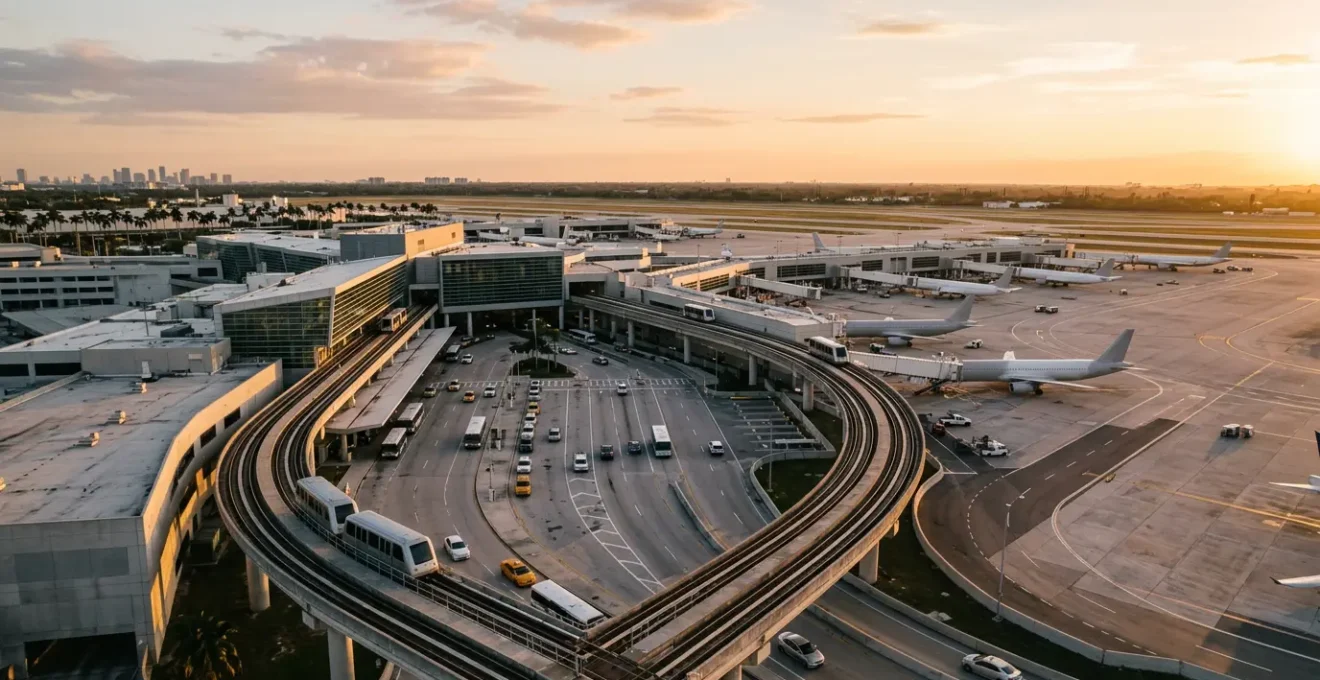
Follow the signs for the MIA Mover, located on Level 3. This is a free, automated train designed to connect the main terminal to the Miami Intermodal Center (MIC), which houses the Rental Car Center and the Metrorail station. The ride itself is a mere three minutes, with trains running every few minutes. By taking this short journey, you physically remove yourself from the airport’s high-demand, high-surcharge pickup zone.
Once you arrive at the MIC, you have smarter, cheaper options. You can exit on the ground level and request a standard Uber or Lyft. The prices here are often significantly lower than at the terminal curb, as you are no longer in the designated airport pickup surcharge area. For the most budget-conscious, you can continue on to the Miami Airport Station and take the Metrorail for just $2.25 per person towards downtown, connecting to a shorter, cheaper taxi or bus for the final leg to your South Beach hotel. This “Mover-first” strategy is the single most effective way to start your journey without being overcharged.
The Unlicensed Taxi Trap That Costs Exhausted British Tourists Over £100
After a long flight, a friendly face offering a quick, flat-rate taxi ride can seem like a blessing. In reality, it’s the gateway to one of Miami’s most prevalent tourist traps. Unlicensed operators prey on tired families at baggage claim and outside the terminals, using convincing-looking Uber or Lyft decals bought online to appear legitimate. These rides are not only illegal but also incredibly dangerous, as drivers bypass all mandatory safety checks.
The scale of the problem is significant. Miami-Dade County’s enforcement actions between January 2023 and March 2024 saw 102 vehicles being impounded and drivers facing over $2,000 in fines each. Legitimate drivers must undergo background checks, vehicle inspections, and hold proper insurance—safeguards that are completely absent with these illegal operators. Accepting an “off-app” cash ride not only exposes your family to risk but also means you have no trip record, no GPS tracking, and no recourse if things go wrong.
The key is to only use officially licensed taxis from the designated taxi ranks or rideshare services booked exclusively through the official apps. A licensed Miami-Dade taxi will have a visible medallion, a meter, and the company’s details clearly displayed. Any driver who approaches you directly, offers a “special” cash price, or can’t be verified through an app should be considered a major red flag.
Metrorail or Ride-Share App: Which Miami Transfer Method Reaches South Beach Faster?
The answer to this question is not static; it depends entirely on when you land. While a direct Uber or Lyft to South Beach seems fastest on paper, it can easily become the slowest and most expensive option during Miami’s notorious traffic jams, especially the “cruise ship crunch.”
During peak cruise disembarkation periods, typically between 11 AM and 3 PM on weekends, thousands of passengers head to MIA simultaneously. This overwhelms the causeways connecting Miami to Miami Beach, turning a 25-minute drive into a 60-minute-plus crawl. In these situations, surge pricing on ride-sharing apps can easily double the fare. The smart traveller’s move is to use real-time data to make the best decision. While waiting for your luggage, open Google Maps and check the estimated drive time to your hotel. If it’s showing over 45 minutes, the multi-step public transport route becomes the faster and much cheaper alternative.
The following table breaks down the options, but remember to overlay this with the real-time traffic reality. The data below is based on official Miami Airport transportation guidance, providing a baseline for your decision.
| Transportation Method | Base Cost | Peak Hour Impact | Total Journey Time | Best For |
|---|---|---|---|---|
| Direct Uber/Lyft | $35-50 (non-surge) | Can double during events | 25-60 minutes | Groups with luggage |
| MIA Mover + Metrorail + Bus/Uber | $2.25 + $10-15 | No surge pricing | 45-75 minutes | Solo travelers with carry-ons |
| Taxi (metered) | $40-60 | Traffic delays only | 25-60 minutes | No app required |
| MIA Mover + Uber from Rental Center | $25-35 | Moderate surge risk | 35-50 minutes | Avoiding airport pickup fees |
When to Schedule Your Return Flight to Avoid Terrible Miami Airport Rush Hours?
Timing your departure from Miami is just as critical as timing your arrival. The airport operates on a rhythm dictated by business travel, holiday schedules, and, most importantly, the cruise industry. Scheduling your flight home during a “red zone” period can mean adding an extra 90 minutes of stress, queues, and traffic to your journey.
The “golden hours” for flying out of MIA with the shortest waits are typically mid-day from Tuesday to Thursday (10 AM – 2 PM) and on late-night flights after 9 PM. Conversely, you should avoid the early morning business rush (5-8 AM on Mondays and Fridays) and the Sunday evening scramble as weekend holidaymakers head home (4-8 PM). However, there are two hidden rush hours that catch many travellers by surprise. The first is the aforementioned “Cruise Ship Crunch” from 11 AM to 3 PM on Saturdays and Sundays. The second is the major departure bank for South American flights, which creates significant congestion in the international terminals between 8 PM and 11 PM, regardless of the day.
Before you even leave for the airport, your best tools are the MyTSA app and the official MIA website, which provide real-time security wait times. If your travel coincides with a major Miami event like Art Basel or the Miami Boat Show, add at least an extra hour to your planned airport arrival time. A little bit of forward planning can be the difference between a relaxed farewell drink and a frantic dash to the gate.
Why Renting a Car Directly at the Terminal Often Takes Hours Longer Than Expected?
For a family with luggage, renting a car seems like the most practical choice for a Florida holiday. The mistake is assuming the process at the airport is quick. Renting a car at MIA is a notorious “time-sink trap,” where the perceived convenience is obliterated by a multi-stage process that can easily take over two hours during peak times.
The process at the Rental Car Center is a significant hidden time cost that most travellers don’t anticipate. First, there’s the 15-minute process of waiting for and riding the MIA Mover. Upon arrival, you’ll likely face a queue of 60 minutes or more at the rental counter, especially if you haven’t joined the company’s loyalty program. This is followed by another 20 minutes of high-pressure upselling for extra insurance and services, and finally, a 15-minute search for your vehicle in the vast, confusing garage. What looks like a simple pickup on paper can consume a huge chunk of your first afternoon.
The solution is to bypass the counter entirely. Here’s how:
- Join Loyalty Programmes: Before you travel, sign up for the free loyalty programmes of major rental companies like Hertz Gold Plus, National Emerald Aisle, or Avis Preferred.
- Book Directly: Use the company’s app or website to book your car, ensuring you’re logged into your loyalty account to enable counter-bypass features.
- Prepare Documents: For international renters, have your passport, home country driver’s license, and an International Driving Permit (if required) ready. Ensure your credit card has a sufficient limit for the security hold.
- Proceed Directly to the Garage: Upon arrival at the Rental Car Center, follow the signs for your loyalty programme, bypassing the main counters and heading straight to the car selection area or designated bay.
An alternative strategy is to take a short Uber to an off-airport rental location. These smaller branches often have shorter queues and lower prices, saving you both time and money.
Key takeaways
- Your first move at MIA should be to take the free MIA Mover, not head for the taxi rank. This is the simplest way to avoid terminal transport surcharges.
- Always use the “Triple-Check” safety protocol for any rideshare: verify the license plate, car model, and driver’s face in the app before you open the door.
- Real-time traffic is your best guide. If Google Maps shows a journey of over 45 minutes to the beach, the Metrorail will likely be the faster option.
The Terminal Transfer Mistake That Strands International Travellers at Chicago O’Hare
While this guide focuses on Miami, a lesson from another major US hub, Chicago O’Hare, provides a critical warning for any international traveller. The single biggest mistake one can make is assuming that a connecting flight within the US is as simple as walking from one gate to another. For all international arrivals, this is never the case.
Upon your first point of entry into the United States—whether it’s MIA, ORD, or JFK—you must collect all your checked luggage, proceed through immigration and customs, re-check your bags for your onward flight, and then go through a TSA security screening again to re-enter the secure departures area. Many travellers, seeing their luggage tagged to their final destination, make the catastrophic error of heading straight for their connecting terminal, only to be turned away at the gate and forced to backtrack, often missing their flight in the process.
At MIA specifically, this mistake is compounded by the airport’s vast and complex layout. After clearing customs, you might need to take the Skytrain within Concourse D or walk a significant distance to the check-in counters for your connecting airline. The official guidance is clear: plan your route using the airport’s terminal maps *before* you leave the customs hall. Exiting the secure area without a clear plan for your connection is a recipe for disaster. While airlines may suggest minimum connection times of 90 minutes, savvy travellers recommend a self-imposed minimum of three hours for any international-to-domestic transfer in the US.
How to Spot Fake Uber Drivers Circling Busy American Entertainment Districts?
The threat of fake rideshare drivers isn’t confined to the airport. It’s a persistent issue around major tourist hubs, sports stadiums, and entertainment districts across the US. The method is always the same: a driver with a plausible-looking sticker on their car will slow down and offer a ride, often for a tempting cash price, short-circuiting the app process entirely.
A recent crackdown on these fake rideshare operations by Miami-Dade County highlighted the severe risks involved, noting that criminals have used this guise to commit serious crimes like robbery and assault. By accepting an “off-app” ride, you lose every single safety feature the legitimate service provides: GPS tracking, your shared trip status with a loved one, the emergency button, and the company’s insurance.
Your only defence is a strict, non-negotiable verification process. Do not get into any vehicle until you have completed this simple but vital safety check.
Your Action Plan: The Triple-Check Safety Protocol for Rideshare Verification
- Ask, Don’t Tell: Never walk up to a car and ask, “Are you my Uber for Sarah?” This gives a fraudulent driver the information they need. Instead, ask the driver, “Who are you here to pick up?” A legitimate driver will know your name.
- Match the Vitals: Before you even think of opening the door, verify three key pieces of information from the app on your phone: the license plate number, the car make, model, and colour, and the driver’s photo. If even one of these doesn’t match perfectly, do not get in.
- Stay On-App: Never accept an offer for a cheaper cash ride. This is the number one red flag. All payments, tips, and communication should remain within the app’s secure system to maintain a digital trail and safety net.
- Use Official Zones: At venues or airports, always wait within the designated, well-lit, and often police-monitored official pickup zones. Scammers typically operate on the periphery of these areas.
- Share Your Trip: Before you get in, use the app’s “Share Trip Status” feature to send your live location to a trusted contact. It’s a simple tap that adds a powerful layer of security.
Which Urban Transportation Options Keep British Tourists Safest in Major US Cities?
In the modern travel landscape, the safest transportation option is the one that is most transparent and trackable. This is where official, app-based rideshare services like Uber and Lyft, when used correctly, provide a safety net that traditional taxis or public transport often lack. These apps create a digital footprint for your entire journey.
The key is to leverage the built-in safety features that many travellers overlook. Both major platforms offer a ‘Share Trip Status’ feature, allowing a friend or family member to track your journey in real-time. They also include an in-app emergency button that can connect you directly to 911 (the US emergency number) while automatically sharing your precise location and vehicle details with the dispatcher. Furthermore, the entire process, from booking to payment and tipping, is handled digitally, eliminating the vulnerable moments that can arise from handling cash with a stranger.
However, this digital safety net is only effective if you have reliable access to it. The most vulnerable moment for a tourist is when their phone has no data connection. This is why one of the most important safety preparations is to secure a US data plan *before* you land. Services like Airalo or Holafly offer affordable eSIMs that can be installed before you leave the UK, ensuring you have data from the moment you switch off airplane mode. In fact, a staggering $330 million was lost by US travelers to such fraud in recent years, a risk that is significantly mitigated by maintaining connectivity and using official channels. This allows you to use rideshare apps, navigate with Google Maps, and access real-time information without relying on spotty and insecure public Wi-Fi.
Ultimately, a successful and stress-free start to your Florida holiday hinges on preparation. By understanding the airport’s systems, being aware of the common scams, and having a clear plan for your family’s safety, you can bypass the chaos and begin your adventure on the right foot. Your first step should be downloading the necessary apps and setting up a US data plan before you even pack your bags.
Frequently Asked Questions about Navigating US Airports
Do I need to collect my luggage when connecting through a US airport on an international itinerary?
Yes, upon first entry to the US, all international passengers MUST claim luggage, clear customs, re-check bags, and go through TSA security again, regardless of their final destination.
What is a safe connection time for international-to-domestic transfers at major US airports?
While airlines publish Minimum Connection Times (MCT) of 60-90 minutes, experienced travelers recommend a self-imposed 3-hour minimum for international-to-domestic connections to account for immigration queues and security delays.
How can I navigate between terminals at unfamiliar US airports?
Use official airport apps (like MIA’s or ORD’s) which provide terminal-to-terminal navigation, real-time transfer information, and live wait times – these are more reliable than third-party map applications for airport-specific navigation.