In summary:
- Stop trying to see everything; instead, curate a personal “thematic journey” across a few key exhibits.
- Use official guided tours for reconnaissance, not as the main event, to identify areas for personal deep dives.
- Incorporate strategic “active recovery” days (nature, art) to cleanse your cognitive palate and prevent historical burnout.
- Plan logistics like a pro by avoiding cars in dense cities and mastering off-peak visiting times.
There’s a moment every ambitious history buff visiting Washington D.C. or Philadelphia knows all too well. It’s day two. You’ve mapped out the Smithsonian, the National Mall, and every revolutionary landmark. You have the determination, the passion, and the brand-new walking shoes. But by 3 p.m., a profound exhaustion sets in. It’s not just the familiar ache in your feet; it’s a mental fog, a deep-seated fatigue where priceless artifacts start to blur into a meaningless collection of ‘old stuff’. This is classic museum fatigue, the enemy of any great historical pilgrimage.
The standard advice—take breaks, stay hydrated, wear comfortable shoes—is well-meaning but fundamentally misses the point. It treats the symptom, not the cause. The problem isn’t a lack of physical stamina; it’s a crisis of cognitive overload. You’re trying to consume decades of history and culture in a matter of hours, a task doomed to fail. But what if the solution wasn’t to simply do less, but to engage differently? What if you approached your visit not as a tourist with a checklist, but as an efficiency-focused curator designing a personal exhibition?
This guide rejects the “see it all” mentality. Instead, it provides a strategic framework for sustainably consuming history. We will deconstruct common traps, from inefficient tours to logistical nightmares, and replace them with a curator’s toolkit. You will learn to manage your most precious resource—not time, but attention—to transform your overwhelming itinerary into a deeply personal and intellectually rewarding journey.
This article provides a structured approach to conquering America’s most daunting heritage sites. The following summary outlines the key strategies we will explore to help you trade exhaustion for genuine engagement.
Summary: A Curator’s Strategic Guide to Conquering US Heritage Sites
- Why Trying to See the Entire Smithsonian in One Day Always Fails Miserably?
- The Guided Tour Trap That Traps You in Boring Exhibits for Three Hours
- Audio Guides or Human Docents: Which Method Brings American History to Life?
- How to Find the Free Entry Days for the Most Expensive Heritage Museums?
- When to Visit Popular Monuments to Avoid the Massive Swarms of School Children?
- When to Incorporate Emotional Recovery Days into Your Heavy Historical Itinerary?
- Why Hiring a Car in New York or Chicago Is the Ultimate Financial Disappointment?
- How to Plan a Respectful Civil Rights Educational Journey Through the Deep South?
Why Trying to See the Entire Smithsonian in One Day Always Fails Miserably?
The ambition is admirable: conquer the Smithsonian Institution, a sprawling complex of 19 museums, 9 research centers, and a zoo. The reality is a crushing defeat by cognitive overload. The core reason for this failure lies in the science of attention itself. Your brain is not a passive storage device; it’s an active processor with finite capacity. In fact, research from the Florida Museum of Natural History found that visitor interest peaks for about 30 minutes, after which engagement and retention plummet dramatically. Trying to “do” the Air and Space Museum and the National Museum of American History in a single afternoon isn’t just tiring; it’s neurologically inefficient.
The curator’s approach is to abandon the checklist and design a personal narrative. Instead of tackling museums as separate entities, you create a “thematic journey” that weaves through them. For example, instead of seeing “the Air and Space Museum,” you pursue the theme of “Cold War Technology.” This might involve seeing the U-2 spy plane and the Space Race exhibit, then walking over to the National Museum of American History to see artifacts related to the home front and civil defense. Your visit becomes a focused story, not a random collection of highlights.
This strategy forces ruthless prioritization. It means you will intentionally miss 95% of what’s on display. But the 5% you do see will connect into a coherent, memorable experience. You trade breadth for depth, and in doing so, you conquer museum fatigue by giving your brain a clear, manageable story to follow. You leave with a deeper understanding of your chosen theme, rather than a blurry memory of countless glass cases. It’s the ultimate act of taking control of your historical consumption.
The Guided Tour Trap That Traps You in Boring Exhibits for Three Hours
Guided tours seem like the perfect solution for a first-time visitor: an expert-led journey through the highlights. Yet, they often become the “Guided Tour Trap”—a rigid, externally paced experience that subjects you to the group’s average interest level. You’re held captive in front of an exhibit you find dull for twenty minutes, while being rushed past something that genuinely sparks your curiosity. This passive consumption is a primary driver of cognitive fatigue, as you’re not an active participant but a passenger on someone else’s itinerary.
A curator, however, uses tours not as the main event, but as a reconnaissance mission. The “Scout and Return” strategy, as recommended by museum experts, is far more effective. You take the standard 90-minute overview tour with a specific goal: to identify 2-3 areas of high personal interest. You’re not there to absorb every detail but to survey the landscape. You make a mental note: “That section on early computing is fascinating, I’m coming back here. The hall of pottery? Not for me.” After the tour concludes, you are free. You can then return independently to your pre-selected zones for a deep, self-paced dive.
This approach transforms the tour from a passive lecture into an active tool for personalizing your visit. It leverages the docent’s expertise for orientation while reserving your most valuable asset—your focused attention—for the subjects that truly matter to you.
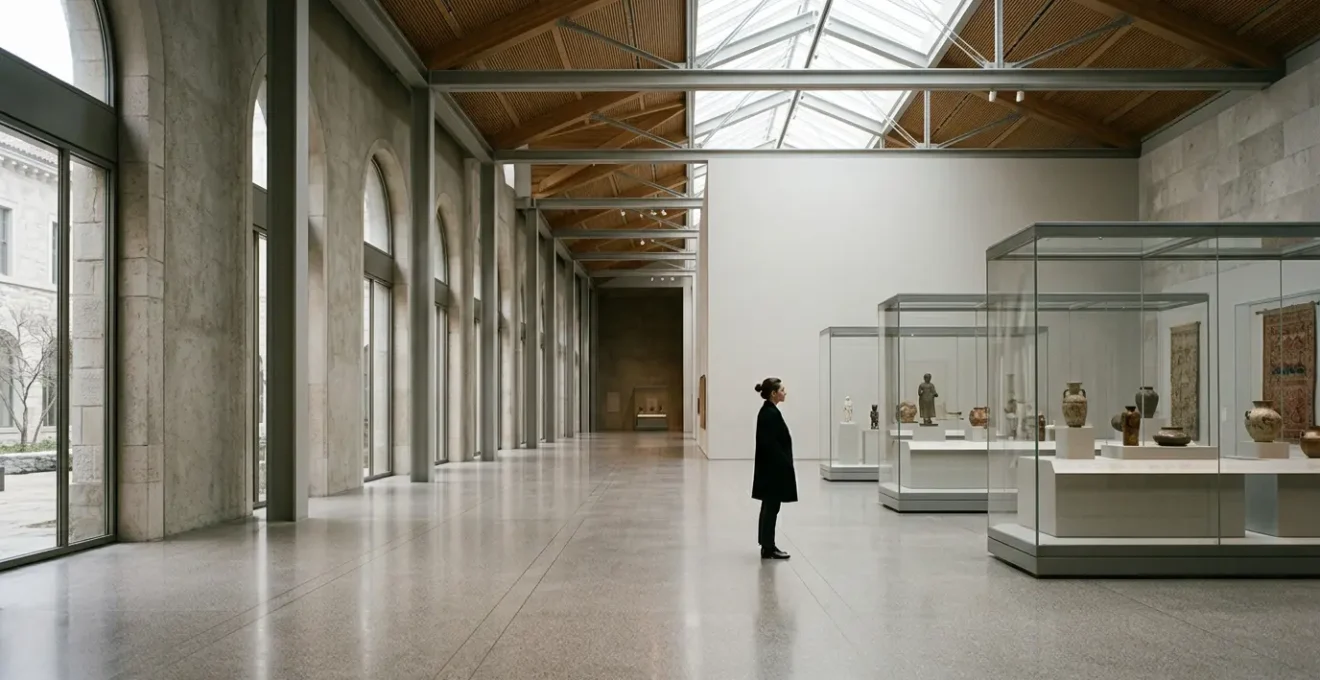
The ultimate goal, as this image suggests, is the moment of personal, unhurried connection. By using tours strategically, you free yourself from the group pace and create opportunities for these profound, individual encounters with history. You are no longer just being shown things; you are actively discovering them.
Audio Guides or Human Docents: Which Method Brings American History to Life?
Choosing your information delivery system is a critical strategic decision. It’s a trade-off between control, depth, and interactivity. Neither audio guides nor human docents are inherently superior; they are different tools for different curatorial goals. An audio guide offers you complete pacing control. You can pause, rewind, and skip—a godsend when you want to spend ten minutes on one object and bypass the next ten. It provides a standardized, often comprehensive, layer of information. However, it’s a monologue; there’s no room for serendipitous questions or tailored explanations.
A human docent, on the other hand, offers a dynamic dialogue. They can read the room, answer specific questions, and often provide rich, anecdotal details not found in the official script. This personalization can be incredibly powerful for bringing history to life. The downside is a loss of control; you are subject to the group’s pace and the docent’s particular focus. The key is to see these options not as a binary choice, but as a spectrum of tools to be deployed strategically.
The “Hybrid Approach” often yields the best results. You might use the museum’s free docent-led tour as a reconnaissance mission (as discussed previously), then use a rented audio guide for your self-directed deep dive into your chosen sections. This gives you both the overview and the detailed, self-paced exploration. The following table breaks down the core features to help you decide which tool best serves your mission for a given visit.
| Feature | Audio Guide | Human Docent | Hybrid Approach |
|---|---|---|---|
| Pacing Control | Complete self-pacing | Group-dependent | Flexible |
| Information Depth | Standardized, comprehensive | Variable, anecdotal | Customizable |
| Interaction Type | Monologue | Dialogue | Both options |
| Personalization | Limited to pre-recorded tracks | Highly personalized Q&A | Strategic personalization |
| Cognitive Load | Self-regulated | Externally paced | Optimized |
| Cost | $5-10 typical rental | Often free with admission | Mixed |
Ultimately, as analysis of visitor experiences shows, the optimal choice depends on your goal. If you want maximum control and data, the audio guide is your tool. If you crave interaction and unique stories, seek out a docent. The savvy visitor knows how to use both.
How to Find the Free Entry Days for the Most Expensive Heritage Museums?
While many of the nation’s premier institutions in Washington D.C. are free, venturing into cities like New York, Boston, or Chicago introduces hefty admission fees that can quickly strain a travel budget. The good news is that a significant number of these museums offer free or pay-what-you-wish days or evenings. The challenge is that these are often the most crowded times, potentially negating the financial saving with a loss in experience quality. A curator’s approach is not just to find these days, but to strategize how to use them effectively.
The first step is research. Many cities have consolidated lists of free museum days, but you must go deeper. Look for “shoulder season” free days—a Tuesday in October is vastly different from a Saturday in July. Also, be aware that while 37% of museums offer free admission or suggested donations, this often applies only to general admission. Special exhibitions, frequently the main draw, may still require a paid ticket. A savvy strategy is to use the free day to explore the permanent collection and then decide if the special exhibit is worth a separate, paid visit on a quieter day.
Furthermore, don’t overlook alternative access programs. Many local libraries offer passes that grant free or discounted admission. For American bank account holders, Bank of America’s “Museums on Us” program provides free access on the first full weekend of every month to over 225 institutions nationwide. Reciprocal membership networks like NARM (North American Reciprocal Museum Association) can also be a game-changer for frequent travelers, granting access to hundreds of museums for the price of a single membership.
Your Action Plan for Mastering Free Museum Days
- Research reciprocal membership networks like NARM or ROAM for potential nationwide access before your trip.
- Cross-reference official free days with shoulder season calendars to find the least crowded options (e.g., an October weekday vs. a July weekend).
- Check the websites of local public libraries in the city you’re visiting for museum pass programs available to the public.
- Target early morning arrival (at opening) or the last 90 minutes on free days to avoid the peak mid-day rush.
- Consider paying for a must-see special exhibition on a quieter day while using the free admission day to explore the general collection.
- Investigate programs like Bank of America’s “Museums on Us,” which grants cardholders free access during the first full weekend of each month.
When to Visit Popular Monuments to Avoid the Massive Swarms of School Children?
Popular outdoor monuments like the Lincoln Memorial or the Liberty Bell present a different challenge than enclosed museums: they are accessible 24/7, but their experience is radically altered by crowd density. The primary obstacle to a contemplative visit, especially during spring and early summer, is the near-constant presence of large, energetic school groups. Avoiding them requires strategic timing that goes beyond the simple “go on a weekday” advice.
The most effective strategy is to operate on the edges of the day. The “Golden Hour”—the first hour after sunrise and the last hour before sunset—offers a triple advantage. First, the crowds are minimal to non-existent. Second, the soft, angled light is breathtakingly beautiful, transforming stone and bronze into works of art. Third, the quiet atmosphere allows for genuine reflection. An early morning visit to the Lincoln Memorial, with the sun rising over the Reflecting Pool, is a profoundly different—and superior—experience to a mid-day visit jostling for a photo.
Beyond the time of day, consider the time of year. The peak season for school trips is generally from March to early June. Planning a trip for September or October can drastically reduce these crowds. A more counterintuitive tactic is the “Weather Gambit.” As one experienced traveler noted, light rain can be a gift.
One of the main contributing factors to Museum Fatigue is one’s fellow museum goers. Navigating around other people while also avoiding touching or bumping into the art, is exhausting. Light rain days offer a rare chance for a solitary, atmospheric visit to typically packed outdoor sites.
– The Wandering Witch, Patheos
A little drizzle can clear out entire plazas, offering you a private, atmospheric viewing of a national icon. Pack a good raincoat and embrace the weather as a strategic tool to engineer the solitude that these powerful sites deserve.
When to Incorporate Emotional Recovery Days into Your Heavy Historical Itinerary?
A packed historical itinerary, especially one that includes sites of conflict, tragedy, or profound social struggle like the 9/11 Memorial or Civil Rights museums, exacts more than just a cognitive toll. It takes an emotional one. This is a distinct form of fatigue that cannot be solved by a coffee break or a good night’s sleep. Failing to account for it is a critical error. A curator understands that the space between the exhibits is as important as the exhibits themselves. Therefore, scheduling “active recovery” days is not a luxury; it is an essential part of a sustainable itinerary.
An active recovery day is not a “day off” spent in a hotel room. It is a deliberate “cognitive palate cleanser.” After a day immersed in the dense, text-heavy history of the American Revolution in Philadelphia, plan the next morning for a visit to a botanical garden or an abstract art museum. The goal is to engage a different part of your brain—one that processes aesthetics, nature, or non-narrative forms. This allows the historically-focused parts of your mind to rest, process, and consolidate what you’ve learned.
As one expert notes, this is a cumulative issue that requires proactive planning.
Museum fatigue builds up over time. You can get away with a day or two of a breakneck pace, but it will catch up to you if you sustain it for days on end.
– A Scholarly Skater, Museum Fatigue Prevention Guide
The most effective strategy is to schedule recovery blocks pre-emptively, especially before the most challenging sites. If you know you are visiting the National Civil Rights Museum in Memphis on Wednesday, make Tuesday an emotionally lighter day. You might also alternate historical periods to avoid chronological overload, for instance, following a day on 20th-century conflict with an exploration of 18th-century decorative arts. This intentional sequencing prevents emotional burnout and ensures you can approach each site with the respect and mental clarity it deserves.
Why Hiring a Car in New York or Chicago Is the Ultimate Financial Disappointment?
For many travellers, especially those from places where the car is king, renting a vehicle seems like the ultimate key to freedom and flexibility. In dense, transit-rich American cities like New York, Chicago, Boston, or D.C., however, it is the single most inefficient decision you can make, both financially and mentally. The daily rental fee is merely the tip of the iceberg. The true cost lies in exorbitant parking fees (often $30-50 per day or even per entry), the stress of navigating aggressive traffic, and the time wasted searching for a parking spot.
The cognitive load of driving and parking in these urban cores is immense. You arrive at the museum not refreshed and ready to learn, but stressed and mentally drained from the logistical battle. This directly undermines the entire purpose of your visit. These cities were designed around public transit, and their museum districts are best accessed this way. A combination of walking and using the subway or bus system is not only cheaper but also transforms your transit time from a stressful chore into an immersive part of the city experience.
Let’s analyze the options from a curator’s perspective, focusing on both cost and cognitive impact. The data clearly shows that a rental car is a demonstrably poor choice for urban museum hopping. The “Walking + Transit Combo” not only minimizes costs but also has the lowest cognitive load, offering gentle transitions and opportunities for spontaneous discovery between your planned destinations.
| Transport Method | Cost Range | Cognitive Load | Flexibility | Museum Experience Impact |
|---|---|---|---|---|
| Rental Car | $60-100/day + $30-50 parking | High (navigation, parking stress) | High | Arrives mentally drained |
| Public Transit | $2.90 per ride (NYC) | Low | Medium | Immersive city experience |
| Point-to-Point Rideshare | $15-30 per trip | Minimal | High | Stress contained to two moments |
| Walking + Transit Combo | $5.80-11.60/day | Very Low | Medium | Gentle transitions, exploration opportunity |
Choosing the right mode of transport is a foundational decision. By forgoing the car in these specific environments, you are making a strategic choice to invest your resources—both financial and mental—in the historical experience itself, not in the battle to get there.
Key takeaways
- The core principle for avoiding museum fatigue is to shift from a ‘checklist’ mindset to a ‘curator’ mindset, focusing on creating a personal, thematic narrative.
- Strategic planning is paramount: this includes using tours as reconnaissance, timing visits to avoid crowds, and mastering public transport in dense cities.
- Recognize that both cognitive and emotional energy are finite resources; build in ‘active recovery’ days to cleanse your mental palate and process what you’ve learned.
How to Plan a Respectful Civil Rights Educational Journey Through the Deep South?
An educational journey through the Civil Rights Trail in the Deep South—connecting sites in Atlanta, Montgomery, Birmingham, and Memphis—is profoundly different from any other historical tour. This is not a leisurely vacation; it is a pilgrimage to sites of struggle, tragedy, and immense courage. The goal here is not efficiency or entertainment, but deep, respectful engagement. A curatorial approach is essential, but the focus shifts from personal narrative to bearing witness to a collective one. Planning requires significant emotional and intellectual preparation.
Before you even book a flight, the work begins. Immerse yourself in the history. Reading foundational texts like ‘Eyes on the Prize’ or watching documentaries like ‘Selma’ is not optional; it is the minimum requirement for arriving with the context this history demands. This pre-trip learning allows you to move beyond basic facts on-site and engage with the emotional weight of the locations. The recommended 7-10 days for the main circuit is a baseline; rushing this journey is a sign of disrespect to the stories it holds.
A crucial strategy for a meaningful journey is the “Then and Now” framework. This involves pairing a historical site with a visit to a contemporary community space. For example, after walking the Edmund Pettus Bridge in Selma, make a conscious effort to visit and support a local Black-owned business or community arts center. This act connects the historical struggle to the living, breathing present. Similarly, seek out both the famous sites and the often-overlooked ones. While the National Civil Rights Museum at the Lorraine Motel is a must-see, so is the Lowndes County Interpretive Center, which tells the vital story of Tent City and the grassroots struggle for voting rights. Booking local guides with personal connections to the Movement can provide oral histories and insights that are simply not available in any book.
Applying this curatorial mindset to your travels transforms you from a passive consumer of history into an active, engaged participant. It’s the most effective way to ensure your journey is not just memorable, but meaningful.