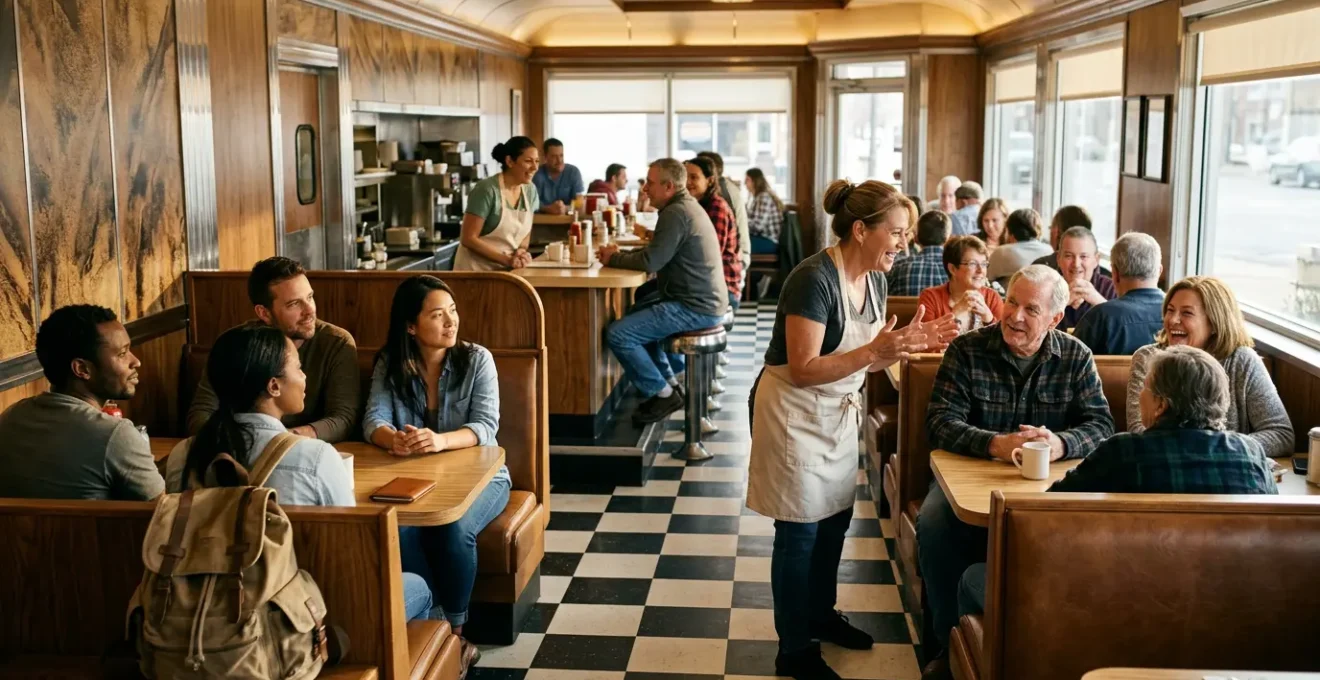
The biggest mistake Brits make in the US is assuming a shared language means a shared culture; it absolutely doesn’t, and it’s the fast track to a holiday filled with awkward silences.
- Your dry sarcasm will likely be taken as genuine negativity, not a sign of affection.
- “How are you?” is a greeting, not a question; launching into your health woes is a major social error.
- Tipping isn’t optional; it’s a fundamental, non-negotiable part of the service staff’s salary.
Recommendation: Stop translating words and start decoding the ‘social operating system’. This guide shows you how to see American etiquette not as bizarre, but as a different set of rules you can learn to navigate with confidence.
Right, let’s get one thing straight. You’ve landed in the United States, armed with a perfect grasp of the English language and a vague notion that everything will be just like home, only with bigger cars and better weather. This is your first, and potentially most significant, mistake. After a decade of living here, I can tell you that the UK and the US are two countries separated by a common language, and nowhere is this more apparent than in our social customs. We Brits are raised on a diet of sarcasm, understatement, and a healthy dose of social reserve. Americans, on the other hand, operate on a completely different social software, one that prizes enthusiasm, directness, and a level of friendliness that can feel utterly baffling to the uninitiated.
You might think navigating this is as simple as remembering to say “gas” instead of “petrol.” But the real challenges are far more subtle. It’s the moment your perfectly-timed, dryly witty comment lands with a thud, leaving a wake of confused silence. It’s the awkward shuffle when you don’t know whether to shake a hand or go in for a hug. It’s the panic that sets in when a payment tablet swivels towards you, demanding a tip for a service you thought was already paid for. The common advice to just “be yourself” is, frankly, terrible. To truly connect and avoid coming across as rude, aloof, or just plain weird, you need to understand the hidden logic behind American social etiquette. This isn’t about changing who you are; it’s about learning a new dialect of social interaction.
This guide will serve as your practical translation manual. We’ll move beyond the stereotypes and dive into the ‘why’ behind the ‘what,’ decoding the specific situations where British instincts can lead you astray. We will explore the nuances of communication, the unwritten rules of social gatherings, the minefield of tipping, and even the critical regional differences that can have legal consequences. Think of it as learning the source code for the American ‘Social Operating System’.
Summary: Navigating the American Social Landscape
- Why British Sarcasm Often Fails Completely During American Social Interactions?
- Handshake or Hug: Which Greeting Fits Various US Regional Social Situations?
- The Small Talk Mistake That Makes British Travellers Appear Rude to Americans
- How to Navigate Complex US Tipping Culture Without Feeling Constantly Cheated?
- How to Adapt Your Communication Style to Build Rapid Rapport With US Locals?
- How to Adapt Your Behaviour Quickly When Moving from Liberal to Conservative States?
- Why Ignorance of Local Traditions Quickly Turns Tourists into Unwelcome Targets?
- Why Ignoring US Regional Variances Can Result in Unexpected Legal Trouble for Tourists?
Why British Sarcasm Often Fails Completely During American Social Interactions?
In Britain, sarcasm is a love language. It’s how we bond, show affection, and gently mock the absurdity of life. A deadpan “Oh, brilliant” in response to a sudden downpour is understood by all as a shared moment of grim solidarity. Try that in Ohio, and you’ll likely get a sincere, “I know, isn’t it? We really needed the rain!” The American social operating system is not built to process British irony. As etiquette expert Myka Meier notes, “Americans are generally more casual,” and this extends to their communication, which prioritizes clarity and positivity over layered, cynical wit.
The core of the issue lies in a fundamental difference in outlook. American culture is built on a foundation of optimism and enthusiasm. This positive framing is not insincere; it’s a social lubricant designed to make everyone feel welcome and comfortable. Your dry, understated sarcasm, which at home is a tool for building rapport, can be easily misconstrued here as genuine negativity or passive-aggression. They aren’t looking for the hidden meaning because, most of the time, there isn’t one. What you see is what you get. When you say something negative, even in jest, it’s often taken at face value, marking you as a complainer rather than a wit.
Therefore, deploying your usual level of sarcasm is like trying to run British software on an American machine—it crashes the system. You’ll need to translate. This means swapping dry wit for more overt forms of humour. Self-deprecation works universally, as poking fun at yourself is a clear signal of playfulness. Exaggerated, enthusiastic statements are another safe bet. Instead of a flat “Great, more paperwork,” try a hyper-enthusiastic “Wow, I am SO excited to do this paperwork!” accompanied by a massive grin. This flags the comment as a joke in a way that American social cues can easily register, avoiding the awkward silence that follows a misunderstood quip.
Handshake or Hug: Which Greeting Fits Various US Regional Social Situations?
The first thirty seconds of meeting someone new can be an etiquette minefield. Do you offer a firm handshake like you’re closing a business deal, or do you lean in for the kind of hug you’d give your aunt? In the UK, the rules are relatively clear: a handshake for professional or formal settings, and a reserved nod for almost everything else. The US, however, is a patchwork of regional and contextual norms where the wrong move can create instant awkwardness. Getting it right is about reading the room and understanding the relationship level.
As the image above suggests, American greetings are a fluid dance between friendliness and the preservation of personal space. In a professional setting, a firm handshake is always the gold standard, regardless of whether you’re meeting a CEO or a new colleague. It signals confidence and respect. However, the lines blur considerably in social situations. A backyard BBQ in California might involve a casual side-hug for acquaintances, whereas a similar gathering in New England might stick to handshakes. The key is to hang back for a second and observe what others are doing. Don’t be the first to initiate; mirror the behaviour you see.
To demystify this, consider the following general guidelines. A simple head nod or wave is a safe, low-commitment greeting for strangers in almost any casual context. As you move from stranger to acquaintance, the handshake becomes more common, but in very casual social circles (especially among younger people or in more relaxed states like those on the West Coast), a quick side-hug or even a fist bump can be the norm. The full, two-armed hug is generally reserved for close friends and family. Following a simple matrix can save you a world of second-guessing.
| Setting/Context | Stranger | Acquaintance | Close Friend |
|---|---|---|---|
| Business Meeting | Firm handshake | Handshake | Handshake (sometimes hug after) |
| Backyard BBQ | Wave/nod | Handshake or side hug | Full hug |
| Bar/Social Event | Head nod | Fist bump/handshake | Hug or back-pat |
| Friend’s Party | Wave/verbal greeting | Side hug | Full hug |
| Office Hallway | Head nod | Head nod/verbal | Verbal greeting |
The Small Talk Mistake That Makes British Travellers Appear Rude to Americans
A cashier in London might scan your items in complete, comfortable silence. A cashier in Kansas will likely ask, “How are you today?” and this is where many Brits fall into a major cultural trap. Our instinct is to treat this as a genuine, interrogative question. We might pause, consider the state of our day, and offer a measured, “A bit tired, to be honest, the jet lag is a killer.” This, while honest, is a social blunder. You’ve mistaken a phatic expression for a real inquiry, and the cashier is now backed into a corner, forced to engage with your personal problems when all they did was say “hello” in American.
In the US, “How are you?” is not a question; it’s a greeting. It’s a social lubricant, a ritual designed to acknowledge another person’s existence and open a channel for communication without actually demanding any personal information. The correct, and only, answer is a variation of “Good, how are you?” or “Doing great, thanks!” Anything more is considered an overshare. It can make you seem self-absorbed or even rude for placing an unexpected emotional burden on a stranger. It’s the conversational equivalent of a handshake—a simple, reciprocal gesture, not an invitation to inspect each other’s palms.
This misunderstanding is a primary reason British visitors can sometimes be perceived as negative or standoffish. When an American offers a bright “How’s it going?” and receives a mumbled “Mustn’t grumble,” the American hears a downer, not the classic British understatement it is. They offered a signal of positive connection, and you responded with what sounds like a complaint. The key to navigating small talk is to reclassify these phrases in your mind. They belong in the same category as “Alright?” or “You well?”—greetings that expect a simple, positive response in return, thereby keeping the social wheels turning smoothly.
How to Navigate Complex US Tipping Culture Without Feeling Constantly Cheated?
For many Brits, the American tipping system is a source of constant anxiety and resentment. It feels arbitrary, confusing, and like you’re being guilted into paying extra. The crucial mind-set shift is this: stop thinking of a tip as a “gratuity” or a reward for exceptional service. In the US, for many workers, the tip is not a bonus; it is their wage. The structural reason for this is the federal tipped minimum wage, which remains at just $2.13 per hour. This is based on the legal assumption that tips will make up the difference to at least the standard minimum wage. Not tipping a server is, in effect, causing them to work for nearly free.
The baseline for a sit-down meal is 15-20% of the pre-tax bill, with 18% being a common standard. Anything less suggests there was a significant problem with the service. But the “tipflation” phenomenon, often seen on payment tablets like the one pictured, has expanded tipping expectations into new territories. You’ll now be prompted to tip for counter service, a takeaway coffee, or a pre-packaged sandwich. In these situations, tipping is more discretionary. A dollar or two in a tip jar or selecting the lowest tablet option (often 10-15%) is appreciated but not as socially mandatory as for a full-service restaurant meal.
The system extends far beyond restaurants. You’re expected to tip bartenders, hotel housekeeping, valet drivers, tour guides, and rideshare drivers. The sheer number of people to tip can feel overwhelming. The best approach is to treat it as a fixed cost of your trip, like a local sales tax. Budget for it and follow a clear guide to avoid the stress of deciding in the moment. Remember, while it feels foreign to us, it’s the deeply ingrained system that millions of people depend on for their livelihood.
This table covers common scenarios beyond the standard restaurant meal, providing a cheat sheet for navigating these transactions with confidence. Knowing the expected amount beforehand removes the guesswork and ensures you’re treating service workers fairly according to local norms.
| Service Type | Expected Tip | When to Tip |
|---|---|---|
| Bartender | $1-2 per drink or 15-20% of tab | Per round or when closing tab |
| Coffee Shop Tip Jar | $0.50-$1 or round up | Optional for counter service |
| Hotel Housekeeping | $2-5 per night | Daily (leave on pillow/nightstand) |
| Valet Parking | $2-5 | When retrieving car |
| Tour Guide | 10-20% of tour cost | End of tour |
| Rideshare Driver | 10-15% minimum | Through app after ride |
How to Adapt Your Communication Style to Build Rapid Rapport With US Locals?
Beyond sarcasm and small talk, the general frequency of British versus American communication is set to a different rhythm. As Brits, our default setting is reserved. We use understatement as a power tool (“The Grand Canyon is ‘quite nice'”). Americans, by contrast, communicate with a level of enthusiasm that can feel performative to us. But this ‘active enthusiasm’ is a crucial signal of engagement and friendliness. When you respond to their exciting news with a reserved “Oh, that’s good,” you might think you’re being calm and collected; they might hear “I’m not interested.”
Building rapport requires you to dial up your own enthusiasm. This doesn’t mean you need to become a different person, but you do need to learn to perform your interest more overtly. This involves verbal and non-verbal cues. Sprinkle your conversations with affirmations like “That’s awesome!”, “No way!”, or “How cool!” to show you’re listening and engaged. When they talk about an achievement, mirror their pride instead of downplaying it. This also extends to physical space. Research indicates that Americans are comfortable with closer conversational distances than Brits. According to a study, Americans prefer conversing with acquaintances at a distance of 68 cm, which feels noticeably closer than the arm’s-length distance many Brits prefer. This physical proximity is part of a package of more expressive communication, so leaning back or creating distance can be perceived as aloofness.
The goal is to mirror the energy level of the person you’re speaking to. If they are animated and expressive, a stoic, reserved response creates a social mismatch. One of the best ways to bridge this gap is to proactively ask for recommendations. Asking a local, “Where’s the best place to get a burger around here?” does two things: it shows you trust their expertise and it opens the door for them to share their enthusiasm, creating an instant, positive connection. It’s a simple technique for translating British reserve into a language of American rapport.
Your Action Plan: The Active Enthusiasm Technique
- Practice verbal affirmations: Sprinkle in ‘That’s awesome!’, ‘No way!’, ‘How cool!’ to show engagement.
- Transform understatement to direct positivity: Replace ‘not bad’ with ‘really good’, ‘quite nice’ with ‘fantastic’.
- Ask for recommendations to show trust: ‘Where do you get the best burger around here?’ validates local expertise.
- Share achievements with confidence: Americans appreciate hearing about your work and successes when framed positively.
- Mirror energy levels: Match the enthusiasm of the person you’re talking to rather than maintaining British reserve.
How to Adapt Your Behaviour Quickly When Moving from Liberal to Conservative States?
One of the most dangerous assumptions a visitor can make is that “America” is a single, monolithic culture. It isn’t. The social and political distance between Brooklyn, New York, and a small town in rural Alabama is vaster than the distance between London and Athens. Your behaviour, conversation topics, and even your clothing might be perfectly acceptable in one place and cause genuine offence in another. The key to navigating this is developing a skill for “reading the room” on a macro, statewide level.
As noted by a travel advisory, in conservative regions like the South, “Visitors are expected to give and receive ‘Southern hospitality’, or old-fashioned etiquette where good manners are essential.” As they state in their advice on American culture:
Visitors are expected to give and receive ‘Southern hospitality’, or old-fashioned etiquette where good manners are essential. So remember your pleases and thank-yous whenever you eat out, meet someone, or even while driving
– SCTI Travel Advisory, American Culture Tips for the USA
This “old-fashioned etiquette” also comes with an expectation to avoid contentious topics. While a lively political debate might be a fun pub activity in a liberal city, it’s a major social faux pas in many conservative areas, where it’s seen as confrontational and disrespectful. You don’t need to change your beliefs, but you do need to learn when to hold your tongue. You can quickly get a read on the local climate by observing a few simple cues. Look at the bumper stickers on cars, the types of flags being flown from homes, and the news channel playing in public spaces like cafes or airport lounges. These are all immediate indicators of the local political and social leanings.
This process of contextual code-switching is a vital survival skill. In a liberal area like Portland, Oregon, a rainbow flag and a “Black Lives Matter” sign are common. In a conservative part of Texas, you’re more likely to see American flags and religious symbols. Acknowledging these signals allows you to adjust your approach. For instance, the indirect communication style of the South, where “Bless your heart” can be an insult, is very different from the blunt, fast-paced directness of the Northeast. Paying attention to these cues will prevent you from accidentally stepping on cultural landmines.
Why Ignorance of Local Traditions Quickly Turns Tourists into Unwelcome Targets?
Beyond broad regional differences, American culture is also a mosaic of intensely local traditions. Violating these unwritten rules, even out of simple ignorance, can instantly mark you as an inconsiderate outsider and, in some cases, make you a target for frustration or even scams. These are the shibboleths of belonging, and learning a few can go a long way. A prime example is queue culture. As one guide on respectful travel points out, “If people are waiting in line, it is considered extremely rude to cut your way to the front.” In the US, the line is sacred. Respecting it is a non-negotiable sign of social awareness.
This respect extends to local identity. Making an effort to correctly pronounce a difficult local name (like “Schuylkill” River in Philadelphia, pronounced ‘SKOO-kill’) signals respect and effort. Similarly, knowing how to order the local delicacy correctly (e.g., a Philly cheesesteak “wit” or “witout” onions) shows you’ve done your homework and aren’t just a clueless tourist. These small acts transform you from a passive observer into an active, respectful participant in the local culture.
This is especially critical when visiting places of natural or historical significance. America’s National Parks operate on a strict “Leave No Trace” principle. This means packing out everything you bring in, including food scraps. Leaving rubbish behind is seen as a profound sign of disrespect to nature and to the community that maintains the park. Likewise, approaching wildlife for a selfie is not just dangerous; it’s a violation that can carry heavy fines and immediately brands you as an irresponsible tourist. Showing reverence at war memorials and historical sites is another unspoken rule. These are not just photo opportunities; they are sacred spaces for the community. By taking a moment to understand and follow these hyperlocal customs, you earn a degree of acceptance and respect that makes for a much richer travel experience.
Key Takeaways
- Sarcasm is a risk; opt for enthusiastic exaggeration or self-deprecation for humour.
- The US is not a monolith; adapt your behaviour and conversation topics based on observable regional cues (liberal vs. conservative).
- Tipping isn’t a bonus, it’s a wage. Budget 15-20% for sit-down meals and learn the norms for other services to avoid stress and disrespect.
Why Ignoring US Regional Variances Can Result in Unexpected Legal Trouble for Tourists?
While social gaffes can lead to awkward moments, ignoring the patchwork of state and local laws across the US can lead to much more serious consequences, including hefty fines and even arrest. The assumption that a single set of rules applies nationwide is a dangerous one for any tourist. What is perfectly legal in one state can be a felony just one mile down the road in another. This is especially true for two key areas: alcohol and cannabis.
Laws regarding alcohol consumption vary dramatically. In many cities, like Las Vegas or New Orleans, you can walk down the street with an alcoholic beverage. In most other places, having an open container of alcohol in public (or even in the passenger area of a car) is a finable offense. Furthermore, some counties, particularly in the South, are “dry counties” where the sale of alcohol is completely prohibited. When it comes to cannabis, the legal landscape is even more treacherous. While it may be legal for recreational use in states like Colorado or California, transporting it across state lines—even to another state where it is also legal—is a federal crime. Never, ever travel between states with cannabis products.
Driving rules also contain hidden traps for the unsuspecting Brit. The “right turn on red” rule is a major one. In most of the US, after stopping at a red light, you are permitted to turn right if the way is clear. However, this is not universal, and you must look for signs that explicitly say “No Turn on Red.” Getting this wrong can result in an expensive ticket. Even something as simple as crossing the street has legal implications. In sprawling cities like Los Angeles, “jaywalking”—crossing the street mid-block instead of at a designated crosswalk—is strictly enforced and can land you with a fine of over $200.
To avoid these costly and stressful encounters with law enforcement, a pre-emptive check of local regulations is essential. The following table highlights some of the most common legal pitfalls for tourists. A quick search for “local ordinances” in the city you’re visiting can save you a world of trouble.
| Legal Area | Common Violation | Consequence | Prevention |
|---|---|---|---|
| Alcohol Laws | Open containers in public | Fines $100-500+ | Keep alcohol in trunk, check dry counties |
| Cannabis | Crossing state lines with legal cannabis | Federal felony charges | Never transport between states |
| Driving | Right-on-red violations | Traffic tickets $150+ | Look for ‘No Turn on Red’ signs |
| Jaywalking | Crossing mid-block in LA/NYC | Fines $200+ | Always use crosswalks |
| Wildlife | Approaching animals in parks | Fines $5000+, jail time | Maintain 25+ yards distance |
Armed with this cultural decoder, you are no longer just a tourist; you are an informed traveller. By understanding the ‘why’ behind American social customs—from the logic of tipping to the function of enthusiastic small talk—you can navigate your trip with confidence instead of confusion. You’re now equipped to avoid the most common pitfalls and build genuine, positive connections. Go forth and explore, not just the landscape, but the fascinating and complex culture of the United States.