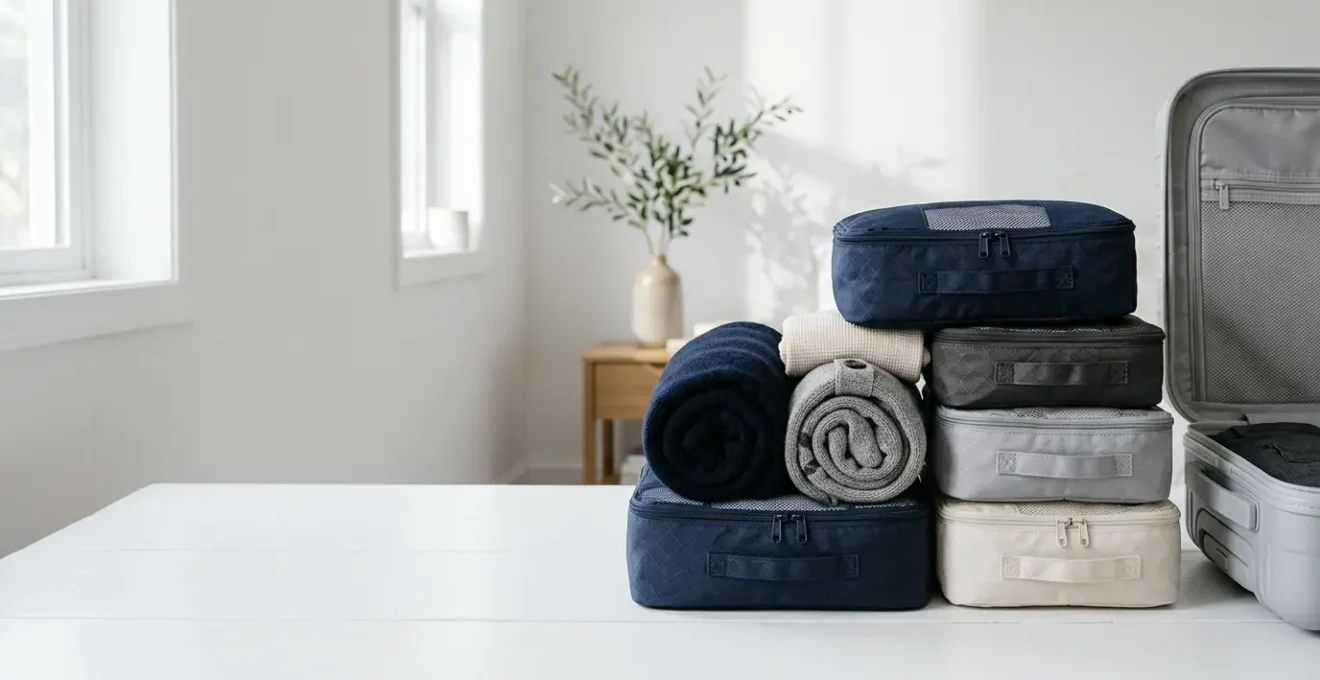
The secret to avoiding punitive airline fees isn’t fitting more into your bag—it’s building a ruthless packing system where excess is eliminated by design.
- Swap all liquid toiletries for solid alternatives to bypass security limits and prevent spills.
- Adopt a strict 15-item capsule wardrobe and a “wash, don’t pack” mentality for trips of any length.
- Strategically buy certain bulky items like hairdryers upon arrival in the US; it’s cheaper and lighter than packing them.
Recommendation: Stop thinking about what to pack and start thinking about what to eliminate. Your bank account will thank you.
The moment of truth at the check-in desk. You heave your bulging suitcase onto the scales, hold your breath, and watch the numbers flash up. It’s over the limit. That sinking feeling is immediately followed by the airline staff’s cheerful announcement of the £60 penalty. For UK travellers heading to the US, this scene is an all-too-common holiday tax. The internet is full of well-meaning but ultimately shallow advice: “roll your clothes,” “wear your heavy coat.” These are temporary fixes, not a cure.
The real problem isn’t your packing technique; it’s your entire philosophy. You’re playing a losing game of Tetris with your belongings, trying to cram just one more thing in. True hand-luggage-only travel, the kind that makes overweight fees a conceptual impossibility, requires a radical shift. It demands you think like an efficiency expert, not a holidaymaker. It’s about building a cohesive, interlocking system where every single item justifies its existence through multi-functionality and minimal weight.
But if the key isn’t just using packing cubes, but fundamentally re-engineering what goes inside them, what does that system look like? The truth is that mastering carry-on travel is less about clever folding and more about ruthless elimination. It’s a system built on a foundation of fabric economics, the strategic abandonment of redundant electronics, and a complete overhaul of your toiletry bag.
This guide will deconstruct that system piece by piece. We will move beyond the generic platitudes and into the core mechanics of extreme packing efficiency. From compressing winter gear into a tiny space to choosing fabrics that survive Florida’s humidity, you’ll learn the principles that allow seasoned travellers to cross the Atlantic for weeks with nothing more than a cabin bag.
To help you navigate this new approach, this article breaks down the essential components of a minimalist packing system. The following sections will provide a clear roadmap to building your own ultra-efficient travel setup.
Summary: How to Master US Holiday Packing to Avoid the Dreaded £60 Overweight Luggage Fee?
- How to Roll and Compress Bulky Clothing for a Three-Week US Winter Holiday?
- The Toiletries Packing Mistake That Ruins Hand Luggage During Transatlantic Flights
- Hard Shell or Soft Duffle Bag: Which Luggage Survives US Domestic Flights Better?
- How to Create a Versatile Travel Capsule Wardrobe With Only Fifteen Items?
- Why Packing UK Electronics Adapters is Often a Waste of Precious Suitcase Space?
- Gore-Tex Jackets or Traditional Ponchos: Which Protection Works Best in Heavy Rain?
- How to Pack Enough Breathable Items Without Exceeding Airline Weight Limits?
- How to Choose Breathable Clothing That Survives the Extreme Florida Summer Humidity?
How to Roll and Compress Bulky Clothing for a Three-Week US Winter Holiday?
A three-week winter trip to the US with only a carry-on seems impossible. The culprits are always the same: bulky jumpers, thick trousers, and heavy coats. The common advice to “roll your clothes” is a starting point, but it’s incomplete. To conquer bulk, you need a system of extreme compression. The most effective method is the “Ranger Roll,” a technique used by the military to maximise pack density. It goes beyond a simple roll by creating a tight, self-contained bundle that resists unravelling.
For a jumper, you lay it flat, fold the sleeves inward to create a rectangle, then fold the bottom hem up to create a “cuff.” Then, you roll tightly from the collar down towards the cuffed end. Once you reach the bottom, you pull the cuff over the entire roll, locking it into a tight, compact log. This method, combined with compression packing cubes, is the cornerstone of fitting winter wear into a small space. These cubes aren’t just bags; they are vices. A high-quality set of compression cubes can accommodate up to 40L of packing volume and then squeeze the air out, reducing the space your clothes occupy by 30-50%.
This isn’t just about saving space; it’s about creating structured, dense blocks of clothing. These solid “bricks” of fabric are easier to arrange within your luggage, eliminating the dead air space that plagues traditionally packed bags. Mastering this technique transforms packing from an art of folding into a science of density management.
The Toiletries Packing Mistake That Ruins Hand Luggage During Transatlantic Flights
The single biggest mistake UK travellers make with hand luggage isn’t forgetting an item; it’s a fundamental reliance on a liquid-based hygiene system. Decanting your favourite shampoo and conditioner into tiny bottles is a fool’s errand. It’s a constant battle against the TSA regulations that limit liquids to a strict 3.4 oz (100ml) maximum per container, all crammed into a single, flimsy plastic bag. This approach is prone to leaks that can ruin your clothes and electronics, and it never provides enough product for a multi-week trip.
The expert solution is ruthless elimination: get rid of liquids entirely. The modern travel market is filled with high-performance solid alternatives that are lighter, last longer, and are completely exempt from security restrictions. This isn’t a downgrade; it’s a strategic upgrade. A single shampoo bar can replace three bottles of liquid shampoo, toothpaste tablets eliminate bulky tubes, and solid deodorant sticks offer more product by weight than their aerosol counterparts. This systemic shift is the key to a stress-free security experience and a lighter bag.
Adopting a solid toiletry system liberates you from the tyranny of the 100ml rule. It means no more last-minute scrambles at Boots for travel-sized items, no more anxiety at the security scanner, and no more opening your suitcase to find a lotion explosion. It’s a simple change that has a profound impact on your entire packing process, saving space, weight, and sanity.
Your Action Plan: Converting to a Solid Toiletry System
- Replace liquid shampoo with a shampoo bar (often lasts 80+ washes).
- Switch to toothpaste tablets or tooth powder instead of a tube.
- Opt for a solid deodorant stick over any aerosol or roll-on.
- Find a solid perfume stick or wax-based cologne.
- Choose a powder or paste-based dry shampoo over a spray can.
Hard Shell or Soft Duffle Bag: Which Luggage Survives US Domestic Flights Better?
The bag itself is the chassis of your packing system, and choosing the right one is critical. The debate between hard-shell suitcases and soft duffle bags often centres on aesthetics, but for the minimalist traveller, the decision is purely functional. While soft bags offer tempting flexibility and are often lighter when empty, they are a trap. Their expandability encourages overpacking, the very habit we aim to break. They also offer minimal protection against the brutal reality of US domestic travel, where bags are unceremoniously tossed and stacked.
A modern hard-shell suitcase, made from lightweight polycarbonate, is the superior choice for a disciplined packing system. As noted by one travel expert in the Away Travel Guide, “a modern polycarbonate hard shell can be lighter than a fabric one, offering more protection for the same weight.” Its rigid structure serves two purposes. Firstly, it provides robust protection for your belongings. Secondly, and more importantly, it enforces discipline. Its volume is finite. You cannot squeeze in “one last thing.” This forces you to adhere to your packing system without compromise.
The choice between these two styles becomes even clearer when comparing their features side-by-side.
| Feature | Hard Shell | Soft Duffle |
|---|---|---|
| Weight (empty) | 5-7 lbs | 3-5 lbs |
| Protection Level | Excellent | Moderate |
| Sizer Cage Compliance | Consistent shape | Can compress/expand |
| Overpacking Risk | Fixed capacity | Expandable temptation |
| Durability | Impact-resistant | Tear-prone |
While a soft bag might be marginally lighter, the protection and enforced discipline of a hard shell provide far more value. It’s the framework that ensures your entire system remains intact, compact, and compliant with every airline’s sizer cage, every time.
How to Create a Versatile Travel Capsule Wardrobe With Only Fifteen Items?
The heart of any carry-on-only system is the capsule wardrobe. This is not a random assortment of your favourite clothes; it’s a highly curated, 15-piece collection where every single item coordinates with at least three others. The goal is to maximise the number of possible outfits from the minimum number of items. A well-executed capsule wardrobe can easily generate enough distinct looks for a three-week trip, making the idea of packing 21 different outfits obsolete.
The most effective framework is the 5-4-3-2-1 method. This algorithm provides a clear structure: five versatile tops, four complementary bottoms, three layering pieces, two pairs of shoes, and one statement accessory or jacket. A travel blogger who has visited over 40 countries swears by this system, noting that the key is a strict adherence to a neutral colour palette (like navy, grey, and white) and selecting wrinkle-resistant fabrics. The system relies on the principle of re-wearability and planning for a laundry stop every 5-7 days.
This approach forces you to think of your clothing as a team, not a collection of individuals. A merino wool t-shirt isn’t just a t-shirt; it’s a base layer for a cold day, a smart-casual top for dinner, and a comfortable option for the flight. A single pair of dark, well-fitting jeans can be used for city exploring, a casual dinner, or a travel day. This “multi-functionality quotient” is the metric by which every item is judged. If an item serves only one purpose, it doesn’t make the cut.
Why Packing UK Electronics Adapters is Often a Waste of Precious Suitcase Space?
One of the most common and heaviest packing mistakes is the dreaded “bag of wires.” UK travellers, conditioned to different voltages, often pack bulky, heavy voltage converters alongside a mess of plug adapters. This is almost always a complete waste of space and weight. The reality is that most modern electronics support 110-240V dual voltage. Your laptop, phone charger, and camera charger are almost certainly designed to work anywhere in the world with only a simple, lightweight plug adapter.
The only common culprits that require a true voltage converter are high-wattage heat-producing devices, primarily hairdryers and straighteners. Packing a heavy converter (which can weigh 2-3 lbs) for these is a strategic blunder. A cost analysis reveals it’s far more economical to employ the “Buy-on-Arrival Gambit.” For a three-week trip, the space and weight saved by not packing a converter allows for 3-4 additional clothing items. You can purchase a perfectly functional hairdryer from a US store like Target or Walmart for about $20—often less than the cost of a good quality converter.
This is ruthless elimination in practice. You’re not just leaving an item at home; you’re making a calculated economic decision. Is the convenience of using your own hairdryer worth sacrificing half your clothing allowance and risking an overweight fee? For the minimalist traveller, the answer is a definitive no. Pack one multi-port USB charger, the necessary cables, and a single, feather-light US plug adapter. Leave everything else behind.
Gore-Tex Jackets or Traditional Ponchos: Which Protection Works Best in Heavy Rain?
Choosing rain protection is a classic minimalist dilemma. Do you invest in a high-performance, but bulky, Gore-Tex jacket, or opt for a feather-light but less effective poncho? The answer depends entirely on the mission profile of your trip. There is no single “best” option; there is only the right tool for the job. Packing for a week of hiking in the Pacific Northwest demands a different solution than preparing for a potential 20-minute downpour at a Florida theme park.
An expensive Gore-Tex shell offers unbeatable dryness and breathability but is heavier and packs down larger. A packable synthetic shell is a good middle-ground for city travel. But the humble, disposable poncho, while offering poor breathability, is the undisputed champion of packability and weight. As one expert from Outside Online puts it, “a cheap, disposable poncho is perfect for a 20-minute downpour at Disney World.” It weighs next to nothing, takes up zero space, and can be discarded after use if necessary.
The key is to honestly assess your itinerary and choose the gear that provides the required level of protection for the minimum penalty in weight and space.
| Factor | Poncho | Packable Shell | Gore-Tex |
|---|---|---|---|
| Packability (1-10) | 10 | 8 | 5 |
| Dryness (1-10) | 5 | 7 | 10 |
| Breathability | Poor | Moderate | Excellent |
| Weight | 3-5 oz | 8-12 oz | 12-20 oz |
| Best Use Case | Theme parks | City travel | Hiking |
For a mixed-itinerary US trip, the most strategic choice is often a combination: a high-quality packable shell for general use and a disposable poncho tucked away for emergencies. This layered, mission-specific approach embodies the minimalist mindset.
How to Pack Enough Breathable Items Without Exceeding Airline Weight Limits?
The ultimate secret to packing light without sacrificing options is fabric economics. The material your clothes are made from has a greater impact on your luggage weight than almost any other factor. A suitcase full of cotton is a suitcase full of dead weight. Cotton is heavy, bulky, and takes forever to dry, making it a poor choice for the minimalist traveller who relies on a “wash and wear” system.
The solution is to invest in superior fabrics like merino wool and modern synthetics. These materials are engineered for performance. For instance, a lightweight merino wool at 150 GSM weighs 40% less than cotton at 250 GSM for a garment of the same size. This weight saving is monumental when multiplied across an entire wardrobe. Furthermore, these fabrics are quick-drying and often have natural anti-microbial properties, meaning they can be worn multiple times before needing a wash. This directly enables the “Wash & Wear” system.
This system dictates that you should pack for a maximum of seven days, regardless of your trip’s length. Instead of packing 21 pairs of socks for a three-week trip, you pack seven high-quality pairs and plan to do laundry once a week. This single shift in mindset cuts your underwear and sock allowance by two-thirds. By packing three quick-dry shirts instead of ten cotton ones and including a tiny travel laundry bar, you can create a endlessly renewable wardrobe within the strict confines of a carry-on.
Key takeaways
- System over stuff: Success comes from a ruthless packing system, not just clever folding techniques.
- Solids are superior: Eliminating liquid toiletries saves space, weight, and security checkpoint stress.
- Fabric is everything: Choosing lightweight, quick-drying, multi-wear fabrics like merino wool is the single biggest weight-saving hack.
How to Choose Breathable Clothing That Survives the Extreme Florida Summer Humidity?
Packing for extreme humidity, like that found in a Florida summer, presents the final test for any packing system. Here, the wrong fabric choice doesn’t just mean discomfort; it means clothes that become heavy with moisture, smell quickly, and are impossible to re-wear. This is where the concept of fabric performance becomes paramount. Cotton, the default for many, is the absolute worst choice. It absorbs moisture like a sponge and creates a breeding ground for bacteria.
Travel testing in high-humidity environments consistently shows that moisture-wicking synthetics and lightweight merino wool are vastly superior. They actively pull sweat away from the skin and dry quickly, staying up to 50% drier than cotton. Furthermore, the physical weave of the fabric is crucial. Loose-fitting linen and seersucker provide significantly better airflow than tight-knit materials, improving comfort in sweltering conditions. As one travel fashion expert from BusBee Style’s guide explains, “in extreme humidity, bacteria thrives and clothes get smelly fast. Fabrics with anti-microbial properties allow for re-wearing clothes, which is the ultimate space-saving hack.”
Choosing clothing with these properties—moisture-wicking, quick-drying, anti-microbial, and breathable weaves—is the final piece of the minimalist puzzle. It ensures that your small, curated capsule wardrobe can stand up to the most demanding conditions, allowing you to wash less and re-wear more. It’s the ultimate expression of the system, where intelligent, upfront choices eliminate problems before they can even occur.
By adopting this systemic, ruthless approach to packing, the £60 overweight fee is no longer a threat to be dodged. It becomes an irrelevant charge for a service you no longer need. Begin building your own minimalist packing system today by evaluating every item not on what it does, but on how efficiently it performs within the whole.