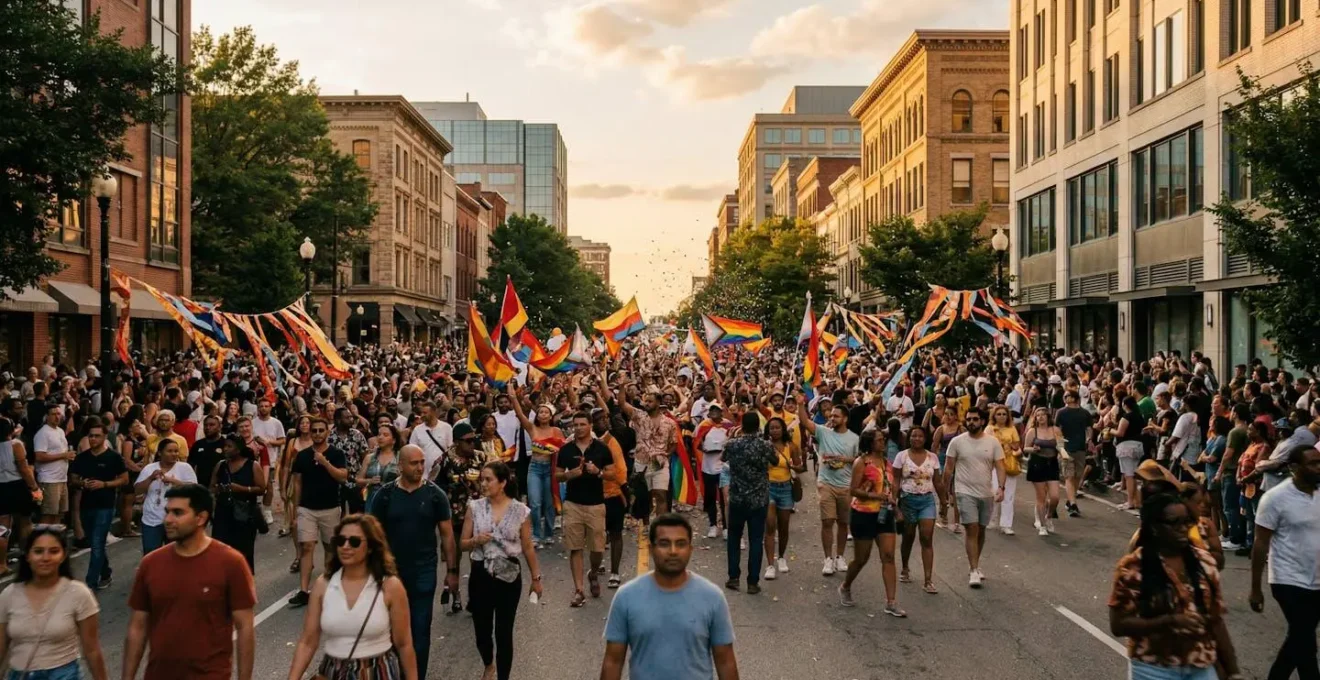
The real danger for tourists at intense US festivals isn’t just crime; it’s misreading the cultural and environmental signals that turn celebration into chaos.
- Distinguish between sacred events (like Powwows), which have strict unwritten rules, and secular parties (like Mardi Gras), which have official security structures.
- Learn to decode crowd dynamics by observing sound, movement, and police posture to identify specific “exit triggers” before a situation turns hostile.
Recommendation: Shift your mindset from a passive tourist to an active, culturally-aware observer to ensure your experience is both safe and enriching.
The allure of an authentic American street festival is undeniable. The vibrant energy of a New Orleans Mardi Gras parade, the deep-rooted tradition of a Native American Powwow, or the chaotic joy of a neighbourhood block party promise an experience far removed from a typical packaged tour. For the British traveller, it’s a chance to dive headfirst into the heart of American culture. Yet, this immersion comes with a unique set of anxieties. Standard travel advice—”be aware of your surroundings,” “watch your wallet”—feels hopelessly inadequate when faced with the sheer scale and intensity of these events.
The common wisdom often fails because it doesn’t address the core challenge: a cultural and environmental communication gap. The real key to safety and enjoyment lies not in a generic checklist, but in developing what cultural anthropologists call ‘situational literacy’. This is the ability to accurately read the unwritten social codes, unspoken behavioural boundaries, and subtle environmental cues that locals understand instinctively but can be invisible to an outsider. It’s about knowing the profound difference between a sacred space and a public party, or recognizing the shift in a crowd’s murmur that signals a change in mood.
But what if the true secret to navigating these events safely wasn’t about avoiding risk, but about understanding it? This guide moves beyond the platitudes to provide a framework for decoding these complex environments. We will explore the critical distinctions between different types of celebrations, teach you how to read the warning signs of a deteriorating atmosphere, and offer concrete strategies for engaging respectfully and avoiding the social faux pas that can lead to friction. By learning to see these events through a local’s eyes, you can transform apprehension into confident and memorable participation.
To help you navigate this complex cultural landscape, this article breaks down the essential skills and knowledge you’ll need. The following sections will guide you through understanding local traditions, event safety, and social etiquette to ensure your experience is both safe and deeply rewarding.
Summary: A UK Tourist’s Guide to Navigating US Street Festivals
- Why Ignorance of Local Traditions Quickly Turns Tourists into Unwelcome Targets?
- The Street Photography Mistake That Angers Indigenous Celebration Participants
- Managed Parades or Unofficial Street Parties: Which Experience Is Safer for Families?
- How to Secure Safe Viewing Spots Without Paying Extortionate Balcony Fees?
- When to Leave a Crowded Street Celebration Before the Atmosphere Turns Hostile?
- Why British Sarcasm Often Fails Completely During American Social Interactions?
- The Late-Night Subway Mistake That Puts Unwary Tourists in Extreme Danger
- How to Master US Local Customs and Avoid Embarrassing Social Faux Pas?
Why Ignorance of Local Traditions Quickly Turns Tourists into Unwelcome Targets?
The first step in developing situational literacy is understanding that not all large gatherings are created equal. A music festival and a Native American Powwow may both involve crowds, music, and food, but their purposes are worlds apart. One is primarily for entertainment; the other is a sacred cultural event. To Native Americans, a powwow is a time to gather, honour traditions, and renew friendships. The dance arena, or Circle, is blessed ground, and treating it like a concert floor is a profound sign of disrespect that can quickly mark a visitor as an ignorant outsider.
This ignorance isn’t just a matter of poor manners; it’s a failure to recognize the deep significance of the proceedings. For example, it’s a little-known fact that Native Americans have the highest rate of military service among all ethnic groups on a per capita basis. Consequently, songs honouring veterans and the flag are moments of deep reverence. A tourist chatting loudly or failing to stand during these moments isn’t just being rude; they are disrespecting a community’s heroes and sacred protocols. In a close-knit community, such behaviour is immediately noticed and can create a hostile perception of all outsiders.
To avoid this, your primary guide is the Master of Ceremonies (MC). Their voice is your key to understanding the flow of the event. They will announce when to stand, when to remove hats, and when photography is inappropriate. Adhering to these explicit instructions is the most basic form of respect. The core mistake is assuming the rules of one type of event apply to another. What is acceptable at a chaotic street party could be a deep offense at a cultural ceremony, turning a well-meaning tourist into an unwelcome target of justified local resentment.
The Street Photography Mistake That Angers Indigenous Celebration Participants
One of the most common ways tourists create friction at cultural events is through the lens of a camera. The vibrant regalia and expressive dances at a Powwow are visually stunning, and the instinct to capture the moment is strong. However, this is where the line between appreciation and intrusion becomes critically important. A photograph is not just an image; it is a taking. Without consent, it can feel like a violation, especially when the subject is participating in a spiritual or deeply personal act. The fundamental mistake is treating participants as props for a holiday photo album rather than as people engaged in a living tradition.
The rules of photographic etiquette are a core part of situational literacy. As the United Indians of All Tribes Foundation explicitly states, consent is paramount. This goes beyond a simple nod; it requires active respect for the event’s sacred moments. As they explain, you must ask first and be clear about your intentions.
Pictures should NOT be taken during Veterans Songs, Flag Songs, Prayers, or any other time announced by the Master of Ceremonies. If you wish to photograph a dancer in regalia, ask first. If the picture is for publication or commercial use, that should be explained before the picture is taken.
– United Indians of All Tribes Foundation, Powwow Frequently Asked Questions
This advice highlights a crucial distinction: are you a respectful observer or a consumer of culture? The best practice is to keep your camera down during formal proceedings and focus on being present. The image below symbolizes this principle of respectful distance, where the observer prioritizes the integrity of the event over capturing a photo.
During breaks or inter-tribal dances (when the MC invites everyone to participate), you may have an opportunity to politely ask a dancer if they would be willing to be photographed. A simple, “Your regalia is beautiful, would you mind if I took a photo?” shows respect and often yields a positive response. Treating participants as individuals, not as an anonymous spectacle, is the key to avoiding anger and creating a positive interaction.
Managed Parades or Unofficial Street Parties: Which Experience Is Safer for Families?
For families traveling with children, the choice between a large, officially managed parade and a spontaneous, unofficial street party is a critical safety decision. While an unofficial block party might seem more “authentic,” it lacks the fundamental safety infrastructure that makes large-scale events manageable. A managed parade, such as those during New Orleans’ Mardi Gras, is a massive logistical operation with safety at its core. It’s not just a procession; it’s a controlled environment.
The sheer scale of the security presence is a key differentiator. During a major Mardi Gras parade, there are over 1,800 combined law enforcement personnel deployed per day, including city police, National Guard, and Sheriff’s deputies. This creates a powerful deterrent for opportunistic crime and provides a structured system for crowd control and emergency response. Unofficial parties, by contrast, have a variable and often limited police presence, leaving attendees to largely fend for themselves if the atmosphere sours. The following table breaks down the key safety differences.
| Safety Aspect | Managed Parades | Unofficial Street Parties |
|---|---|---|
| Security Presence | High – Professional crowd control | Limited – Variable police presence |
| Medical Services | First aid stations staffed | Limited access to medical help |
| Crowd Density Control | Barricades and designated areas | Uncontrolled crowd flow |
| Family Zones | Often designated safe areas | No family-specific areas |
| Exit Routes | Clearly marked and monitored | Unpredictable escape paths |
For families, the presence of designated family zones, first aid stations, and clear exit routes in managed events is invaluable. Even with these measures in place, proactive safety is essential in any dense crowd. Simple tools and rules can make a world of difference if you get separated.
Your Family Safety Checklist for Crowded Events
- Take a selfie with your kids before attending the parade in case they get separated; their clothing will be documented.
- Use a temporary tattoo or a wristband with a parent’s phone number written on it for each child.
- Equip children with noise-cancelling headphones to prevent sensory overload from sirens, music, and shouting.
- Establish a firm rule: if separated, the child should immediately find a police officer or a mother with other children to ask for help.
- Choose and agree upon a clear, easily identifiable landmark as a meeting point in case of separation.
How to Secure Safe Viewing Spots Without Paying Extortionate Balcony Fees?
At popular parades, securing a good viewing spot is a competitive sport. The coveted hotel balconies along the route can cost a small fortune, pushing many tourists into the dense crowds on the street. However, a safe and free spot is achievable with a bit of strategic thinking and, most importantly, an understanding of the unspoken rules of the pavement. The key is not to fight the crowd, but to use the existing safety infrastructure to your advantage.
The single most important environmental cue to understand is the barricade. Whether it’s a solid metal fence or a simple rope strung between posts, this line is not a suggestion. It is a hard boundary established and monitored by law enforcement for crowd control and to keep the parade route clear for floats and first responders. As public safety officials at Tulane University warn, crossing this line is a direct violation that can lead to a swift arrest. Respecting the barricade is your first rule of engagement.
Case Study: The Strategic Use of Barricades
According to Mardi Gras safety guidelines, a barricade serves as a critical safety barrier. By positioning your family directly behind it, you create a buffer zone. You have a clear view, are protected from the forward surge of the crowd behind you, and have a solid object to hold onto. Furthermore, police officers regularly patrol these lines, making it one of the most secure places on the street. Arriving early to claim a spot along this line is far more strategic than trying to push through a dense crowd later.
Other strategic spots include positioning yourself near a lamp post or other fixed object, which can prevent you from being jostled from all sides. Another tactic is to find a spot on the “lee” side of a street corner. As the parade turns, the crowd tends to bunch up on the inside of the corner, leaving more space on the outside. By learning to read these simple environmental features, you can find a relatively comfortable and secure viewing position without spending a penny.
When to Leave a Crowded Street Celebration Before the Atmosphere Turns Hostile?
The most crucial aspect of situational literacy is recognizing the moment a celebratory crowd begins to turn. In a dense mass of people, the shift from festive to hostile can happen with alarming speed. The common advice to “leave if you feel unsafe” is often too late; by the time your intuition is screaming, exit routes may already be compromised. The key is to identify the early warning signs—the subtle “exit triggers”—that precede a major incident. This requires engaging all your senses, not just your eyes.
First, listen to the sound of the crowd. A happy crowd has a generalized, rolling cheer. A turning crowd’s sound becomes fractured. You’ll hear more isolated, aggressive shouts, arguments, or the distinct sound of breaking glass. Next, feel the movement of the crowd. A stable crowd has a fluid, predictable flow. A dangerous crowd develops what experts call “pressure waves.” You’ll feel yourself being pushed and pulled involuntarily by surges from deep within the mass. Sudden, panicked movements or people trying to run against the flow are critical red flags. The aerial view below illustrates how these pressure zones can form.
Finally, watch the authorities. Police officers who are relaxed and interacting with the public are a sign of a stable environment. If you see officers suddenly start putting on riot gear, forming lines, or focusing intently on one area, they are anticipating trouble. That is your cue to move in the opposite direction calmly but immediately. This checklist provides a summary of these critical exit signals.
- Sound: Collective cheers shifting to isolated aggressive shouts.
- Movement: Fluid crowd flow changing to pressure waves or sudden stampedes.
- Police Activity: Officers putting on riot gear or forming defensive lines.
- Atmosphere: A noticeable increase in physical altercations or aggressive arguments.
- Personal Instinct: If you find yourself wondering whether you should leave, it’s already time to go.
Trusting that last point is paramount. Don’t wait for validation. The moment the question “Should we get out of here?” pops into your head, the answer is always yes.
Why British Sarcasm Often Fails Completely During American Social Interactions?
Navigating the social landscape is just as important as navigating the physical one, and for many Brits, this is where the biggest stumbles happen. A primary point of friction is the British use of sarcasm and dry, ironic understatement. In the UK, this is a common, often affectionate, form of bonding and humour. In the United States, especially among strangers in a loud, fast-paced environment, it can be completely misunderstood. American social interaction, particularly in informal settings, tends to favour explicit positivity and earnestness.
When a Brit says, “Well, this is a bit of a disaster, isn’t it?” with a wry smile, they mean “This is fantastically chaotic and I’m enjoying it.” An American, however, is likely to hear the literal words and think you are genuinely unhappy or critical. This can lead to awkwardness, confusion, or the perception that you are a negative or complaining person. The context and subtle tonal cues that make sarcasm work are often lost in translation, leaving only the negative surface meaning.
The solution is not to lose your sense of humour, but to engage in a form of “cultural code-switching.” This means consciously adopting a communication style that is more easily decoded by your audience. Instead of irony, lean into enthusiastic observation and genuine curiosity. Americans generally welcome questions and are happy to explain things to an interested visitor. Swapping sarcasm for self-deprecating humour that is clearly a joke is also a much safer bet. This guide offers a practical translation:
- Replace sarcasm with over-the-top, self-deprecating humour that Americans recognize as clearly joking.
- Use enthusiastic positive observations (“This is incredible!”) instead of ironic negative comments.
- Ask genuine, curious questions (“What’s the story behind this tradition?”), which Americans typically welcome.
- Add clear, exaggerated tonal and facial cues (a big smile, a laugh) when attempting humour to avoid misunderstandings.
- When in doubt, default to explicit positivity that matches the prevailing American social norm.
The Late-Night Subway Mistake That Puts Unwary Tourists in Extreme Danger
After a long day at a festival, the journey back to your accommodation presents its own set of challenges, especially on a late-night subway system like New York’s. The perception for many tourists is one of pervasive danger. However, the reality is more nuanced. Statistically, the subway is remarkably safe; there was under one violent index crime for every million rides in the NYC system last year. The real danger often lies not in random violence, but in making simple, avoidable mistakes that mark you as an easy target for opportunistic crime.
The single biggest mistake a tired tourist can make is seeking privacy by entering a completely empty subway car when other cars are populated. Locals know to avoid empty cars for a reason: it isolates you. If trouble occurs, there are no witnesses and no one to help. Always choose a car with other people in it. Another common error is being completely oblivious to your surroundings, often due to exhaustion or being engrossed in your phone. As New York safety expert Tracy Kaler notes, there’s a difference between appearing zoned out and actually being zoned out.
In most cases, the subway is a safer mode of transportation than driving… I believe that wearing headphones makes you less of a target, especially if you can appear to be zoned out, even if you are actually zoned in on everything that’s going on.
– Tracy Kaler, A Guide to New York Subway Safety
This is a masterclass in urban situational literacy: using props to project an image of non-engagement while maintaining full awareness. Beyond this, a few simple rules dramatically increase your safety late at night. Pickpocketing opportunities are highest at chokepoints like turnstiles and crowded platform entrances, so be extra vigilant there. Standing away from the platform edge and near a pole gives you stability and a barrier. Following these local-tested rules is far more effective than succumbing to generalized fear.
- Never enter a completely empty car when others are occupied—locals avoid it for a reason.
- Stay alert at station entrances and turnstiles, where exhausted crowds create pickpocket opportunities.
- Set a phone alarm for the stop *before* yours to avoid falling asleep and missing your station, which can leave you stranded in an unfamiliar area.
- Keep music volume low enough to maintain awareness of your surroundings.
- Stand away from the platform edge and position yourself near a pole or wall for stability.
Key Takeaways
- Always differentiate between sacred cultural events like a Powwow, which demand reverence, and secular public parties like Mardi Gras, which are built for chaotic fun.
- Your best safety tool is learning to read crowd dynamics. A change in sound from cheers to shouts, or a shift in movement from flow to pressure waves, are clear exit signals.
- Adapt your communication style. In the US, direct enthusiasm and genuine curiosity are far more effective social tools than British irony or sarcasm.
How to Master US Local Customs and Avoid Embarrassing Social Faux Pas?
Ultimately, navigating American celebrations successfully boils down to a mindset shift: moving from a passive tourist to a welcome, respectful guest. This is achieved by mastering the small social customs that demonstrate you are making an effort to connect, not just consume. One of the most common areas of confusion for international visitors is tipping. In the US, tipping is not just a bonus for good service; it’s a fundamental part of the wage structure for many workers and a sign of respect.
This applies even in the temporary economy of a street festival. Bartenders at pop-up stalls, street performers who you stop to watch, and service staff all rely on tips. A good rule of thumb is to tip $1-2 per drink and to have small bills ready for performers whose act you enjoy. Beyond the transactional, acknowledging the people who make your trip special is a powerful tool. As one travel expert advises, simple acts of gratitude go a long way.
If you’re in a hotel, don’t forget to tip the housekeeping staff. For all those many people who make your trip wonderful but for whom tipping would be awkward, offer a spontaneous coffee or surprise flowers. At minimum, take the time to learn something about them, smile, and thank them.
– Solo Traveler World, Conscious Travel: Tips for Respecting Local Cultures
This ethos of engagement is your most powerful tool. Instead of feeling awkward about your ignorance, use it as an opening. Adopting the persona of an ‘Enthusiastic, Curious Observer’ can turn potential faux pas into moments of connection. A phrase like, “This is my first time here, it’s amazing! What’s the story behind this tradition?” is almost always met with a friendly and helpful response. It shows you value the local culture and are willing to learn, transforming you from just another tourist into a person worth engaging with.
- Master the ‘Enthusiastic, Curious Observer’ persona with phrases like, “This is amazing! What’s the story behind…”
- Tip bartenders at temporary stalls $1-2 per drink as a standard courtesy.
- Tip street performers when you stop to watch their performance for more than a moment.
- Use polite, non-confrontational exit strategies in conversations: “It was great talking to you, I need to find my friends now.”
- Express genuine interest in local practices to turn your status as an outsider into a tool for connection.
By embracing this mindset of situational literacy and respectful curiosity, you can confidently step into the heart of America’s most vibrant celebrations. Now, go beyond simply seeing the country and start to truly understand it. Your next journey will be richer and safer for it.