Contrary to the belief that a rental car offers freedom, in major US cities, it’s a financial liability designed to drain your wallet.
- The base rental cost is just the beginning; hidden tolls, exorbitant hotel parking, and fuel costs can easily double your daily budget.
- Public transit, when understood, isn’t just cheaper—it’s often significantly faster by bypassing the gridlock that traps cars and buses.
Recommendation: Ditch the car entirely upon entering a major city. Master the local transit system, combine it with walking and micro-mobility, and treat urban navigation as a strategic puzzle to be solved.
You’ve done it. You’ve successfully navigated the sprawling highways of America, completing the cross-country road trip of a lifetime. But as you pull into Manhattan or Chicago, a new, more terrifying reality sets in: the £60-a-day parking fee. This isn’t just a high price; it’s a cold shock that paralyses your travel budget and turns your dream trip into a logistical nightmare. The common advice is to use a parking app or book a hotel with a garage, but these are merely plasters on a gaping wound. They are part of a system that assumes you need a car and makes you pay dearly for that assumption.
The truth is, relying on a car in a tier-one American city is the single biggest financial mistake a tourist can make. It’s not just the parking. It’s a cascade of expenses, from outrageous toll pass schemes run by rental companies to the simple, maddening cost of fuel while sitting in traffic. Many believe the alternative, public transport, is confusing or unsafe. This article will dismantle that myth. We’re not just going to tell you to “take the subway.” We’re going to give you a frugal urban mobility hacker’s mindset.
Forget everything you think you know about American transport. The key isn’t just to find cheaper parking; it’s to make the car completely irrelevant. This guide will show you why your rental car is a financial disappointment waiting to happen, how to avoid the insidious hotel parking trap, and how to master the combination of subways, walking, and micro-mobility to move faster, cheaper, and safer than you ever could by car. We will break down the real costs and benefits of transit passes, explain how to use underground systems with confidence, and reveal which options truly keep you secure. It’s time to stop being a victim of the urban transport system and start hacking it.
This article provides a comprehensive framework for ditching the car and mastering urban mobility in the US’s most expensive cities. The following sections break down the hidden costs of driving and reveal the strategies for navigating these metropolises efficiently and affordably.
Summary: A Hacker’s Guide to American Urban Mobility
- Why Hiring a Car in New York or Chicago Is the Ultimate Financial Disappointment?
- The Hotel Parking Trap That Secretly Adds £50 to Your Nightly Bill
- Multi-Day Transit Passes or Pay-As-You-Go: Which Fares Best in Major Metropolises?
- How to Use Underground Transit Systems Safely During Peak Commuter Hours?
- How to Combine Walking Paths with Micro-Mobility Scooters for the Fastest Commute?
- Why Renting a Car Directly at the Terminal Often Takes Hours Longer Than Expected?
- Why Relying Exclusively on American Public Buses Often Leads to Severe Delays?
- Which Urban Transportation Options Keep British Tourists Safest in Major US Cities?
Why Hiring a Car in New York or Chicago Is the Ultimate Financial Disappointment?
The sticker price on a rental car is a work of fiction. It’s the opening bid in a negotiation you are destined to lose. Before you even factor in fuel or parking, the baseline costs in cities like Chicago are astronomical. For instance, a 2024 analysis reveals that you could be looking at over $700 for a 7-night rental from O’Hare airport. This is the first layer of the financial trap: a price that already rivals the cost of a domestic flight, and it’s just the start.
The real pain comes from the hidden fees, specifically the toll pass scams. Rental companies prey on tourists’ ignorance of local toll roads. They offer an E-Z Pass or similar transponder for “convenience,” but it comes at a staggering premium. As a damning analysis from the NYC Comptroller’s office revealed, renting from certain companies can lead to paying an 85.96 in fees using the rental car’s E-Z Pass—a shocking 77% markup compared to what a local with a personal transponder pays. You’re not paying for convenience; you’re paying a penalty for being a tourist.
This entire model is designed to punish the “car mindset.” It assumes you need a car and systematically extracts wealth at every turn. From inflated insurance add-ons to the inevitable city-specific taxes and surcharges buried in the fine print, the final bill will bear little resemblance to the price you thought you were getting. The car is not a tool for freedom here; it’s a subscription to a series of escalating costs you have no control over.
The Hotel Parking Trap That Secretly Adds £50 to Your Nightly Bill
After the shock of the rental and toll fees, the next ambush awaits at your hotel. You’ve booked a room, and you see “On-site Parking Available.” What this discreet phrase often means is “On-site Parking Available for an Eye-Watering Fee That We Don’t Prominently Disclose.” This is the hotel parking trap, a tactic that can instantly add £40, £50, or even £70 per night to your bill. It’s a classic bait-and-switch, where the convenience of parking at your hotel is leveraged into a massive, non-negotiable expense.
Many travellers then turn to technology for a solution, pulling out their phones to find a cheaper option on a parking app. This is often a frustrating and fruitless exercise. The apps present a map of seemingly infinite choices, but the reality in a dense urban core like Midtown Manhattan or The Loop in Chicago is that “cheaper” is a relative term. You might save £10, but you’ll have to park six blocks away in a garage with questionable security and strict in-and-out policies. You spend 30 minutes circling the block, stressed and burning fuel, only to find a marginally better deal. The app provides the illusion of choice while the system ensures there are no truly good options.
This experience highlights a core tenet of mobility hacking: you cannot solve a problem of physical space and high demand with a digital tool alone. The problem isn’t the lack of information; it’s the fundamental scarcity of cheap, convenient parking. The only way to win this game is not to play it. By arriving in the city without a car, the entire problem of parking—the cost, the stress, the time wasted searching—evaporates instantly. The £50 you save per night on parking can be reinvested into better meals, experiences, or a superior transport method.
Multi-Day Transit Passes or Pay-As-You-Go: Which Fares Best in Major Metropolises?
Once you’ve wisely decided to ditch the car, the next strategic decision is how to pay for public transport. The default tourist move is to buy a 7-day unlimited pass, assuming it offers the best value. However, this isn’t always the case. The “best” option depends entirely on your travel patterns. A cost-per-mile analysis is crucial. An unlimited pass only becomes economical after a certain number of rides—the break-even point. If you plan to take many short trips each day, a pass is a clear winner. But if your itinerary involves one or two long subway rides combined with extensive walking, pay-as-you-go might be significantly cheaper.
Cities are also evolving their fare systems. New York’s OMNY system, for example, has a brilliant “fare capping” feature. You use your contactless card or phone to pay per ride, and once you spend $34 within a seven-day period (the cost of a 7-Day pass), every subsequent ride in that period is free. This offers the best of both worlds: you never overpay if you travel infrequently, and you get the benefit of an unlimited pass if you travel a lot. This is a perfect example of a system that rewards smart use over blind prepayment.
Comparing the options across cities reveals key differences in value. A detailed look at transit costs shows how the break-even point varies, making one choice better in one city and worse in another. The following table, based on data from public sources including an analysis by the New York State Comptroller’s office, illustrates this.
| City | 7-Day Pass Cost | Break-Even Point | Best For |
|---|---|---|---|
| New York (OMNY) | $34 (cap system) | 12+ rides/week | Frequent daily trips |
| Chicago (CTA) | $28 | 14 rides/week | Regular commuters |
The takeaway is clear: don’t automatically buy the weekly pass. Before you arrive, do a quick calculation based on your likely itinerary. For a weekend trip with lots of walking, pay-as-you-go is almost always superior. For a week-long, city-spanning adventure, a pass or a capped system is your best bet.
How to Use Underground Transit Systems Safely During Peak Commuter Hours?
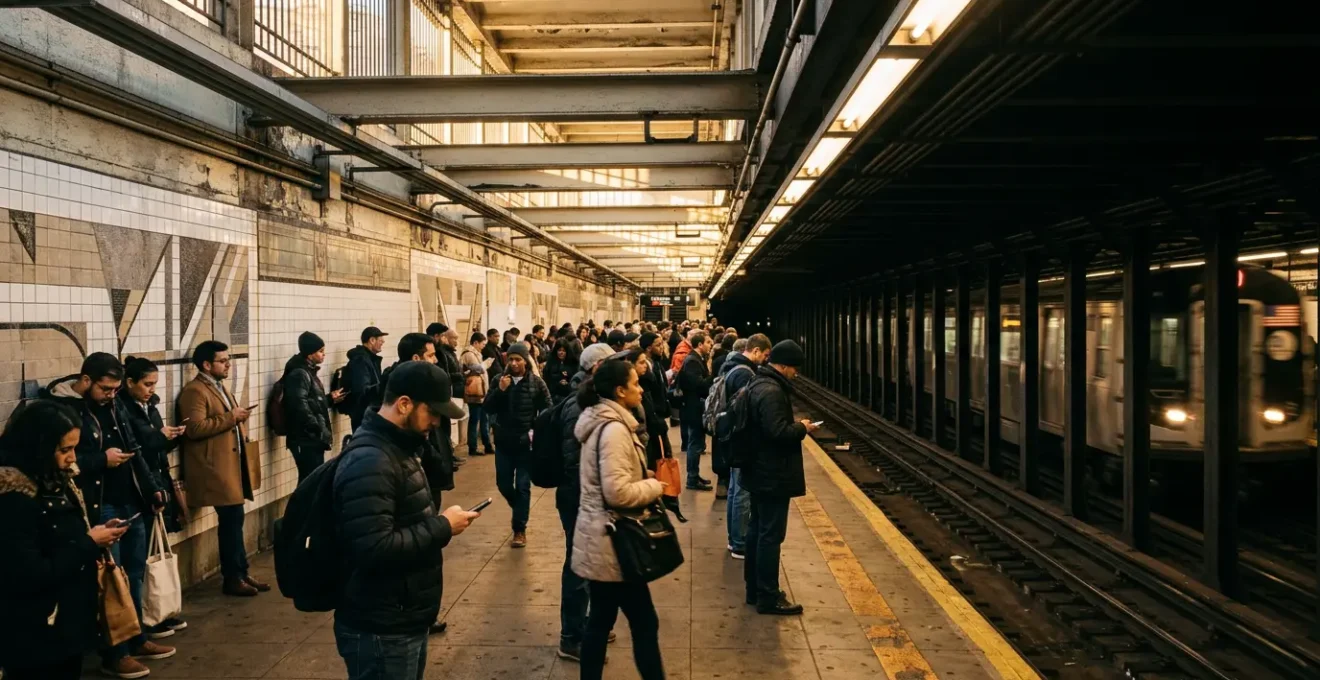
For many tourists, the idea of a crowded American subway during rush hour can be intimidating. The key to navigating it safely and confidently is to think and act like a local commuter, not a bewildered visitor. The first rule is situational awareness. This doesn’t mean being paranoid; it means being present. Keep your phone in your pocket when on a crowded platform or train car, keep your bag in front of you, and be aware of your surroundings.
One of the most effective yet little-known safety strategies involves your positioning on the train. A report from NYC’s Office of the State Comptroller highlighted a crucial tip for commuters: position yourself in the middle cars of the train. This is where the conductor is typically located, providing an enhanced level of security and staff presence, especially during evening hours when visibility matters most. Avoid the very first or last cars, as they are often the most isolated. This simple act of strategic positioning drastically increases your passive safety.
Blending in is another critical aspect of safety. Tourists stick out when they block doorways, stare at maps in the middle of a busy walkway, or fumble for their payment at the turnstile. The commuter’s dance is one of efficiency: let people exit the train before you try to board, stand to the side on escalators, and have your OMNY-ready card or phone in your hand well before you reach the fare gate. These small actions signal that you understand the unwritten rules of the system, which makes you a less obvious target. Confidence, even if feigned at first, is a powerful deterrent.
How to Combine Walking Paths with Micro-Mobility Scooters for the Fastest Commute?
The fastest way across a dense city is rarely a single mode of transport. True mobility hacking lies in stringing together different options. The most powerful combination for short-to-medium distances (one to three miles) is the synergy between walking and micro-mobility, like e-scooters or city bikes. This approach allows you to bypass traffic entirely while moving faster than a walk would allow. Cities like Chicago are perfectly suited for this, as The Zebra’s analysis ranks it 7th in walkability and 6th in bike score nationally.
The strategy works like this: use a transit app to plan a route from point A to B. For a two-mile journey, the app might suggest a 15-minute bus ride that will almost certainly be delayed by traffic. Instead, look at the map. You might see that a 10-minute walk through a park or along a pedestrian-friendly avenue gets you halfway there. At that point, you can pick up a readily available e-scooter for the final mile, a journey of only a few minutes. This multi-modal approach is often faster, more enjoyable, and gives you a much better feel for the city’s texture and layout.
This isn’t about aimless wandering; it’s a calculated decision. You are trading the unpredictable delays of vehicle traffic for the certainty of your own two feet, augmented by the speed of an electric motor. It requires a slight mental shift—from seeing a journey as a single, monolithic trip to seeing it as a series of short, interconnected legs. This is particularly effective for “last mile” problems, like getting from a subway station to your final destination that’s just a bit too far to walk comfortably. The scooter or bike bridges that gap with incredible efficiency.
Why Renting a Car Directly at the Terminal Often Takes Hours Longer Than Expected?
The illusion of convenience is a rental car company’s greatest asset. You book a car for pickup “at the airport,” imagining a seamless transition from your flight to the driver’s seat. The reality is often a multi-stage logistical ordeal that can consume hours of your precious holiday time. Many airport rental locations, especially at sprawling hubs like Chicago O’Hare (ORD) or JFK, are not actually in the terminal. They are housed in massive, consolidated rental facilities located miles away, accessible only by a dedicated shuttle train or bus.
This is where the hidden time costs begin to accumulate. As one Chicago traveller warned in a review, you must “plan time accordingly” because the car is not in the terminal and a train is needed. That “train” is often a packed shuttle bus that snakes through airport traffic, making multiple stops. The journey itself can take 20-30 minutes. Once you arrive, you’re greeted by a queue that can easily be 50 people deep, all tired, frustrated, and waiting to be served by a handful of agents. It’s not uncommon to spend 45 to 90 minutes just getting from your flight’s gate to behind the wheel of your car.
This frustrating experience stands in stark contrast to the efficiency of public transport. From most major US airports, you can walk from baggage claim to a train platform in under 10 minutes. The train to the city center—like the Blue Line from O’Hare or the AirTrain/LIRR from JFK—departs every few minutes and, most importantly, is completely immune to the gridlock on the expressways. You arrive in the heart of the city relaxed and on a predictable schedule, while the car renter is still stuck in a queue at the rental facility, their holiday ticking away.
Why Relying Exclusively on American Public Buses Often Leads to Severe Delays?
While public transport is the urban hacker’s best friend, not all forms are created equal. For a tourist on a tight schedule, relying solely on public buses in a major US city is a recipe for frustration and severe delays. The fundamental flaw of the bus system is simple: it is subject to the exact same physics as a car. It gets stuck in the same traffic, stopped at the same red lights, and blocked by the same delivery trucks. A bus is, in essence, just a very large, slow-moving car.
This creates a phenomenon of asymmetrical delays. While the subway, ‘L’ train, or any rail-based system operates on a separate, dedicated right-of-way, the bus is fighting for space on congested city streets. A journey that takes 15 minutes by subway can easily take 45 minutes by bus during peak hours. The bus route might look more direct on a map, but in practice, its speed is dictated by the traffic around it, making arrival times wildly unpredictable.
This critical distinction is often lost on visitors who may be more accustomed to comprehensive bus networks with dedicated lanes back home. As one transportation analyst from the Transit Center bluntly put it in a report on urban mobility:
Unlike the Tube or ‘L’ train, most US city buses are stuck in the exact same gridlock as cars.
– Transportation analyst, Transit Center Report on Urban Mobility
Buses have their place in a multi-modal strategy, particularly for reaching areas not served by rail or for very short trips. But using them as your primary mode of transport is a strategic error. The savvy traveller uses the subway or ‘L’ for the main, long-haul parts of their journey and only resorts to the bus for the final few blocks if necessary, always aware that they are trading the certainty of rail for the gamble of surface-level traffic.
Key Takeaways
- Renting a car in a major US city is a financial trap due to high base costs, hidden toll fees, and exorbitant parking.
- The fastest and cheapest way to navigate is by adopting a “mobility hacker” mindset, combining subway, walking, and micro-mobility.
- Safety on public transport is achieved through situational awareness and acting like a local, such as by choosing middle train cars and being efficient at fare gates.
Which Urban Transportation Options Keep British Tourists Safest in Major US Cities?
Beyond cost and efficiency, personal safety is a paramount concern for any tourist navigating an unfamiliar city. A strategic approach to your transport choices can significantly mitigate risk. The foundation of this strategy is understanding that risk is contextual. It varies based on time of day, location, and the mode of transport itself. The safest options are those with high visibility, a constant presence of other people, and a clear, fixed infrastructure.
Daytime walking in busy commercial districts and using official airport shuttles with predefined routes represent the lowest risk tier. They are predictable and public. The next safest options are rideshare services where the trip is tracked in an app and subway travel during peak daytime and commuter hours when trains and platforms are full of people. The crowd itself is a form of passive security. Risk begins to increase with late-evening subway rides in quieter stations or bus travel through neighbourhoods you don’t know. The highest risks are associated with activities that put you in direct contact with unpredictable traffic, such as riding a scooter, or being isolated, like walking alone late at night.
Adopting a safety-first mindset involves more than just choosing the right mode; it’s about preparation. You must have a plan for when things go wrong. This is where a practical checklist becomes an essential tool, moving from abstract ideas to concrete, life-saving actions.
Your Essential Safety Checklist: Navigating US Cities
- Assess Your Options: Before your trip, identify the hierarchy of risk for your transport choices, from lowest (daytime walking in busy areas) to highest (solo late-night travel).
- Prepare Your Tools: Save local taxi numbers in your phone as a backup. Ensure your phone is charged and that Apple/Google Pay is set up for contactless fares to avoid fumbling with cash or cards.
- Master Your Location: Always know the cross-streets of your location. If you need to call 911, this is the most critical piece of information you can provide for a fast response.
- Travel Smart in Transit: On subways, stick to the middle cars near the conductor, especially at night. On buses, sit near the front, closer to the driver.
- Trust Your Instincts: If a situation or an area feels unsafe, it probably is. Leave immediately. Don’t hesitate to spend money on a rideshare or taxi to exit a situation where you feel vulnerable.
Now that you are equipped with these strategies, the final step is to consistently apply this hacker mindset. Treat every journey not as a simple A-to-B task, but as an opportunity to optimize for cost, time, and safety, turning the city’s transport network from an adversary into an asset.
Frequently Asked Questions About US Urban Transit
Which subway car is safest?
The middle cars where conductors are stationed offer the best combination of staff proximity and fellow passenger presence. This provides an added layer of passive security, especially during off-peak hours or late at night. Avoid the very first or last cars, which can be more isolated.
How do I blend in as a tourist?
To blend in, focus on efficiency and awareness. Let passengers exit the train completely before you board, keep backpacks in front of you in crowded spaces to avoid bumping into people, and have your payment method (contactless card or phone) ready before you reach the turnstile to avoid holding up the line. Moving with purpose and confidence is key.