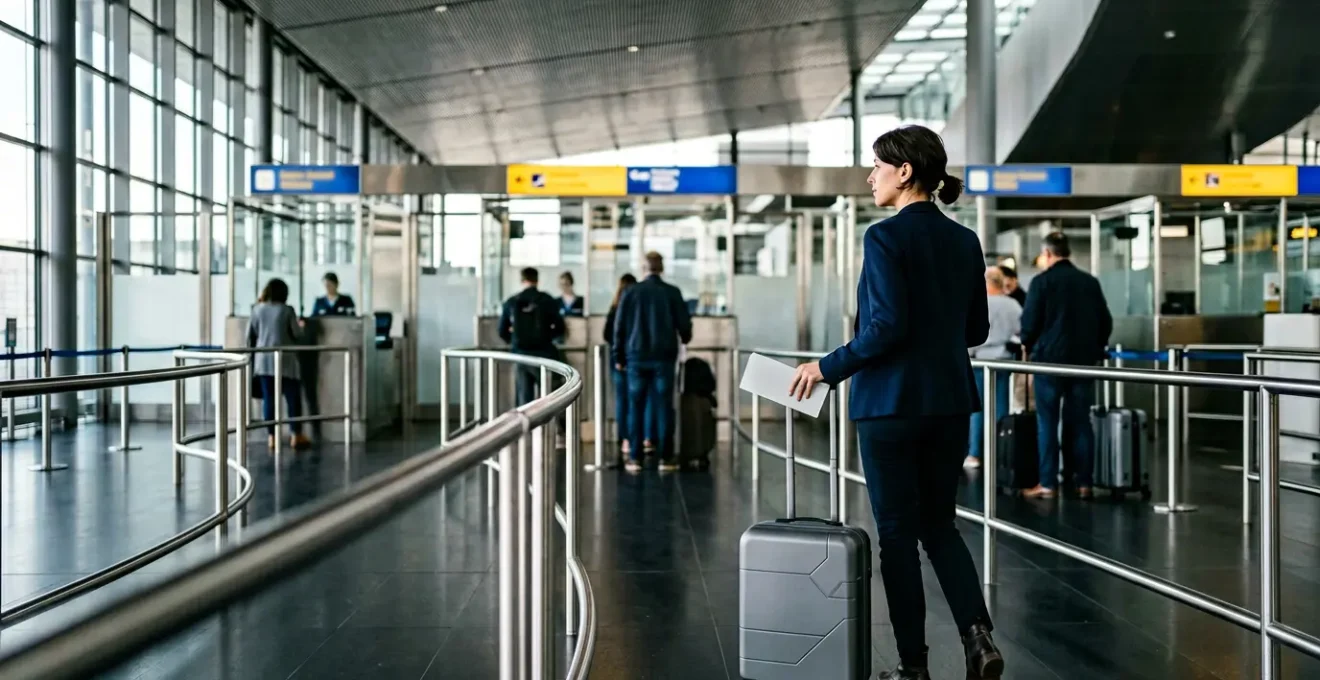
For British travellers with chronic health conditions, the fear of having NHS prescriptions confiscated by US Customs is a significant source of anxiety. The solution is not just to carry a doctor’s note, but to shift your mindset. This guide details how to proactively prepare a professional ‘case file’ for your medication, understand the logic behind customs rules, and present your situation to a CBP officer with clarity and confidence, ensuring your essential treatments are seen as a medical necessity, not a red flag.
The moment of handing your passport to a US Customs and Border Protection (CBP) officer can be daunting, especially when your luggage contains essential medication for a chronic condition. For many British travellers, the fear of having their vital NHS prescriptions scrutinised, or worse, confiscated, can overshadow the excitement of a trip. You’ve likely heard the standard advice: keep pills in their original packaging and bring a doctor’s letter. While correct, this is merely the starting point and often fails to address the core of the issue.
The anxiety stems from a lack of understanding of the officer’s perspective. They are not looking to inconvenience you; they are legally mandated to prevent the entry of unapproved drugs, controlled substances, and potential biohazards. Simply having the right papers isn’t enough; you must present them in a way that pre-emptively answers their questions and demonstrates full, transparent compliance. The real key to a stress-free entry is to move beyond passive hope and adopt a strategy of proactive preparation.
But what if the true strategy wasn’t just about what you carry, but how you frame its necessity? This guide reframes the process entirely. Instead of seeing yourself as a potential suspect, you will learn to act as a prepared individual presenting a clear, organised ‘case file’ for your personal medical needs. We will break down the specific regulations that trip up UK travellers, from common painkillers to seemingly innocent snacks, and provide the legal rationale and practical steps to navigate each checkpoint with confidence. This article will equip you to manage not only your medications but also declarations for food, high-value electronics, and cash, transforming a moment of fear into a smooth, procedural formality.
To help you master these regulations, this guide is structured to address each major concern methodically. The following sections will provide detailed legal insights and actionable advice for every step of your journey through US customs.
Summary: Navigating US Customs with Confidence
- The Painkiller Mistake That Can Get UK Citizens Detained by US Customs
- How to Declare Food and Gifts Correctly Under Strict Federal Customs Regulations?
- Checked Luggage or Hand Baggage: Where Should You Pack High-Value Electronics?
- Why Failing to Declare More Than $10,000 Results in Immediate Cash Seizure?
- How to Prepare Your Customs Declaration Items Before Landing to Save Time?
- Why Bringing Certain British Snacks Causes Immediate Territory Entry Fines?
- Why Glasses and Heavy Makeup Can Trigger Annoying Biometric Screening Failures?
- How to Navigate US Airport Biometric Screening Without Delays or Privacy Fears?
The Painkiller Mistake That Can Get UK Citizens Detained by US Customs
One of the most significant points of friction for UK travellers is the carrying of common painkillers. The core issue lies in substances like codeine, a component in medications such as Co-codamol, which are available over-the-counter or via a standard NHS prescription in the UK but are classified as controlled substances in the United States. From a CBP officer’s perspective, undeclared codeine is not just a simple painkiller; it’s a regulated narcotic. This discrepancy in classification is what can trigger intense scrutiny, delays, and potential detention if not handled with proactive transparency.
The mistake is not in bringing the medication, but in failing to prepare a robust justification for it. An officer’s primary concern is intent: is this for legitimate personal medical use, or is it for distribution or misuse? Your task is to provide irrefutable evidence for the former. As highlighted in traveller forums, passengers arriving at major airports like JFK have faced significant delays due to codeine-containing medications. The consensus among experienced travellers is clear: a comprehensive ‘case file’ is non-negotiable.
This means assembling your original pharmacy-labelled packaging, your NHS prescription summary, and a detailed doctor’s letter that specifies the condition being treated, the medication name, and the dosage. The letter must be on official letterhead and written in English. Rather than waiting to be questioned, you should initiate a proactive declaration. The following script provides a framework for this crucial conversation.
Your Action Plan: The CBP Conversation Script for Declaring Controlled Medications
- Approach the CBP officer with your complete document ‘case file’ ready and visible in your hand.
- State clearly and calmly: “Officer, I need to declare prescription medication containing a controlled substance, [e.g., codeine], for my personal use.”
- Present the medication in its original packaging with the pharmacy label clearly showing your name.
- Provide your doctor’s letter on official letterhead, explaining the medical necessity.
- Confirm the quantity is consistent with personal use for the duration of your stay (e.g., “I have a 3-week supply for my 3-week visit”).
- State the exact quantity and confirm the duration of your trip if asked, ensuring the amounts align.
By following this structured approach, you shift the dynamic. You are no longer a person to be investigated but a compliant traveller who understands and respects US law, making the officer’s job easier and your entry smoother. According to guidance for travellers, this proactive communication is key to preventing misunderstandings about prescription medicine when entering the US.
How to Declare Food and Gifts Correctly Under Strict Federal Customs Regulations?
Declaring items is not an admission of guilt; it is a fundamental requirement of US federal law designed to protect the country’s agriculture and economy. The logic behind strict food regulations is to prevent the introduction of foreign pests and animal diseases. Many items that are harmless in the UK can pose a significant threat to US ecosystems. Therefore, the CBP’s rule is simple: when in doubt, declare it. Failure to declare prohibited items, even by accident, is taken seriously. As reported by travel experts, customs violations can result in fines ranging from $300 to over $1,000.
The declaration process itself offers modern efficiencies. While the traditional blue-and-white paper Form 6059B is still distributed on many international flights, frequent travellers should consider using the official Mobile Passport Control (MPC) app. It allows you to complete your declaration digitally before landing, generating a QR code that grants access to an expedited processing lane at participating airports. This not only saves time but also reduces the chance of making a last-minute error on a paper form.
The table below compares the two methods to help you decide which is best suited for your travel style.
| Method | Processing Time | Key Features | Best For |
|---|---|---|---|
| Paper Form 6059B | Standard queue | Fill on plane, all questions visible | First-time visitors |
| Mobile Passport Control | Expedited lane | Pre-fill before landing, QR code generation | Frequent travelers |
Ultimately, the method is less important than the accuracy of the information provided. Be prepared to declare all food items, the total value of gifts, and any commercial merchandise you are carrying.
Checked Luggage or Hand Baggage: Where Should You Pack High-Value Electronics?
The unequivocal rule for travelling with high-value electronics such as laptops, cameras, tablets, and spare lithium batteries is to pack them in your hand baggage. Never place them in checked luggage. The reasoning is twofold: security against theft and damage, and compliance with aviation safety regulations regarding lithium batteries. However, from a customs and border security perspective, there is a third, crucial dimension to consider. Your electronic devices are subject to inspection.
As legal experts on travel regulations point out, you must operate under the assumption that your devices can be searched at the border. As the National Security Law Firm advises in its traveller’s guide, you should be aware that “Border officers can inspect electronic devices at the border, and foreign customs might too – so carrying sensitive information poses both legal and security risks.”
Border officers can inspect electronic devices at the border, and foreign customs might too – so carrying sensitive information poses both legal and security risks.
– National Security Law Firm, Complete Traveler’s Guide to Customs Declarations
This doesn’t mean you should leave your devices at home, but it does mean you should be strategic in how you pack and what data you carry. For the physical screening process at the security checkpoint, organising your hand baggage for quick access is essential. A disorganised bag that requires a lengthy search not only causes delays for you but can also attract unwanted attention. The following strategy ensures you are prepared for an efficient X-ray screening process.
- Pack all electronics and their associated cables in a single, clear packing cube placed at the top of your carry-on for easy access.
- Coil all cables neatly with velcro ties to prevent them from appearing as a tangled mass on the X-ray screen.
- Place laptops and large tablets in dedicated, easily accessible sleeves for quick removal.
- Keep all spare lithium batteries and power banks in your hand baggage, and be prepared to place them in a separate bin during screening.
- If you have multiple devices, arrange them in layers within your bag, not stacked directly on top of each other.
Why Failing to Declare More Than $10,000 Results in Immediate Cash Seizure?
The rules surrounding the transportation of currency are absolute and strictly enforced. Any individual or family group travelling together who is carrying $10,000 or more in U.S. dollars (or the foreign equivalent) in any form—including cash, traveller’s cheques, money orders, or other monetary instruments—must declare it to a CBP officer and file a FinCEN Form 105. The legal basis for this is the Bank Secrecy Act, a law designed to combat money laundering and the financing of illicit activities. When you fail to declare, a CBP officer’s logic assumes a potential link to illegal enterprise, and the default consequence is immediate seizure of the currency.
It is a civil forfeiture, meaning you do not have to be charged with a crime to have your money taken. The burden of proof then falls on you to demonstrate that the funds are from a legitimate source and were intended for a legitimate purpose—a difficult, lengthy, and expensive legal process. The law requires a declaration when carrying over the $10,000 combined value threshold for all monetary instruments.
A critical and often misunderstood aspect of this law is the “family group” rule. This is not a $10,000 limit per person if you are travelling together for a common purpose.
Case Study: The ‘Family Group’ Rule in Practice
Legal experts clarify that the $10,000 limit applies collectively to families or groups travelling together. For instance, a family of four heading to Florida for a holiday cannot each carry $9,999 without declaring it. If the money is pooled for a shared purpose, the total amount is what counts. If their combined funds exceed $10,000, they must file a single, joint FinCEN 105 form. Attempting to circumvent the rule by splitting the cash among group members, an act known as ‘structuring’, is itself a federal crime and will lead to seizure and potential criminal charges.
Understanding this nuance is vital. The law is designed to track large sums of money crossing the border, not to penalise tourists. Declaring the funds is not illegal and does not incur a tax; it is simply a required transparency measure.
How to Prepare Your Customs Declaration Items Before Landing to Save Time?
The final 30 minutes of a transatlantic flight should not be a frantic search for a pen and your hotel address. This is the crucial window to finalise your ‘case file’ and prepare for a smooth customs process. Being organised upon arrival signals to a CBP officer that you are a diligent and prepared traveller, reducing the likelihood of additional screening. The key is to have everything you need consolidated into one easily accessible ‘go-pouch’ or travel wallet before the plane begins its descent.
This preparation involves more than just filling out the declaration form. It’s about having all supporting documentation ready for inspection. This includes your passport, the completed declaration form (or the QR code from the MPC app on your phone), and any receipts for high-value items or gifts you have purchased. A simple, effective method is to take photos of all your purchase receipts and save them in a dedicated album on your phone labelled ‘US Trip Receipts’. This creates a digital backup and makes calculating the total value of goods straightforward.
This pre-landing ritual is your last opportunity to run through a mental checklist of everything you need to declare. Having this information organised and at your fingertips saves time and reduces stress at the primary inspection point. The following checklist outlines the essential steps to take before the seatbelt sign comes on for landing.
- Assemble your ‘go-pouch’ 30 minutes before landing, containing your passport, a working pen, and your declaration form.
- If using the Mobile Passport Control app, ensure your profile is complete and you are ready to submit your details upon landing.
- Have your US accommodation address written down or easily accessible in your phone’s notes.
- Pre-calculate the total value of all goods you are bringing into the US in U.S. dollars to fill out the form accurately.
- Organise any physical purchase receipts by category (e.g., gifts, personal items, food) for quick reference if questioned.
- Run a final mental checklist: Have I visited a farm? Am I carrying any fresh food? What is the total value of gifts?
Why Bringing Certain British Snacks Causes Immediate Territory Entry Fines?
For many UK travellers, bringing a taste of home—like a pork pie, a scotch egg, or even a bar of Cadbury’s chocolate—is a cherished ritual. However, some of these comfort foods can lead to significant fines and confiscation at the US border. The reason is not arbitrary; it is rooted in strict agricultural biosecurity laws. The CBP’s primary mission in this context is to protect the United States from foreign animal diseases and plant pests.
As one travel guide explains, the logic is clear: “Many of these items can introduce plant pests or animal diseases from a foreign environment and the last thing they want is a disease outbreak.” This is why products containing meat or certain dairy products are heavily restricted or prohibited outright. For example, any product containing beef or lamb is typically banned due to concerns over diseases like Bovine Spongiform Encephalopathy (BSE). Similarly, pork products are restricted because of concerns about foot-and-mouth disease and swine fever. Even a seemingly harmless ingredient like ‘beef extract’ in a packet of crisps can render the item prohibited.
The key is to know which items are on the red list. While you must declare all food, being aware of what is generally allowed versus what is prohibited can save you the hassle and potential penalties. The following table provides a general guide for common British snacks.
| Red List (Prohibited) | Reason | Green List (Allowed) |
|---|---|---|
| Scotch Eggs, Sausage Rolls | Meat products – disease risk | Walker’s Crisps |
| Pork Pies | Pork – pathogen concerns | Cadbury’s Chocolate |
| Items with beef/chicken extract | Animal origin ingredients | Jaffa Cakes, Jammie Dodgers |
Remember, even if an item is on the ‘Green List’, it must still be declared. Honesty and transparency are paramount.
Why Glasses and Heavy Makeup Can Trigger Annoying Biometric Screening Failures?
The biometric screening process, which uses facial recognition to verify your identity against your passport photo, is designed to be fast and efficient. However, it can become a point of frustration when it fails. These failures are rarely due to a system malfunction; they are typically caused by physical obstructions or significant changes in appearance that prevent the technology from making a confident match. The system’s algorithm is analysing the core geometry of your face—the distance between your eyes, the shape of your nose, and your jawline. Anything that obscures these key data points can trigger a failure.
The most common culprits are glasses and hats. Even if you wear glasses in your passport photo, you must remove them for the biometric scan. The frames can obscure the shape of your eye sockets, and lens glare can interfere with the camera. Similarly, heavy contouring makeup can digitally alter the perceived shape of your face, leading to a mismatch. But the triggers go beyond the obvious.
Case Study: Common Biometric Failure Triggers
CBP data on biometric systems shows that failures can occur for a variety of reasons beyond just glasses. Significant changes in appearance since your passport photo was taken are a primary cause. This includes major weight gain or loss, the growth of a new beard, new facial tattoos or piercings that alter key geometric points, or even looking away from the camera too quickly before the scan has fully completed. Maintaining a neutral expression and holding still are critical for success.
To ensure you pass on the first attempt, you must prepare yourself for the photo as if you were in a professional photo booth. The goal is to present the camera with the clearest, most unobstructed view of your face possible.
- Remove all headwear, including hats, scarves, and non-religious head coverings.
- Take off your glasses, even if they are part of your everyday appearance.
- Push all hair away from your forehead and ensure it does not cover your eyes or eyebrows.
- Maintain a neutral facial expression, with your mouth closed and no smiling.
- Look directly into the camera lens and hold your head still, without tilting it.
- Remove large, dangly earrings that could obscure the outline of your jaw or neck.
Key Takeaways
- Treat your prescription medication documents as a professional ‘case file’ to proactively prove medical necessity, especially for controlled substances like codeine.
- The $10,000 currency declaration limit applies to the total amount carried by a family or group travelling together, not per individual.
- Restrictions on British food items like pork pies are not arbitrary but are based on strict agricultural laws to prevent the introduction of foreign animal diseases.
How to Navigate US Airport Biometric Screening Without Delays or Privacy Fears?
Biometric screening is now a standard part of the entry process at most major US airports. For international visitors, including those from the UK, the primary system you will encounter is ‘Simplified Arrival’. This programme is not optional for non-US citizens. It compares a photo taken at the inspection point to your passport or visa photo to automate the identity verification process. While privacy is a valid concern, the system is designed to be secure. For most foreign nationals, CBP retains the photo for up to 75 years in a secure Department of Homeland Security database. The key to navigating this system without fear is understanding your role within it and knowing the available programmes that can expedite your journey.
While you cannot opt out of biometrics as a UK citizen, you can leverage other programmes to make the process smoother, especially if you are a frequent visitor. These programmes still use biometrics but offer dedicated, faster lanes. The two main options are Global Entry and Mobile Passport Control (MPC). Global Entry is a paid Trusted Traveler Program that provides highly expedited clearance, while MPC is a free app that offers a middle ground of faster, but not fully expedited, processing. Understanding the differences is key to choosing the right tool for your travel frequency and budget.
| Program | Cost | Processing Time | Data Retention |
|---|---|---|---|
| Simplified Arrival | Free | Standard | Up to 75 years (non-citizens) |
| Global Entry | $100/5 years | Expedited | Up to 75 years |
| Mobile Passport Control | Free | Faster lane | Session only (data deleted after trip) |
For the average British holidaymaker, Simplified Arrival will be the default. The most effective way to navigate it is not to fear it, but to prepare for it by following the biometric success checklist outlined previously. For business travellers or those visiting family multiple times a year, investing in Global Entry can be a transformative decision, saving hours in queues over its five-year validity.
To ensure full compliance and peace of mind on your next trip to the United States, the logical next step is to meticulously review these guidelines and prepare your travel ‘case file’ well in advance of your departure.