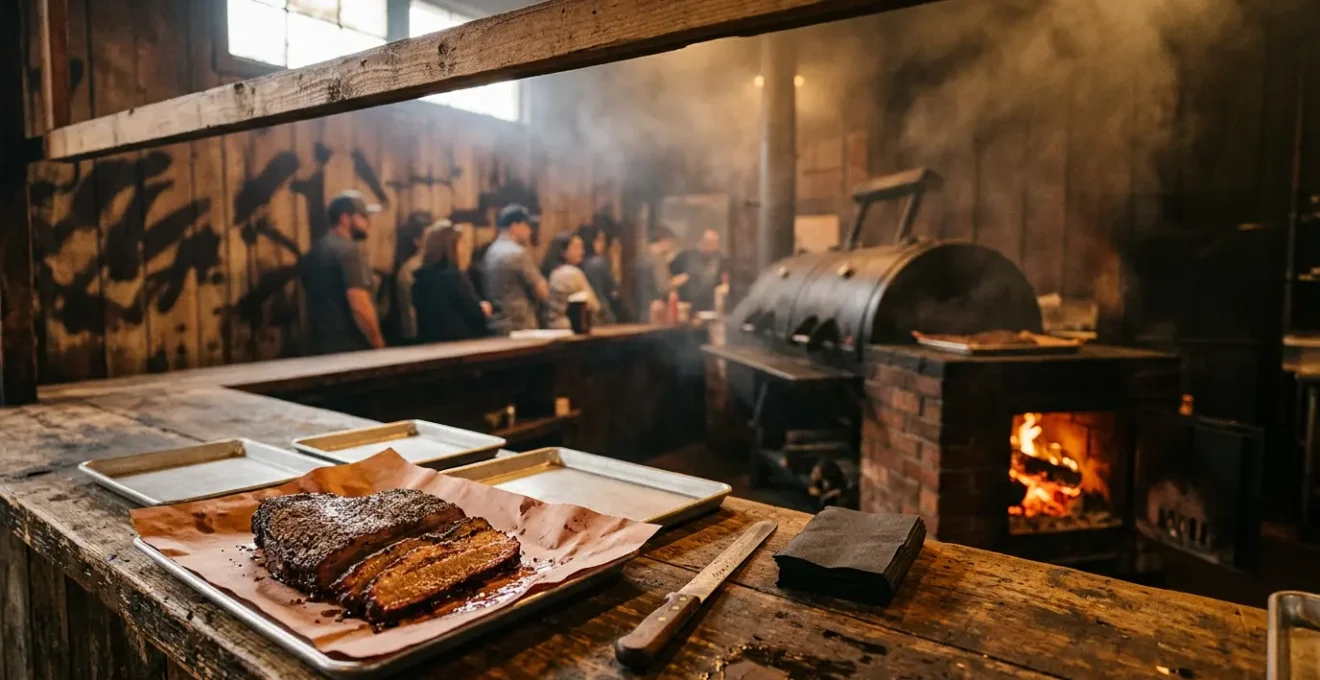
Feeling intimidated by the fast-moving queues and unwritten rules at Texas’s legendary BBQ joints? The secret isn’t learning a complex menu, but understanding the simple cultural ritual. This guide translates the chaos for you, focusing on the ‘why’ behind the ‘what’: order by weight, know your cut (moist or lean), and use the simple sides to complete the experience. You’ll go from anxious tourist to confident regular in one visit.
The first thing that hits you is the smell. Not just smoke, but the rich, intoxicating aroma of post oak and rendering beef fat that hangs in the Texas air for blocks. Then you see it: the line. A patient, almost reverent procession of people who know they’re about to experience something special. For a UK visitor on a BBQ pilgrimage, this moment is a mix of pure excitement and sheer panic. The accents are different, the pace is fast, and the rules are completely unspoken. You’ve heard the legends, but now you’re at the front line, and the fear of getting it wrong is very real.
Most guides will tell you the basics: get there early, order brisket, and know that “a pound” is the unit of currency. But this advice misses the point. It doesn’t explain the *why*. It doesn’t translate the cultural logic that turns a simple meal into a hallowed ritual. Ordering Texas barbecue isn’t a transaction; it’s a conversation with a craft that’s been perfected over generations. The key isn’t to memorize a script, but to understand the rhythm and respect the process. That’s what separates a confused tourist from someone who truly appreciates the art of smoke.
Consider this your personal translator, your guide from a native Texan pitmaster. We’re not just going to tell you what to do; we’re going to explain the method behind the madness. From decoding the sell-out times and navigating the all-important meat counter to understanding why American portion sizes are a feature, not a bug, you’ll learn to walk in, order with confidence, and savour every single bite like you were born and raised in the heart of Texas. Let’s get you ready for the best brisket of your life.
This guide breaks down the entire experience, from arrival strategy to the final bite. To help you navigate this culinary journey, here is what we will cover.
Summary: How to Master the Texas Smokehouse Experience
- Why Famous Brisket Joints Sell Out Before Midday Every Single Weekend?
- The Trimming Mistake That Leaves You Paying £40 for Pure Beef Fat
- Wet Pork Ribs or Dry Beef Rub: Which Classic Texan Style Should You Try First?
- How to Navigate the Chaotic Meat Counter Ordering System Without Delaying the Queue?
- When to Arrive at Legendary Austin Smokehouses to Guarantee Your Brisket?
- When to Arrive at Traditional Texas BBQ Joints to Avoid the Sold-Out Signs?
- Why American Portion Sizes Cause Immediate Digestive Shock for UK Tourists?
- How to Navigate Heavy US Culinary Specialties with Strict Dietary Restrictions?
Why Famous Brisket Joints Sell Out Before Midday Every Single Weekend?
The first rule of Texas BBQ is that it runs out. This isn’t a marketing gimmick; it’s a fundamental consequence of the craft. A true Texas brisket is smoked “low and slow” for 10, 12, or even 18 hours. This means the brisket you’re eating for lunch was put on the smoker yesterday afternoon. Pitmasters are limited by the physical size of their smokers, and once that day’s batch is gone, it’s gone for good. There is no “making more” on the day. Legendary places like Franklin Barbecue are known to sell out of an inventory of over 2,000 pounds of brisket within four hours of opening their doors.
This “sell-out culture” is a sign of authenticity and quality. It proves the meat is fresh and cooked with the time-honoured, time-consuming methods. It creates a system where the reward goes to those who show up. For a visitor, this can be frustrating, but for locals, it’s a respected part of the ritual. The scarcity is what guarantees the quality. If a BBQ joint in Texas has a full menu at 8 PM, it’s often a red flag, suggesting they might be reheating meat or using faster, lower-quality cooking methods.
So, what do you do if you arrive too late and are greeted by the dreaded “Sold Out” sign? Don’t despair. This is where a little local knowledge goes a long way. If you miss out in Austin, for example, remember that the town of Lockhart, the official “Barbecue Capital of Texas,” is a short drive away. There, you’ll find a holy trinity of historic joints—Black’s Barbecue, Kreuz Market, and Smitty’s Market—that serve world-class BBQ with their own unique histories and, often, more manageable queues. Embracing the backup plan is part of the true Texas experience.
The Trimming Mistake That Leaves You Paying £40 for Pure Beef Fat
When you’re at the counter and the meat cutter holds up a glistening, pepper-crusted brisket, you’re looking at a piece of culinary anatomy with two distinct parts: the “point” (or “moist” end) and the “flat” (or “lean” end). The point is marbled with rich, decadent fat, while the flat offers a leaner, more traditional beef flavour. The biggest mistake a newcomer can make is not understanding this distinction and how the fat is trimmed—or isn’t.
This image provides a close-up of the beautiful marbling and texture you should look for in a quality brisket.
A good pitmaster renders most of this fat during the long cooking process, turning it into liquid gold that flavours the meat. However, some large, hard pockets of fat will never render down, no matter how long they’re cooked. According to barbecue master Aaron Franklin’s renowned technique, the key is to trim the fat cap to a ¼-inch thickness and remove those hard fat sections before cooking. If a joint doesn’t trim properly, you can end up paying top price for inedible chunks of pure fat. When you order, asking for “moist” or “lean” tells the cutter which part of the brisket you prefer, giving you control over the fat content of your slice.
Don’t be afraid to specify. Saying “half a pound of moist brisket” is standard language. The cutter will slice it in front of you, and you can see exactly what you’re getting. This transparency is central to the experience. You are not just a customer; you are the final inspector of the pitmaster’s work. Paying attention to the trim is how you ensure every penny of your £40 goes towards perfectly smoked meat, not a lump of unrendered fat.
Wet Pork Ribs or Dry Beef Rub: Which Classic Texan Style Should You Try First?
One of the most confusing things for an outsider is that “Texas BBQ” isn’t one single style. It’s a vast state with regional traditions that are fiercely defended. The sauce-slathered ribs you might have had in the UK are likely inspired by East Texas style, which uses a sweet, tomato-based sauce. But when you’re in Austin or the Central Texas Hill Country, you’re in the land of the dry rub, where beef is king and sauce is, at best, an afterthought.
The philosophy of Central Texas BBQ is one of minimalist perfection. As the MasterClass culinary team explains in their guide, the focus is entirely on the quality of the meat and the smoke. They note, “Central Texas BBQ generally has a very simple dry rub—usually just salt and pepper… The meat is smoked for many hours at low temperatures.” This “dalmatian rub” approach doesn’t hide the flavour of the beef; it amplifies it. The smoke from Post Oak or Pecan wood is the only other ingredient.
To understand the context, this table shows the fundamental differences between the main Texas BBQ styles.
| Style | Meat Focus | Preparation | Sauce |
|---|---|---|---|
| Central Texas | Salt and pepper rub only | Indirect heat from pecan/oak | No sauce tradition |
| East Texas | Meat cooked to ‘falling off the bone’ | Hickory wood, sweet tomato-based sauce | Sweet & tangy |
| South Texas | Thick molasses-like sauces | Barbacoa style, Mexican influence | Molasses-based |
So, which should you try first? When in Central Texas, do as the locals do: start with the brisket or beef ribs. This is the heart of the tradition. You are there to taste the sublime alchemy of just three things: high-quality beef, salt and pepper, and clean oak smoke. Trying to find a “wet” rib in a legendary Austin joint is like going to a single malt distillery in Scotland and asking for a piña colada. You can get pork ribs, and they’ll be delicious, but they will still be seasoned with a dry rub, not a wet sauce. Embrace the local specialty; it’s what you came for.
How to Navigate the Chaotic Meat Counter Ordering System Without Delaying the Queue?
This is the moment of truth. You’ve waited in line, you’re inside, and the air is thick with smoke and anticipation. The line moves fast, and the pressure is on. This isn’t a restaurant with waiters; it’s a direct-to-butcher system. As the celebrated writer Calvin Trillin noted for The New Yorker, in this world, the primary focus is squarely on one thing: “Discussions of Central Texas pit barbecue do not concern the piquancy of the sauces or common side dishes—the main consideration is the quality of the cooking of the meats.” Your ordering should reflect this priority.
The key is to be prepared. Think of the person behind the counter not as a cashier, but as a skilled meat surgeon who is there to assemble your perfect plate. Your job is to give them clear, concise instructions so they can execute with precision. Panic and indecision are what cause delays. Confidence and clarity are your best friends. The entire transaction, from start to finish, can and should take less than a minute.
To help you, here is a step-by-step script. Memorize the sequence, and you’ll order like you’ve been doing it your whole life. It’s the key to unlocking a smooth and successful counter experience.
Your 30-Second BBQ Ordering Plan
- Grab your tray: As you enter, take a cafeteria-style tray. This is your canvas.
- State your weight first: Approach the butcher and state the quantity by weight (e.g., “half-pound,” “one pound,” “quarter-pound”). This is the most important piece of information.
- Specify the meat type: Immediately follow the weight with the meat (e.g., “of brisket,” “of pork ribs,” “of sausage”).
- Refine your cut: Add the specific cut if you have a preference (“moist end,” “lean end,” “from the fatty side”).
- Assemble your sides: After your meat is weighed and on your tray, move down the line. Pick up your complimentary sides: pickles, raw onions, and slices of plain white bread.
A full order sounds like this: “Howdy. I’ll take a half-pound of moist brisket, a half-pound of pork ribs, and one sausage link, please.” It’s that simple. Clear, efficient, and respectful of the craft and the people waiting behind you.
When to Arrive at Legendary Austin Smokehouses to Guarantee Your Brisket?
At the most famous Austin smokehouses, like the world-renowned Franklin Barbecue, the question isn’t “what time should I arrive for lunch?” but “what time should I arrive for the queue?” The answer can be shocking to an outsider. For an 11 a.m. opening, dedicated fans know that lines start forming before dawn. It’s not uncommon to see the first people arrive with camping chairs and coffee flasks as early as 6 or 7 a.m. This isn’t just about food; it’s a social event, a tailgate party for brisket.
This image captures the spirit of the early morning wait, a communal gathering before the doors even open.
For a guaranteed taste of brisket at a top-tier place on a weekend, the rule of thumb is to be in line no later than 8:30 a.m. for an 11 a.m. open. Yes, this means a three-hour wait. Locals come prepared. They bring chairs, coolers with drinks (sometimes even beer), and good company. The wait is part of the experience, a chance to soak in the atmosphere and build anticipation. One pro-tip is to go with a group; it makes the wait more enjoyable and allows you to hold your spot while someone makes a coffee run. As one food blogger noted, wearing comfortable shoes is essential because once the line starts moving, you’ll be on your feet for the rest of the time.
If a three-hour wait sounds like your personal vision of hell, you have options. Arriving on a weekday (most are closed on Mondays) can sometimes cut the wait time in half. Alternatively, aim for a slightly less-hyped but still world-class spot, where a 10 a.m. arrival might be perfectly sufficient. But if your heart is set on the most legendary brisket in town, you have to be willing to pay the price, not just in dollars, but in time.
When to Arrive at Traditional Texas BBQ Joints to Avoid the Sold-Out Signs?
Outside of the hyper-competitive Austin scene, the rules for timing your arrival at traditional Texas BBQ joints become a bit more nuanced. While you might not need to arrive at sunrise, showing up at 1 p.m. is still a risky gamble. The key is to understand the pitmaster’s rhythm. An fascinating piece of insider knowledge is the “overnight rest.” Many top joints in Texas finish cooking their briskets in the evening, let them rest for a few hours, and then place them in a special low-temperature warmer to hold overnight. This long rest is crucial for producing incredibly tender and juicy meat for the lunch service the next day.
This means the best, freshest meat is available right when they open, typically around 10:30 or 11 a.m. A good rule for most traditional, high-quality spots across the state is to plan your arrival for 30 minutes before opening. This gets you a prime spot in line without the multi-hour commitment of the Austin “destination” spots. You’ll likely be eating by 11:15 a.m. and on your way, full and happy, by noon.
You can also become a “smoke detective.” The type and amount of smoke coming from a joint’s chimney can tell you a lot about their schedule and authenticity. Here’s how to read the signals.
Reading the Smoke Signals: An Old-School Guide
Authentic Texas BBQ is cooked with wood, not gas or electricity. Look for a steady stream of thin, bluish smoke, which indicates a clean-burning fire. Heavy, white, billowing smoke is a bad sign. If you see thick, fragrant smoke pouring out around 10 a.m., it’s a great sign they are in the peak of their operation. If you drive by at 11:30 a.m. and see little to no smoke, it could mean they are already winding down and starting to sell out. The most authentic places use specific woods; the distinct, fragrant smoke of mesquite or oak is the signature scent of real Texas BBQ.
By combining the “30 minutes before opening” rule with a quick visual check of the smoke signals, you give yourself the best possible chance of securing a plate of Texas’s finest without sacrificing your entire morning.
Why American Portion Sizes Cause Immediate Digestive Shock for UK Tourists?
Let’s be direct: American portions are big. And in the world of Texas BBQ, where meat is sold by the pound, the potential for over-ordering is immense. A “half-pound” of brisket might not sound like much, but when it’s densely packed, richly marbled meat, it’s a very substantial meal. For a UK tourist used to more modest serving sizes, ordering what seems like a normal amount can lead to a state of “meat shock”—a feeling of being overwhelmingly full before you’re even halfway through your tray.
The system of ordering by weight is actually your friend here. It gives you precise control, but only if you can visualize what you’re asking for. Ordering a “pound of brisket” (454g) is a common move for a couple to share, but for a solo diner, it’s a Herculean task. A half-pound (227g) is the standard single portion for a hearty appetite. If you’re a lighter eater or want to try multiple meats, starting with a quarter-pound (113g) is a much safer bet. You can always go back for more.
This table provides a simple visual guide to help you translate weights into real-world portion sizes and avoid common ordering mistakes.
| Weight | Metric | Visual Reference | Serves |
|---|---|---|---|
| Quarter-pound | 113g | Size of a deck of cards | Light meal for 1 |
| Half-pound | 227g | Standard brisket portion | Full meal for 1 |
| Full pound | 454g | Size of a small book | Sharing portion for 2 |
The best strategy for a group is to order “family style.” Instead of each person getting their own plate, you collectively order a larger amount of various meats—say, a pound of brisket, a pound of ribs, and a few sausage links—and share everything. This allows everyone to sample the full range of what the smokehouse offers without any single person being overwhelmed. This is also where the humble sides—pickles, onions, and white bread—play their crucial role. They aren’t just filler; they are tools to cleanse your palate and cut through the richness, allowing you to eat more comfortably.
Key Takeaways
- It sells out because it’s real: BBQ is a slow craft, and limited smoker space means a finite daily supply. “Sold out” is a sign of quality.
- Order like a pro: State your order clearly and concisely—weight first, then meat, then cut (e.g., “Half-pound of moist brisket”).
- Sides are functional tools: Use the pickles, onions, and white bread to cleanse your palate and cut through the rich fat between bites.
How to Navigate Heavy US Culinary Specialties with Strict Dietary Restrictions?
Navigating a rich, meat-heavy cuisine like Texas BBQ with dietary restrictions might seem like a daunting task. However, the beautiful simplicity of traditional Central Texas style is actually a huge advantage for those with specific needs, particularly for anyone on a gluten-free, keto, or paleo diet. Because the core of the cuisine is just meat, salt, pepper, and wood smoke, it’s naturally free of most common allergens and additives.
The key is to stick to the heart of the Central Texas tradition. As confirmed by multiple sources, the quintessential rub is simply salt and black pepper. This means the star attractions—smoked brisket, beef ribs, and plain sausage—are generally safe. The complimentary sides of pickles, onions, and jalapeños are also typically fine. Your main challenge is avoiding hidden sugars, which are most prevalent in sauces and some commercial rubs.
To stay safe, follow this simple guide:
A Dietary-Friendly BBQ Checklist
- Stick to Central Texas Style: This style, with its simple salt and pepper rub, is your safest bet. It’s naturally gluten-free and low-carb.
- Embrace the Dry Rub: Smoked meats with a visible dry rub are generally safe. Your targets are brisket, beef ribs, and turkey.
- Avoid Sauces and Certain Styles: Steer clear of East Texas style with its sweet, tomato-based sauce, and South Texas style which uses heavy molasses-based sauces. These are full of sugar.
- Beware the Bun: Avoid anything served on a bun, like pulled pork sandwiches, unless you can confirm it is gluten-free.
- Ask the Magic Question: To be absolutely sure, walk up to the counter and ask, “Is your rub just salt and pepper?” This one question will tell you everything you need to know.
By focusing on the pure, unadulterated smoked meats of the Central Texas tradition, you can not only eat safely but also experience the cuisine in its most authentic and celebrated form. The dietary “restrictions” actually guide you directly to the best stuff on the menu.
So get in that line, take a deep breath of that oak smoke, and get ready. You’re not just a tourist anymore; you’re part of the ritual. Now go get your brisket.