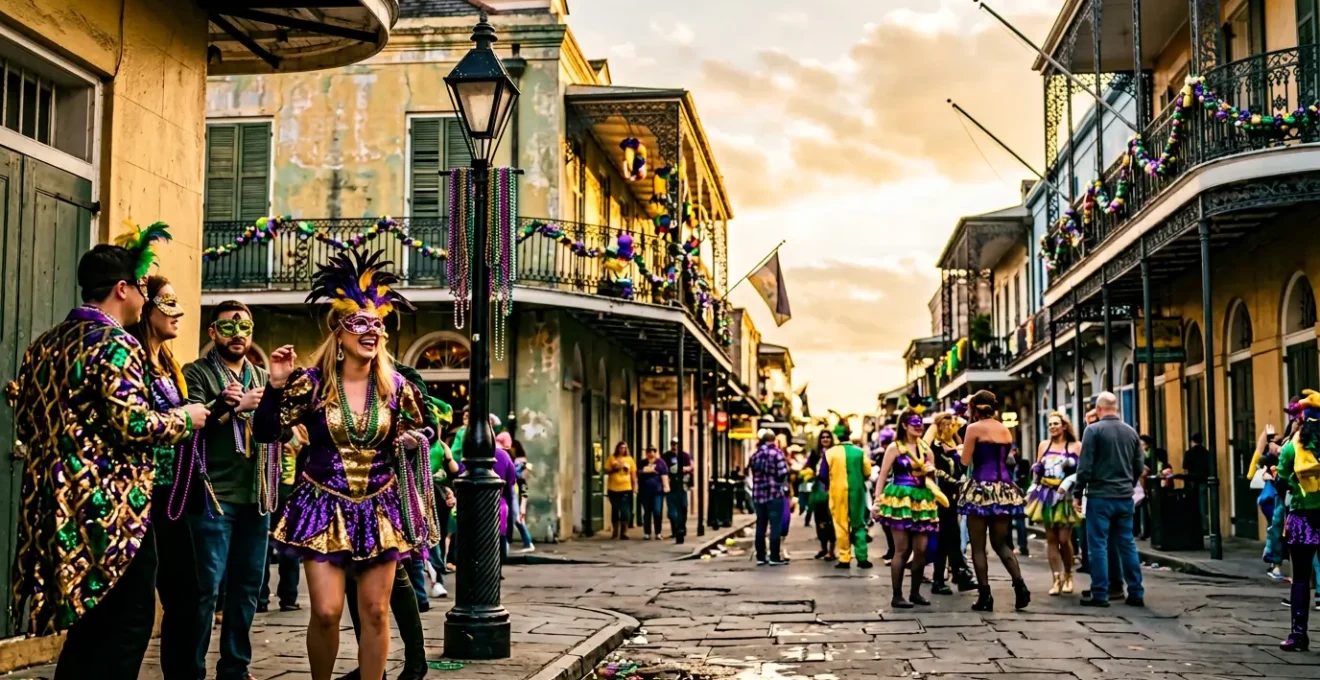
Experiencing an authentic Mardi Gras without getting ripped off is entirely possible, but it requires ditching the tourist mindset and adopting a local’s strategy.
- Swap the overpriced chaos of the French Quarter for the authentic, family-friendly parade routes in Uptown neighborhoods.
- Understand that the most expensive “experiences,” like Bourbon Street balcony parties, often deliver the least value.
- Start planning 9-11 months in advance to secure affordable flights and lodging, avoiding the last-minute price surge.
Recommendation: The key to a brilliant, budget-conscious trip is to consciously trade the crowded tourist funnels for the neighborhood celebrations where the real magic of Carnival happens.
You and your partner picture it now: the soulful sound of a jazz trumpet echoing through the streets, the dazzling spectacle of a parade float drifting by, the electric energy of New Orleans at its peak. But then, another image creeps in: astronomical hotel bills, wallet-draining drinks, and the sinking feeling of being just another tourist caught in an expensive trap. For many British couples, the dream of Mardi Gras is perpetually shadowed by the nightmare of its cost. The common advice you’ll hear is predictable: “book early,” “stay outside the main area,” or “don’t buy beads.” Frankly, that’s not a strategy; it’s a list of compromises.
This guide isn’t about telling you what to give up. It’s about revealing what you stand to gain by thinking differently. The secret to conquering Mardi Gras on a budget isn’t about avoiding the fun; it’s about understanding the “tourist funnels” designed to separate you from your money and learning to navigate the city like someone who lives here. We’ll bypass the generic tips and dive into the mechanics of the biggest budget traps, from lodging and nightlife to transportation and parade-watching. You’ll learn the “why” behind the local strategies, enabling you to make smart choices that lead to a more authentic, enjoyable, and financially sane Carnival experience.
This article will provide a strategic roadmap. We’ll deconstruct the most common financial pitfalls and show you the local-approved alternatives for each. By the end, you’ll have a clear plan to experience the vibrant, soulful heart of Mardi Gras without the financial hangover.
Summary: A Local’s Playbook for an Affordable New Orleans Carnival
- Why Booking French Quarter Hotels Often Ruins Your Ability to Actually Sleep?
- The Bourbon Street Trap That Costs Intoxicated Tourists Hundreds of Dollars
- Uptown Routes or Downtown Parades: Which Offers the Most Authentic Local Experience?
- How to Catch the Best Throws from Floats Without Fighting Aggressive Crowds?
- When to Start Planning Your Next Mardi Gras Trip to Secure Affordable Flights?
- The Unlicensed Taxi Trap That Costs Exhausted British Tourists Over £100
- The Late-Night Subway Mistake That Puts Unwary Tourists in Extreme Danger
- How to Escape Miami International Airport Quickly During Peak Florida Holiday Seasons?
Why Booking French Quarter Hotels Often Ruins Your Ability to Actually Sleep?
The first, and most seductive, mistake is believing you need to stay in the French Quarter to be “in the middle of the action.” The reality is you’ll be in the middle of a 24/7 cacophony that makes actual rest impossible. Beyond the sheer expense, where pricing research shows French Quarter hotels cost at least $296 per night, you’re paying a premium for a sleepless experience. The noise from street revelers, garbage trucks, and emergency sirens is relentless. What seems like a convenient location on a map becomes a sleepless prison, leaving you exhausted for the actual parades you came to see.
A true local strategy involves staying just outside this chaos. Neighborhoods like the Lower Garden District, the Central Business District (CBD), or Uptown offer beautiful, quieter accommodations that are often a short, scenic streetcar ride away from the action. You get to retreat from the madness, enjoy a proper night’s sleep, and experience a more charming side of New Orleans. This is the first step in authenticity arbitrage: trading overpriced, low-quality tourist experiences for high-quality, affordable local ones. To avoid the noise trap even if you choose a hotel near the edge of the Quarter, you must become a proactive investigator before booking.
Your Pre-Booking Noise Assessment Checklist
- Ask directly: ‘Is my room facing the street or an interior courtyard?’ A courtyard room can be a sanctuary.
- Verify the specifics: ‘What floor is the room on and how far is it from elevators and ice machines?’ Higher floors are generally quieter.
- Check the rules: ‘Do you have specific and enforced guest noise policies during the Carnival season?’
- Request visual proof: ‘Can I see photos of the actual room’s view and its location relative to the street?’
- Confirm adjacencies: ‘Is the hotel bar, restaurant, or a public venue directly below or next to my room?’
To truly understand the value of this decision, it’s vital to appreciate how the city’s geography funnels unsuspecting visitors into specific zones. Mastering this geography is the key to unlocking a better trip.
The Bourbon Street Trap That Costs Intoxicated Tourists Hundreds of Dollars
Bourbon Street during Mardi Gras operates as a highly efficient “tourist funnel.” It’s designed to attract visitors with the promise of a wild party and then systematically drain their wallets. The most visible manifestation of this is the “VIP” balcony package. For hundreds of dollars per person, you’re promised an exclusive view, an open bar, and access to private bathrooms. While the bathroom access is a genuine perk, the rest is often a poor value proposition. The “open bar” frequently serves cheap, sugary drinks, the food is mediocre, and your “exclusive” view is shared with dozens of others packed onto a small balcony.
The real cost isn’t just financial; it’s experiential. You’re paying a fortune to be cordoned off from the actual street-level energy of Carnival. Instead of interacting with the crowd and parades, you become a passive observer. Locals know the best party isn’t bought; it’s joined. The vibrant, creative, and genuinely fun parts of Mardi Gras are happening on the streets of the Marigny and Frenchmen Street, where live music spills out of every doorway, and in the family-friendly zones of the Uptown parade routes.
Case Study: The Illusion of VIP Access
An analysis of typical VIP Bourbon Street Balcony packages reveals tickets for locations like 201 Bourbon or above the famous Old Absinthe House. While they advertise an open bar and snacks, the primary “product” is a small piece of real estate overlooking the chaotic street and, crucially, access to a private party-room bathroom. Tourists pay a premium to escape the very crowd they came to see, highlighting how these packages monetize inconvenience rather than providing a superior experience.
This is the core of the Bourbon Street trap: it sells you an expensive, sanitized version of an experience that is free and more authentic just a few blocks away. The key is knowing where to find that authentic experience.
Uptown Routes or Downtown Parades: Which Offers the Most Authentic Local Experience?
The strategic answer to the chaos of the French Quarter and Downtown is to shift your focus Uptown. This is where New Orleans families have gathered for generations to watch the parades. The atmosphere along the historic St. Charles Avenue is completely different: it’s a giant, linear picnic, not a drunken mosh pit. Here, you’ll find more space, a friendlier crowd, and a far more pleasant and authentic Carnival atmosphere. This is the essence of “Parade Route IQ”—choosing your location based on experience, not just proximity to a hotel.
Downtown parades, especially those that skirt the French Quarter, are compressed and intense, attracting a tourist-heavy, party-focused crowd. It’s harder to see, harder to move, and harder to catch anything. The Uptown route, by contrast, is long and sprawling, allowing the crowds to spread out. People set up ladders (a local tradition), bring coolers with their own drinks and food (perfect for a budget), and interact with the float riders in a more relaxed way. This is also where you’ll catch better “throws,” as the major krewes save their best, most unique items for the crowds along the traditional St. Charles route.
The following comparison breaks down the fundamental differences, making the choice clear for anyone seeking an authentic, less stressful experience.
| Aspect | Uptown Route | Downtown/French Quarter |
|---|---|---|
| Crowd Type | Local families, picnic atmosphere | Tourist-heavy, party atmosphere |
| Viewing Space | More spread out along St. Charles | Concentrated, harder to navigate |
| Transportation | Streetcar accessible (when running) | Walking distance from hotels |
| Throw Quality | Krewe-specific, higher quality | Mass-produced, quantity-focused |
| BYOB Culture | Common and accepted | More vendor-focused |
As the New Orleans Tourism Official Guide suggests, a smart strategy combines the best of different worlds, completely avoiding the most congested areas. In their New Orleans Local’s Guide, they offer a perfect game plan:
Start your day on the Uptown route for a classic family-friendly parade like Iris, then transition to the Marigny for the unique walking krewes like ‘tit Rəx or Chewbacchus, completely bypassing the Downtown tourist crush.
– New Orleans Local’s Guide, New Orleans Tourism Official Guide
Once you’ve chosen the right location, the next step is to master the art of actually catching the coveted throws without getting into a scuffle.
How to Catch the Best Throws from Floats Without Fighting Aggressive Crowds?
Many first-timers think that catching throws—the beads, doubloons, and toys thrown from floats—is a matter of luck or brute force. Locals know it’s a science. This is “Throwonomics,” and it’s all about strategic positioning. Fighting the aggressive crowds in the dense tourist zones is a losing game. Instead, you use your knowledge of the parade route to be in the right place at the right time. The key is to find spots where the floats are moving slower or where the riders are just beginning their long journey and are still enthusiastic and fully stocked.
The single best strategy is to position yourself near the beginning of the Uptown route, known as “the box.” This area, roughly from Napoleon Avenue to St. Charles Avenue, is where parades line up. Riders are fresh and have their full supply of the best throws. Another prime spot is immediately after a major turn in the route, as the large floats have to slow down, giving riders more time to spot you and aim. Making eye contact and showing enthusiasm is far more effective than screaming. A simple, friendly sign like “It’s My First Mardi Gras!” or “We’re from the UK!” can create a personal connection and make you a target for the best loot.
Forget the scrum. A little planning and a friendly demeanor will yield a better haul than the most aggressive shoving. The following checklist outlines the professional approach to securing your spot.
Your Strategic Parade Positioning Guide
- Arrive early: For major weekend parades like Endymion or Bacchus, get there at least 4 hours early to claim a front-row spot.
- Position at the start: Set up near Napoleon Avenue at the beginning of the route where float riders have their full, premium stock of throws.
- Target the turns: Find a spot immediately after a major turn where the large floats are forced to slow down, giving you more time to interact.
- Plan your exit: Stand on the ‘river side’ of St. Charles Avenue. It generally provides easier access to cross-streets for a quicker departure after the parade.
- Make it personal: Use friendly, easy-to-read signs (‘It’s My First Mardi Gras!’) to create a direct connection with float riders.
This on-the-ground strategy is vital, but the most important savings are secured long before you even pack your bags.
When to Start Planning Your Next Mardi Gras Trip to Secure Affordable Flights?
If you start thinking about Mardi Gras in January, you’re already too late for an affordable trip. The single biggest factor in keeping costs down is timing your planning. For the best prices on flights and lodging, you need to be booking 9 to 11 months in advance. This might seem extreme, but it’s the local standard. By late summer, flight prices from Europe begin their steady climb, and the best, most reasonably priced hotels and Airbnbs in desirable, quiet neighborhoods are already being reserved. Waiting until autumn or winter means you’ll be left with the most expensive options or accommodations in inconvenient locations.
A savvy traveller’s secret is to target the “Shoulder Weekend”—the weekend *before* Mardi Gras weekend proper. You’ll still get to see some of the biggest and best parades (like Endymion), but the crowds are slightly smaller, and flight and hotel prices are noticeably lower. You get 80% of the peak Mardi Gras experience for a fraction of the cost and stress. Official planning resources confirm the urgency, noting that hotels are solidly booked by December for the main event, leaving only the most exorbitant options for latecomers. This early-bird approach is the ultimate form of authenticity arbitrage.
Case Study: The Early Planner’s Advantage
The key to affordable Mardi Gras planning is to start early. While hotels in prime locations like the French Quarter book up months in advance, those who plan ahead can secure safer, more affordable, and quieter alternatives in charming neighborhoods like the Marigny, the CBD, or Uptown. This simple shift in timing and location is the difference between a stressful, overpriced trip and a relaxed, authentic one.
This long-range planning protects your wallet from the biggest expenses, but you still need to be wary of the smaller, insidious traps that await you on the ground.
The Unlicensed Taxi Trap That Costs Exhausted British Tourists Over £100
After a long flight from the UK, landing at Louis Armstrong New Orleans International Airport (MSY) leaves you tired and disoriented. This is precisely when you’re most vulnerable to the unlicensed taxi trap. As you exit the terminal, you may be approached by individuals offering a “flat rate” ride to your hotel. These are almost always unlicensed drivers who will charge an exorbitant fee, sometimes well over $120 (nearly £100) for a trip that should cost a third of that. They prey on tourists unfamiliar with the official system and desperate to get to their lodging.
The only safe and legal way to get a taxi at the airport is to follow the signs to the official, dedicated taxi stand. There is a clear, supervised queue, and you will be directed to a licensed cab. The fare to the French Quarter or CBD is a fixed flat rate, which is clearly posted. Alternatively, using rideshare apps like Uber or Lyft is also a reliable option, as you lock in your price before you even get in the car. Never, under any circumstances, accept a ride from someone who solicits you inside or outside the terminal building. That simple rule can save you a significant amount of money and ensure your trip starts on the right foot, not with the feeling of being scammed.
This vigilance with transport doesn’t end at the airport; it’s a mindset you must maintain throughout your stay, especially late at night.
The Late-Night Subway Mistake That Puts Unwary Tourists in Extreme Danger
First, a crucial clarification: New Orleans does not have a subway. The “subway mistake” for a tourist here is metaphorically the same: making a false assumption about the late-night public transport system that can leave you stranded and vulnerable. Visitors see the charming St. Charles Streetcar and assume it’s a reliable 24/7 transport option. During Mardi Gras, this is a dangerous mistake. Parade routes shut down streetcar lines for hours, sometimes for the entire day and night. Service becomes infrequent, unpredictable, and eventually stops altogether.
The mistake is finishing a long day of parading Uptown and assuming you can just hop on a streetcar to get back to your hotel at 1 a.m. You will likely find yourself waiting at a dark, deserted stop for a streetcar that will never come. This leaves you in a potentially unsafe situation, forced to either walk long distances through unfamiliar neighborhoods or fall prey to the same unlicensed, price-gouging drivers you avoided at the airport. The local strategy is to plan your exit before you need it. Know the parade schedule and understand when streetcar service will be interrupted. Have a rideshare app ready as your primary backup for late-night travel. Never assume public transport will be there for you after the last parade has passed. Treating the transport system with this level of healthy skepticism is key to staying safe.
All these strategies—avoiding hotel traps, navigating parades, and planning transport—are pieces of a larger puzzle: mastering the art of escaping the crowds and chaos.
Key Takeaways
- Plan Ahead, Win the Game: The most significant savings come from booking flights and lodging 9-11 months in advance, targeting the “shoulder weekend” before Mardi Gras for the best value.
- Location is Everything: Swap the noisy, overpriced French Quarter for the authentic and relaxed atmosphere of Uptown parade routes to experience Mardi Gras like a local.
- Master Your Logistics: Never rely on late-night public transport and only use official taxis or rideshare apps to avoid scams and stay safe.
How to Escape Miami International Airport Quickly During Peak Florida Holiday Seasons?
While this might seem like a lesson for a different city, the challenge of escaping Miami’s airport during a peak holiday is a perfect metaphor for conquering Mardi Gras. Both situations involve navigating a massive, chaotic “goulot d’étranglement”—a bottleneck—where thousands of people are trying to do the same thing at the same time. Successfully navigating Mardi Gras, just like a busy airport, isn’t about moving faster; it’s about moving smarter and avoiding the main flow of traffic entirely.
Think about it: staying in the French Quarter is like booking a hotel inside the airport terminal—convenient on paper, but a nightmare of noise and crowds. Relying on Bourbon Street for entertainment is like only eating at the terminal’s overpriced food court. Waiting to book your trip is like showing up at the airport without a ticket and hoping for a cheap last-minute seat. The strategies in this guide are your “secret security lane” and your “private lounge access” for Mardi Gras. Choosing an Uptown parade route is like taking a lesser-known exit from the airport that bypasses all the traffic. Planning your transport is your pre-booked car service, waiting while everyone else scrambles for a taxi.
The ultimate lesson is that freedom and enjoyment come from preparation and a willingness to deviate from the path of least resistance, which is almost always the most crowded and expensive one. You escape the traps not by fighting through them, but by knowing they exist and charting a course around them from the very beginning.
Now, with this local’s playbook in hand, you are equipped to plan a trip that captures the true, exhilarating spirit of New Orleans’s most famous celebration, creating incredible memories without bankrupting yourself in the process.