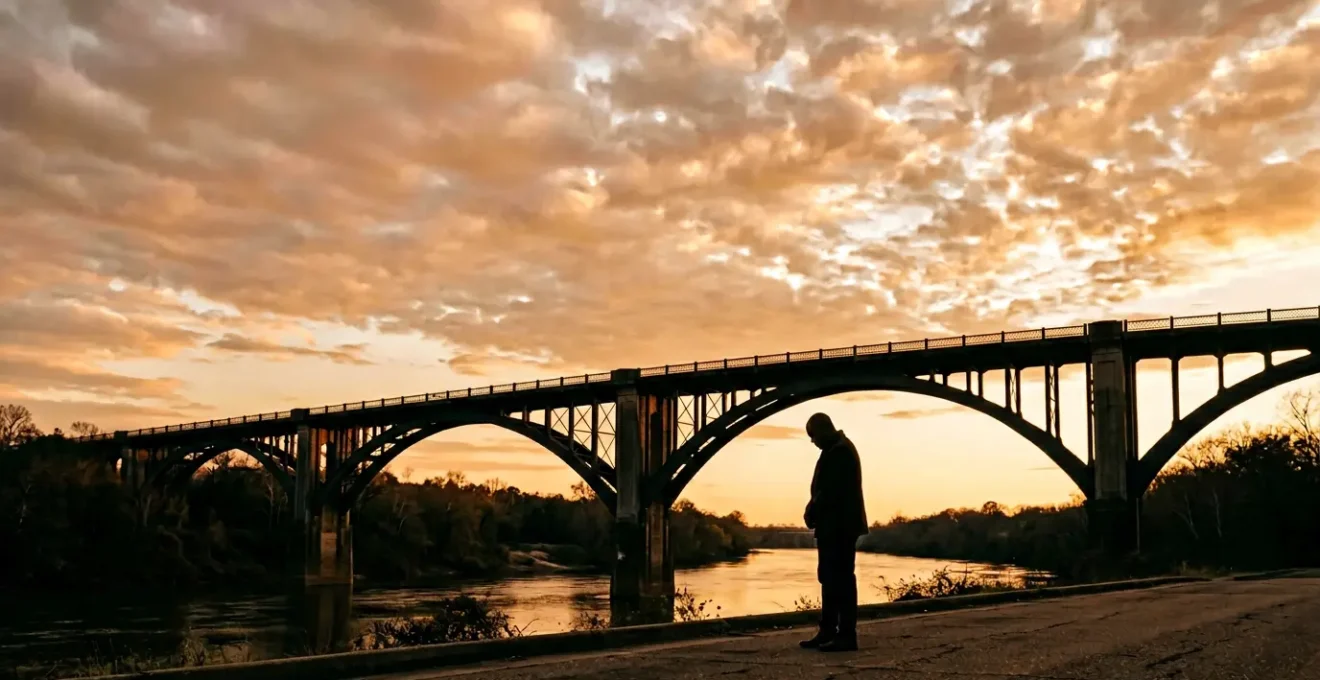
The greatest mistake travellers make on the U.S. Civil Rights Trail is treating it like a holiday; it is a pilgrimage that demands you act as a historical witness, not a tourist.
- Your role is to observe, reflect, and learn, not to consume attractions or centre your experience.
- Planning must prioritise depth over breadth, focusing on thematic narratives rather than geographical checklists.
Recommendation: Reframe your entire approach from “seeing the sights” to understanding the story, which includes where you spend your money and how you manage your own emotional responses.
For the empathetic UK traveller, a journey through the American Deep South to trace the history of the Civil Rights Movement is not a simple vacation. It is a profound undertaking, a modern pilgrimage to the sacred sites of a struggle for justice that reshaped a nation. Yet, many approach these hallowed grounds—churches where bombs were detonated, bridges where blood was spilt—with the same mindset as a trip to Disney World. They collect selfies, tick off museums, and rush from one city to the next, entirely missing the solemnity of the experience.
The standard travel advice to “be respectful” is profoundly inadequate because it fails to define what respect means in this context. It is not just about quiet voices and modest dress. It is a fundamental shift in perspective. The discomfort you may feel is not a sign of a bad holiday; it is an essential part of the process of bearing witness. This journey requires you to engage with the ’emotional labor’ of confronting a brutal history and your place in relation to it. It asks you to de-centre your own experience and instead amplify the voices of the past.
But what if the key to a truly respectful journey was not just in what you see, but in how you see it? This guide abandons the tourist checklist. Instead, it offers a framework for travelling as a ‘historical witness’. We will explore the critical mindset shift required before you even book your flight, dissect the ethics of photography at memorial sites, and provide a structure for planning an itinerary that prioritises depth, narrative, and meaningful solidarity. This is your guide to undertaking the journey with the gravity and reverence it deserves.
To help you navigate this complex and deeply rewarding journey, this article is structured to guide you from the foundational mindset to the practical details of planning. The following sections will provide a clear roadmap for your pilgrimage.
Contents: A Pilgrim’s Roadmap to the Civil Rights Trail
- Why the Civil Rights Trail Demands a Completely Different Mindset to Standard Tourism?
- The Selfies Mistake That Disrespects Sacred American Historical Memorials
- Montgomery or Atlanta: Which City Offers the Most Comprehensive Civil Rights Museums?
- How to Support Local Black-Owned Businesses While Touring the Historic Trail?
- When to Incorporate Emotional Recovery Days into Your Heavy Historical Itinerary?
- Why Trying to See the Entire Smithsonian in One Day Always Fails Miserably?
- Why Ignorance of Local Traditions Quickly Turns Tourists into Unwelcome Targets?
- How to Discover the Authentic and Darker Reality of US Colonial Heritage?
Why the Civil Rights Trail Demands a Completely Different Mindset to Standard Tourism?
The first and most crucial step in planning your journey is a mental one. The U.S. Civil Rights Trail is not a collection of tourist attractions; it is a curated pilgrimage. The official framework invites you to ‘walk in the footsteps of giants’ by visiting the actual churches, schools, and courthouses where history was forged. These are not theme parks. They are sites of profound trauma, resilience, and courage. Approaching them with a consumer mindset—focused on getting the best photo or “doing” a city in a day—is a fundamental misunderstanding of their purpose.
Your role is not that of a tourist, but of a historical witness. This means shifting your objective from entertainment to education, from consumption to reflection. A witness does not seek to be comfortable; they seek to understand. This requires a commitment to ‘historical empathy’—the difficult work of trying to grasp the systemic pressures and impossible choices faced by people in the 1950s and 60s. It involves being prepared to ‘unlearn’ simplified narratives and confront uncomfortable truths about history and your own relationship to it.
Embracing this mindset means you must prioritise depth over breadth. It is far more impactful to deeply understand the significance of a handful of sites in one city than to superficially visit dozens across multiple states. This journey is an internal one as much as it is a physical one. The goal is not to collect experiences but to be transformed by a single, profound story. This requires slowness, humility, and a willingness to listen to the echoes of the past.
This initial reframing of your role from tourist to witness is the foundation upon which every other aspect of a respectful and meaningful journey is built.
The Selfies Mistake That Disrespects Sacred American Historical Memorials
Nowhere is the clash between the tourist and the witness more apparent than in the act of photography. At sites of immense suffering, such as the National Memorial for Peace and Justice in Montgomery, the compulsion to take a smiling selfie is a profound act of disrespect. It centres the visitor’s presence over the historical event and the memory of those who suffered. While photography was a powerful tool for Civil Rights activists to document and disseminate their struggle, modern digital culture often warps this purpose into one of self-validation.
To navigate this, you must practise a form of ‘visual consent of memory’. Before raising your phone, ask a simple question: “Would those who suffered and died here consent to this space being captured and shared in this way?” This ethical check immediately reframes the act. The key is to shift your intention from proving “I was here” to documenting “This is what happened here.” If you choose to photograph, focus on architectural details, interpretive text, or the environmental context. Avoid centring yourself or your companions in the frame.
Even better, consider alternatives to photography for processing your experience. As the image above suggests, engaging in guided journaling, sketching the environment, or making audio notes can be far more powerful ways to internalise what you are witnessing. The goal is to create a personal record for reflection, not a public performance of your visit. When sharing on social media, your priority should be to write educational captions that honour the site’s history and amplify the voices of the movement, rather than detailing your personal emotional journey.
By consciously choosing how you document your journey, you transform a potentially extractive act into one of genuine remembrance and education.
Montgomery or Atlanta: Which City Offers the Most Comprehensive Civil Rights Museums?
A common planning question for UK travellers with limited time is whether to focus on Montgomery, Alabama, or Atlanta, Georgia. Posing it as a competition misses the point. The two cities are not rivals; they are complementary chapters in the same book, and understanding their distinct narratives is key to a powerful itinerary. Approaching them with a “which is better” mindset is a tourist’s question. A witness asks, “What does each city teach me?”
As the following comparison shows, Montgomery provides the ‘thesis’ of the struggle, while Atlanta details the ‘response’. Montgomery is where you go to understand the ‘why’—the profound depth of racial injustice from slavery to mass incarceration. Atlanta is where you learn the ‘how’—the organisation, leadership, and philosophical core of the movement that rose to fight that injustice. For this reason, if you can, start in Montgomery to grasp the scale of the problem before learning about the architecture of the resistance in Atlanta.
| Aspect | Montgomery | Atlanta |
|---|---|---|
| Primary Narrative | The ‘Thesis’ – Understanding the unbroken line from slavery through lynching to mass incarceration | The ‘Response’ – Organisation, leadership, and philosophical core of the movement |
| Key Sites | Legacy Museum, National Memorial for Peace and Justice, Rosa Parks Museum | MLK Jr. National Historical Park, National Center for Civil and Human Rights |
| Focus | The ‘Why’ – Depth of racial injustice | The ‘How’ – Architecture of resistance |
| Recommended Visit Order | Start here to grasp the profound depth of the problem | Visit second to understand the organised response |
If time is extremely limited, focusing on Montgomery offers an incredibly concentrated and powerful narrative arc. The city provides direct access to the Rosa Parks Museum, the Freedom Rides Museum, and the staggering Legacy Museum and National Memorial for Peace and Justice. This density allows for a much deeper engagement than trying to rush between geographically dispersed sites. Choosing one city and exploring it thoroughly is always better than a surface-level tour of two.
Ultimately, the choice is not about which city is ‘better’, but about which part of the story you are prepared to witness most deeply in the time you have.
How to Support Local Black-Owned Businesses While Touring the Historic Trail?
A truly respectful journey on the Civil Rights Trail extends beyond historical sites and into the economic fabric of the present day. Choosing to spend your money at Black-owned businesses is not a token gesture; it is an act of economic solidarity. It directly addresses the systemic economic disenfranchisement that was both a cause and a consequence of the Jim Crow era. The historical struggle for civil rights is inextricably linked to the struggle for economic justice, a battle that continues today.
The numbers are stark. In a city like Atlanta, the cradle of the Civil Rights Movement, there is a staggering disparity where the average white-owned business is valued at more than 11 times that of its Black-owned counterpart. Your travel budget, when spent consciously, can be a small but meaningful tool to help counter this imbalance. This means being intentional about where you eat, where you shop, and what tours you take. It requires moving beyond the convenient chain restaurants and souvenir shops that often dominate tourist areas.
Finding these businesses is easier than ever. Proactively use specialised apps like EatOkra and Black Owned Everything to locate restaurants, bookstores, and galleries. Prioritise historic establishments like Paschal’s or Busy Bee Café in Atlanta, which once served as unofficial headquarters for movement leaders. Instead of a generic bus tour, book a local, Black-owned tour company to gain a personal and deeply-informed perspective. As an inspiring model, look to organisations like Atlanta’s Russell Innovation Center for Black Entrepreneurs, a hub dedicated to fostering the next generation of Black business leaders, built on the legacy of a man who used his own wealth to help finance the movement.
This practice transforms your spending from a simple transaction into a purposeful investment in the communities whose history you are there to honour.
When to Incorporate Emotional Recovery Days into Your Heavy Historical Itinerary?
The Civil Rights Trail is not an emotionally neutral experience. Sites like the Legacy Museum, which viscerally connect the history of slavery to modern mass incarceration, are designed to be unsettling. They are heavy, challenging, and can be psychologically draining. A common mistake is to pack your itinerary too tightly, moving from one traumatic site to the next without allowing time to process. This leads to emotional burnout and an inability to fully absorb the significance of what you are seeing. You must schedule emotional recovery days.
These are not “days off” in the traditional holiday sense. They are an essential part of the ’emotional labor’ required of a historical witness. Plan a full, quiet day after visiting a particularly intense site. For example, after spending a day at Montgomery’s Legacy Museum and National Memorial for Peace and Justice, do not plan to travel or visit another museum the next day. A recovery day is for quiet reflection, processing, and decompression. Feeling overwhelmed, sad, or angry is a natural and appropriate response; give yourself the space and permission to feel it without guilt.
What you do on these days is just as important as scheduling them. Avoid high-stimulation activities. Instead, seek out quiet, restorative environments. Spend time in nature at a local park or botanical garden. Visit an art museum to process emotions through a different creative lens. Listen to the music that powered the movement—gospel, blues, and folk. The goal is to find a peaceful space that allows your mind and spirit to absorb the weight of the history you have just witnessed. Without these pauses, the journey becomes a blur of pain rather than a sequence of profound lessons.
By respecting your own emotional limits, you ensure you can remain present and open to the difficult truths the trail has to teach you.
Why Trying to See the Entire Smithsonian in One Day Always Fails Miserably?
To understand how to approach the vast geography of the Civil Rights Trail, consider a powerful analogy: trying to see the entire Smithsonian in a single day. The Smithsonian’s National Museum of African American History and Culture in Washington, D.C. alone contains 37,000 objects in a vast exhibition space. Visitors know that a “completionist” approach is impossible; to get anything meaningful from it, you must choose one or two exhibits to explore deeply. The Civil Rights Trail, which spans 15 states, must be treated the same way.
The urge to tick off every major city—Selma, Birmingham, Montgomery, Atlanta—in one trip is a tourist’s impulse. It prioritises a checklist over comprehension. This approach inevitably fails, leading to exhaustion, superficial understanding, and a journey that feels more like a frantic road rally than a solemn pilgrimage. The sheer scale of the history means you cannot “do it all.” Trying to do so is a recipe for missing everything that truly matters.
The solution is to adopt a ‘curatorial approach’ to your itinerary planning. Instead of connecting dots on a map, create a thematic narrative. You could, for example, focus your entire trip on the theme of ‘Voting Rights’, travelling from Selma’s Edmund Pettus Bridge to landmarks related to voter registration drives. Or you could build an itinerary around ‘The Role of Youth in the Movement’. This approach provides a coherent thread that connects the sites and transforms your journey into a focused, in-depth study. Limit yourself to a maximum of two or three meaningful sites per day, and build in at least 30-60 minutes after each one for quiet reflection before moving on.
By curating your own focused narrative, you trade a meaningless checklist for a journey of genuine and lasting understanding.
Why Ignorance of Local Traditions Quickly Turns Tourists into Unwelcome Targets?
Travelling through the Deep South as a UK visitor requires a keen awareness of the cultural landscape. It is a region of profound hospitality but also of complex social codes and what is known as ‘dual memory’. A courthouse or town square may be a point of civic pride for one part of the community and a site of historical terror for another. As Alabama’s Tourism Director, Lee Sentell, noted, for a long time, the places where significant Civil Rights history occurred were “ignored or otherwise unappreciated” by mainstream local authorities. Understanding this divided landscape is key to navigating it respectfully.
Your behaviour, dress, and demeanour are constantly being read. The guiding principle should be, as author Stuart M. Matlins advises, to “Be quiet, be humble and be respectful.” This is not a place for loud, boisterous tourism. When visiting active places of worship, such as the 16th Street Baptist Church in Birmingham, you are entering a sacred space, not just a historical marker. Dress modestly (smart casual is a good rule), silence your phone, and be aware of whether a service is in progress. Your respectfulness is a signal that you are a witness, not an intruder.
This humility extends to your interactions. This is a region where politeness and pleasantries are part of the social fabric. Engage with people, listen more than you speak, and be genuinely curious. However, avoid treating local people, particularly African Americans, as historical exhibits. Do not press them for personal stories of racism or trauma. Your education should come from the museums, memorials, and designated interpretive centres, not from imposing an emotional burden on the people you meet.
By acting with quiet reverence and cultural sensitivity, you honour the living community as well as the historical one.
To Retain
- Your role is not of a tourist seeking entertainment, but of a historical witness seeking understanding.
- Planning must be thematic and prioritise depth in one or two locations over a superficial, multi-state checklist.
- A respectful journey involves conscious choices: how you behave, where you spend money, and how you manage your own emotional responses.
How to Discover the Authentic and Darker Reality of US Colonial Heritage?
To truly honour the legacy of the Civil Rights Movement, a witness must go deeper than the 1950s and 60s. The most profound journey connects the struggle for civil rights to its roots in over 250 years of slavery. The movement did not happen in a vacuum; it was a direct response to a system of racial terror that began with the first slave ships. To discover the ‘authentic’ reality of this history is to understand this unbroken line.
This means seeking out the grassroots of the movement. As journalist Charles E. Cobb Jr., a former SNCC field secretary, highlights, the real story is found not only with the famous leaders but with the “local people whose seemingly small contributions made an impact.” It also means creating a ‘continuum itinerary’—a travel plan that deliberately and explicitly links the colonial heritage of slavery to the 20th-century fight for freedom. This provides the ultimate narrative framework for your journey.
Creating such an itinerary is the final step in becoming a true historical witness. It is a commitment to understanding the full, unvarnished story of America’s racial history. The following plan provides a template for how to structure such a journey.
Action Plan: Creating a ‘Continuum Itinerary’
- Start at Slavery Sites: Begin your journey not in Montgomery, but in a port city like Charleston or New Orleans. Visit former plantations and slave markets to witness the origin of the system.
- Research the ‘Archaeology of Struggle’: Before visiting a site like Selma’s Edmund Pettus Bridge, research the history of voter suppression in that county from the 1870s onwards to understand the deep context.
- Connect to Reconstruction Failures: Frame the 1960s movement as the ‘Second Reconstruction’, a response to the political betrayals that followed the American Civil War.
- Visit the Freedom Monument Sculpture Park: In Montgomery, visit this new site which honours the 10 million enslaved people and the specific economic system they were forced to build.
- End at Contemporary Justice Sites: Conclude your journey at the Legacy Museum to understand how the historical struggles against slavery and Jim Crow connect directly to current issues of mass incarceration.
By committing to this continuum, your journey transforms from a trip into a profound educational experience, one that will change how you see not only the American South, but the very nature of history itself.