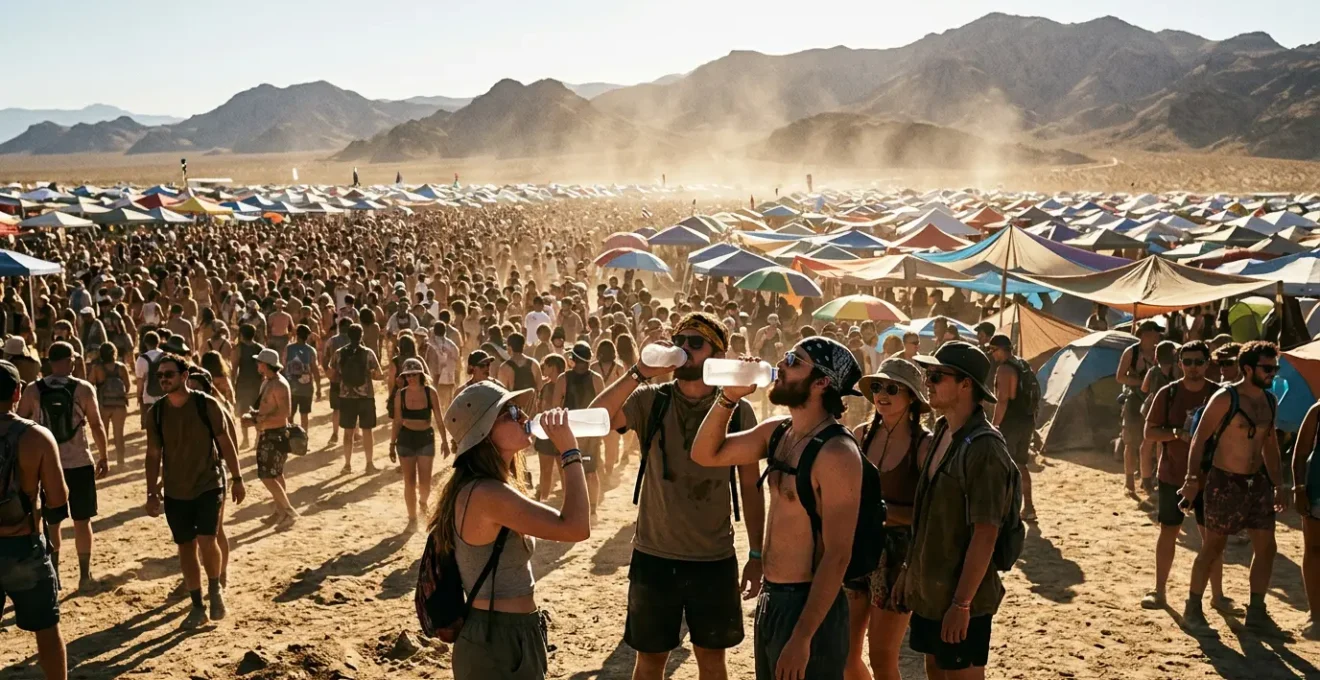
Your British festival experience is a liability in the American desert; survival hinges on unlearning habits built for mud and rain.
- Brutal desert heat makes traditional camping dangerous and requires a complete rethink of hydration and clothing strategies.
- Strict US security protocols and dynamic pricing for accommodation demand meticulous ‘survival logistics’ planned months in advance.
Recommendation: Prioritise an endurance mindset. Treat the festival like a marathon, not a sprint, focusing on heat acclimatization, resource management, and recognizing early signs of heatstroke.
If your festival experience was forged in the muddy fields of Glastonbury or the temperate chaos of Reading, congratulations. You’ve mastered survival in one climate. But be warned: those skills are not just irrelevant at a massive American festival like Coachella or Lollapalooza—they are actively dangerous. You are prepared for rain, but not for relentless, oppressive heat. You are used to a certain scale, but not the sprawling, concrete-and-dust landscapes that can feel like a different planet. The common advice to “stay hydrated” and “wear sunscreen” is woefully inadequate for what you’re about to face.
The challenge isn’t the music or the crowds; it’s a fundamental environmental and logistical ‘system shock’. The real test lies in managing resources—your energy, your money, your access to water and shade—in a high-stakes environment where a simple mistake can lead to severe heat exhaustion. This isn’t about partying; it’s about endurance. The key to not just surviving, but actually enjoying a US desert festival is to abandon your British instincts and adopt a new framework built around heat management, strategic planning, and a deep respect for the desert.
This guide will deconstruct the common failure points for UK visitors. We will explore why your camping gear is wrong, how your hydration pack can get you into trouble, and what choices—from tickets to t-shirts—will dictate whether you spend your time at the medical tent or the main stage. It’s time to prepare for the real headliner: the heat.
Contents: Surviving the Unforgiving Climate of American Music Festivals
- Why British Festival Camping Tactics Fail Completely in the Californian Desert?
- The Hydration Pack Mistake That Gets Your Water Confiscated at American Security
- VIP Passes or General Admission: Which Ticket Actually Survives the Brutal US Crowds?
- How to Smuggle Legal Essential Medications Past Strict American Festival Security?
- When to Book Your Festival Accommodation to Avoid the 300% Price Surge?
- The Cotton T-Shirt Mistake That Leads to Severe Heat Rash on Theme Park Days
- How to Recognize the Subtle Early Warning Signs of Heatstroke in Your Travel Companions?
- How to Survive Hiking in Arid Arizona Deserts Without Suffering Severe Dehydration?
Why British Festival Camping Tactics Fail Completely in the Californian Desert?
The romantic notion of “camping at the festival” is one of the first and most dangerous mistakes a UK visitor can make. At a British festival, your tent is a refuge from rain and cold. In the Californian desert, it becomes a convection oven by 7 a.m. The core problem is the environment: while UK festivals contend with mud and damp, US desert festivals present a dry, punishing heat where temperatures at desert festivals regularly exceed 100°F (38°C). Your waterproof, warmth-trapping tent is designed for the exact opposite conditions.
This environmental mismatch leads to a cascade of survival failures. Sleep becomes impossible past sunrise, leading to rapid exhaustion. As one first-timer noted after a disastrous camping attempt, the “experience” quickly devolves into being a “sleep-deprived zombie with a sunburn” by day two, thanks to the lack of A/C and the greenhouse effect of the tent. This isn’t just uncomfortable; it’s a critical depletion of the physical resources you need to endure the day.
Furthermore, the infrastructure of US festival camping is different. The scale is immense, and amenities like showers can be distant and of questionable hygiene under heavy use. Unlike the communal, often-damp atmosphere of a UK campsite, a desert campsite is a battle for shade and a race against the sun. Your British camping tactics, honed for keeping warm and dry, will leave you exposed, exhausted, and dangerously unprepared for the heat-centric survival logistics required.
The Hydration Pack Mistake That Gets Your Water Confiscated at American Security
Staying hydrated is the most repeated piece of advice for a reason, but the logistics of *how* you carry your water are fraught with peril at US festivals. Many attendees, veterans and newcomers alike, make a critical mistake at the security gate with their hydration packs. Unlike the more relaxed checks at some UK events, American festival security is notoriously strict. They will not allow you to enter with a hydration pack or any bottle that contains liquid. It must be completely empty.
Arriving with a full bladder of water, thinking you’re being prepared, will result in security forcing you to empty it on the ground before you can enter. This is a crucial waste of time and a psychological blow before you’ve even started your day. The correct strategy involves bringing your hydration pack or collapsible bottle in empty and immediately heading to one of the free water refill stations located inside the grounds. This is a non-negotiable part of the entry ritual. You must factor this step into your survival logistics for the day.
The sheer volume of water you’ll need is also frequently underestimated. In the dry desert heat, your body loses moisture not just through sweat, but also through every breath. Many seasoned festival-goers report drinking three liters of water through the first couple of sets alone, often without even needing a bathroom break. This indicates how rapidly your body is processing fluids. A single bottle of water is not enough; a high-capacity, empty hydration pack is your most vital piece of equipment.
VIP Passes or General Admission: Which Ticket Actually Survives the Brutal US Crowds?
At many UK festivals, a VIP pass is a luxury. At a massive US desert festival, it can be a genuine survival tool. The decision between General Admission (GA) and VIP is less about status and more about a cost-benefit analysis of your physical endurance. The primary advantage of VIP isn’t just better viewing angles; it’s access to resources that mitigate the harshest elements of the festival: shade and water.
GA ticket holders are in a constant state of competition for the limited slivers of shade cast by art installations or vendor tents. Lines for water refill stations and bathrooms can be punishingly long under the midday sun. A VIP pass, while expensive, buys you out of this resource scarcity. It grants access to dedicated, less-crowded areas with ample shade, exclusive water stations, and cleaner, more accessible bathrooms. As the Festival Survival Guide notes, this access fundamentally changes the experience: a VIP pass “gives you access to different dining locations where you won’t be eaten alive by a crowd and you’ll get to stand in the VIP section for every show.”
This pass will make your experience a lot easier, more comfortable and way more fun. It gives you access to different dining locations where you won’t be eaten alive by a crowd and you’ll get to stand in the VIP section for every show.
– Festival Survival Guide, Coachella Festival Guide
This table, based on an analysis of festival amenities, starkly illustrates the difference in resource access. For a visitor not yet acclimatized to the heat, spending hours in line or searching for shade can be the tipping point into heat exhaustion.
| Feature | VIP Pass | General Admission |
|---|---|---|
| Shade Access | Dedicated covered areas | Limited, must find own |
| Water Stations | Exclusive, shorter lines | Shared, long waits |
| Bathrooms | Less crowded, cleaner | Porta-potties, long lines |
| Viewing Areas | Front section access | Must arrive early for good spots |
| Cost (Coachella 2025) | $1,399 | $649-779 |
How to Smuggle Legal Essential Medications Past Strict American Festival Security?
For anyone with medical needs, navigating the fortress-like security of a major US festival can be a source of immense anxiety. The goal isn’t to “smuggle” anything, but to achieve legal and transparent compliance in a way that avoids suspicion and delay. American festival security operates with a level of scrutiny that can feel alien to UK festival-goers. Waving a random pill box at a guard will, at best, lead to long questioning and, at worst, confiscation.
The key is meticulous preparation and documentation. All prescription medications must be in their original pharmacy bottles with the label intact. The name on the label must match your government-issued photo ID. For an extra layer of security, obtaining a doctor’s note that explains the medical necessity for each item is highly recommended. Over-the-counter medications should also be kept in their original, sealed packaging to prove they haven’t been tampered with. This level of organization signals that you are prepared and have nothing to hide.
Many festivals have dedicated Accessibility or Medical Needs entrances. These are staffed by personnel who are better trained to handle medical issues with discretion and understanding. Contacting the festival’s accessibility services department weeks in advance, especially for liquid medications or items requiring refrigeration, is a crucial step in your planning. They can provide official guidance and pre-approve your items, giving you peace of mind.
Action Plan: Festival Medication Compliance
- Documentation Check: Ensure all prescriptions are in original bottles with labels perfectly matching your photo ID. Secure a doctor’s note for added proof.
- Packaging Integrity: Keep all over-the-counter pills, liquids, and creams in their original, factory-sealed packaging. Do not combine items into smaller containers.
- Advanced Communication: Weeks before the event, contact the festival’s accessibility department to pre-register any complex or liquid medications.
- Dedicated Entry: On the day, locate and use the designated ‘medical needs’ or ‘accessibility’ entrance for a smoother and more professional screening process.
- Declare Everything: Proactively inform the security staff at the accessibility entrance about your medical items. Transparency is your best tool.
When to Book Your Festival Accommodation to Avoid the 300% Price Surge?
The financial aspect of attending a US destination festival is another area of potential ‘system shock’. The single biggest budget-destroyer is accommodation. Unlike many UK festivals where camping is the default, a huge number of attendees at desert festivals opt for hotels or Airbnbs to recover in air-conditioned comfort. This creates immense demand, and the local hospitality market reacts with aggressive surge pricing.
The timeline for booking is far earlier than you might expect. Experienced attendees understand that the moment a festival’s dates are announced—often months before the lineup is even revealed—the race for reasonably priced rooms begins. Waiting for your favourite artist to be confirmed is a rookie mistake that can cost you hundreds, if not thousands, of dollars. As travel guides consistently warn, festival accommodation sees hotels drastically increase prices and they book up extremely early.
Booking your hotel or rental a full six to nine months in advance is not overkill; it is standard practice. This is the core of your off-site survival logistics. As one booking guide advises, securing rooms months ahead is essential to avoid the inevitable surge pricing that follows the official lineup announcement. This strategy requires a leap of faith but protects you from the 300% or higher price increases that are common in the weeks leading up to the event. The alternative, on-site camping, is also a limited resource, with passes often selling out within minutes of going on sale.
The Cotton T-Shirt Mistake That Leads to Severe Heat Rash on Theme Park Days
Your choice of clothing can be the difference between comfort and misery. One of the most common and damaging mistakes is wearing a standard cotton t-shirt. While cotton is often touted as “breathable,” in extreme dry heat it becomes a liability. When you sweat in a climate where summer temperatures in desert regions can soar above 115°F (46°C), a cotton shirt absorbs the moisture, clings to your skin, and fails to dry. This creates the perfect environment for friction and clogged pores, leading to painful and debilitating heat rash (miliaria).
This isn’t just a minor inconvenience. A severe case of heat rash can feel like thousands of tiny needles pricking your skin, making every movement agony and forcing you to retreat from the festival. The belief that any “natural fiber” is good is a dangerous oversimplification. While very light, loose, and flowy cotton or linen can be acceptable, the best choices are modern synthetic, moisture-wicking fabrics. These materials are designed to pull sweat away from your body and allow it to evaporate quickly, keeping your skin dry and cool.
Your clothing strategy should prioritize the following:
- Material: Opt for lightweight, moisture-wicking synthetics (like polyester or nylon blends) or extremely light, loose-fitting linen. Avoid standard-weight cotton.
- Color: Wear light colors that reflect sunlight rather than absorbing it.
- Fit: Choose loose, flowy garments that allow air to circulate against your skin.
- Protection: A wide-brimmed hat and UV-protective sunglasses are not accessories; they are essential equipment.
Evenings can bring a surprising chill to the desert, so having a light jacket or cardigan is wise, but your primary daytime outfit must be engineered for heat dissipation.
How to Recognize the Subtle Early Warning Signs of Heatstroke in Your Travel Companions?
In the exhilarating chaos of a festival, it’s easy to get tunnel vision and focus only on your own experience. However, adopting an endurance mindset means being vigilant for your entire group. Heatstroke doesn’t always announce itself dramatically; its onset is often subtle. Your ability to recognize the early warning signs in your friends could be life-saving. With some major US festivals report over 1,000 medical visits yearly, many of which are heat-related, this is not a theoretical risk.
The transition from heat exhaustion to the more severe heatstroke can be rapid. You need to watch for behavioral and physical changes that are out of character. Early warning signs of heat exhaustion include:
- Dizziness or light-headedness
- A throbbing headache
- Nausea or a sudden loss of appetite
- Uncharacteristic irritability or confusion
- Excessive sweating, or more alarmingly, a sudden stop in sweating accompanied by hot, dry skin
As one attendee recounted after their friend collapsed from what turned out to be heat exhaustion, paying attention is key: “Watch out for signs of heat exhaustion, like dizziness or headaches.” If a friend who is usually energetic suddenly becomes quiet and withdrawn, or complains of a headache, do not ignore it. This is a red flag.
If you suspect someone is suffering from heat exhaustion, act immediately. Your response should be swift and decisive: get them out of the sun and into a shaded or, ideally, air-conditioned area. The medical tents are staffed by professionals and are the best place to go. Give them water to sip slowly and apply cool cloths to their skin if possible. Do not dismiss their symptoms as simply being tired or drunk. In the desert heat, every sign of distress must be taken seriously.
Key Takeaways
- UK vs. US Realities: Your experience with temperate, muddy festivals is poor preparation for the extreme heat, scale, and strict security of American desert events.
- Logistics are Survival: Success is determined by pre-festival planning, including booking accommodation 6-9 months early and understanding hydration pack rules.
- Mindset is Everything: Adopt an endurance athlete’s approach. Prioritise heat acclimatization, resource management (shade, water), and group vigilance over non-stop partying.
How to Survive Hiking in Arid Arizona Deserts Without Suffering Severe Dehydration?
While you may not be “hiking” in the traditional sense, traversing a massive, sun-baked festival ground for three days is physically analogous to a multi-day desert trek. The principles of survival are identical. The most important lesson desert hikers learn is that hydration is not something you do when you’re thirsty; it’s a constant process that begins long before you set out. If you feel active thirst, you are already dehydrated. Your body needs time to absorb water, so you must sip continuously throughout the day.
An expert rule for desert hikers is a perfect metaphor for festival survival: once half of your water supply is gone, it’s time to turn around and head back to the source. For a festival-goer, this means when your hydration pack is half-empty, your immediate priority is to locate the nearest refill station. Don’t wait until it’s empty. This disciplined approach to resource management prevents you from ever entering a danger zone. It’s also crucial to supplement water with electrolytes. You lose vital salts through sweat, so carrying salty snacks like nuts or jerky, or adding electrolyte powders to your water, is essential for maintaining your body’s balance.
Finally, respect the environment’s power. Your body can take nearly two weeks to fully acclimate to high heat. Flying in from a cool British spring and immediately plunging into a 40°C environment is a profound shock to your system. The first day should be taken at a slower pace to allow your body a chance to adjust. This isn’t about weakness; it’s a strategic approach to long-term endurance. As the Coachella Valley Conservation Commission states with chilling clarity:
Hiking in the extreme heat of a Coachella Valley summer can be deadly.
– Coachella Valley Conservation Commission, Desert Safety Guidelines
To put these strategies into practice, your next step should be to build a detailed, personalized checklist covering your accommodation plan, packing list, and day-of survival logistics, starting today.
Frequently Asked Questions About Surviving US Music Festivals
Should I camp or book a hotel for desert festivals?
While camping is part of the classic festival image, for a desert festival, a hotel is strongly recommended if your budget allows. The ability to recover in air-conditioning is a significant survival advantage. If you want to look and feel good throughout the event, exploring accommodation guides for hotels, apartments, or even RVs with generators is the best path. The most desirable options provide access to official festival shuttle services.
When do on-site camping passes sell out?
Extremely quickly. On-site camping passes, which typically provide a small plot of land for one car and a tent, are in very high demand. They often sell out within minutes or hours of the main ticket release. If camping is your only option, you must be prepared to book the second they become available.
What are the accommodation alternatives?
Beyond hotels and on-site camping, there are several other options. Renting an Airbnb is popular, but subject to the same surge pricing as hotels. RV camping, either on-site or at nearby resorts, offers the benefit of your own private space and A/C if you have a generator. Finally, some third-party companies run off-site camping areas that may offer more amenities or a different atmosphere, often connected to the festival by shuttles.