In summary:
- Your UK-based instincts about weather are dangerously wrong for the Arizona desert; they must be unlearned.
- Never ration water. You need a minimum of one gallon (3.8 litres) per person, per day, just to exist. Drink before you feel thirsty.
- The midday sun is lethal. All hiking and strenuous activity must cease between 10 a.m. and 4 p.m., without exception.
- Cotton clothing is a death trap. It holds sweat and prevents cooling. Use synthetics or merino wool.
- Your car’s air conditioning is a single point of failure. A breakdown can become a fatal situation within minutes. Prepare a vehicle survival kit.
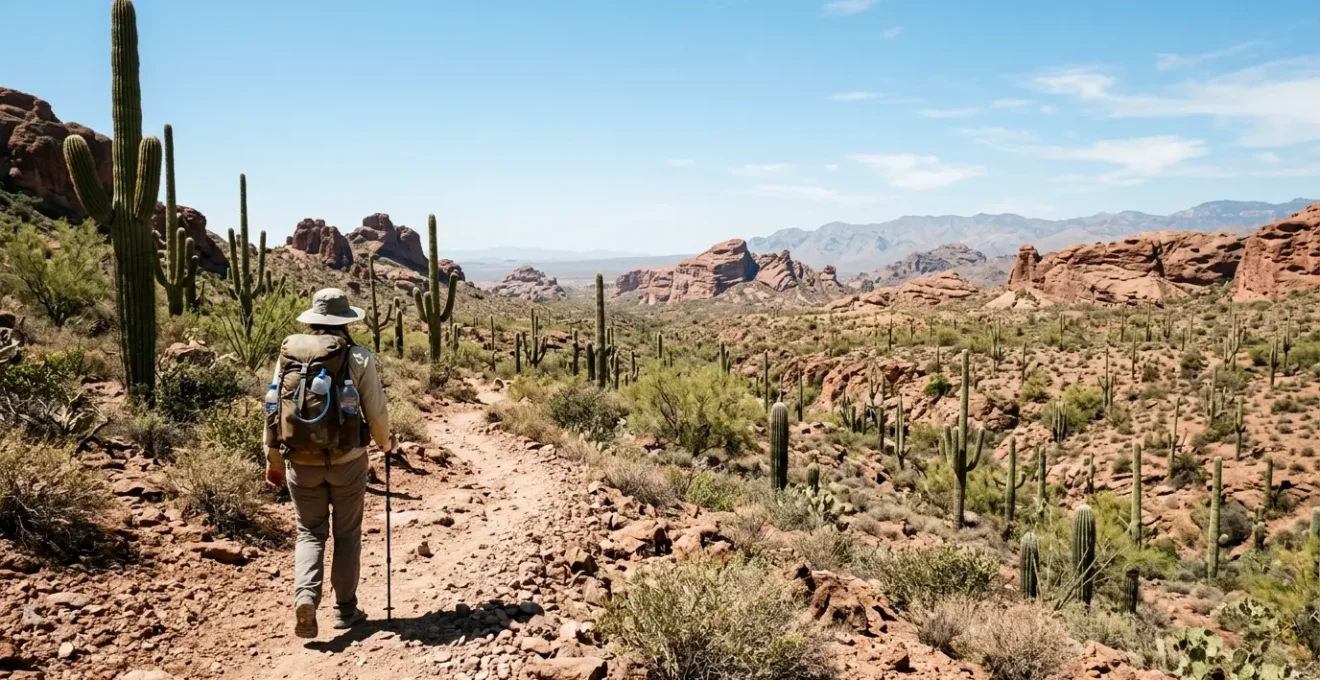
You’ve seen the films. The vast, sun-drenched landscapes of Arizona, the iconic silhouette of a saguaro cactus against a crimson sunset over the Grand Canyon. It looks like the ultimate adventure, a world away from the grey drizzle of a British Tuesday. But here is the first and most important lesson: the American desert you see in movies is a fantasy. The real thing is a lethal environment that has no patience for amateurs, and it is brutally efficient at punishing ignorance.
For a British tourist, accustomed to a mild, forgiving climate, the primary danger isn’t the rattlesnakes or scorpions. It’s your own intuition. Everything you instinctively know about dealing with weather is wrong here. You might think “drink when thirsty” or “a t-shirt is fine if it’s hot.” These common-sense notions from back home can lead to severe dehydration, heatstroke, and a call to Search and Rescue.
But if the key to survival isn’t just ‘drinking more water’ or ‘wearing a hat’, what is it? The truth is, staying alive in the desert is not about being tough; it’s about humility and ruthless, data-driven preparation. It’s about unlearning your European instincts and adopting a new system of rules where underestimation is not an option. This is not a holiday guide; it’s a survival protocol.
This guide is structured to systematically dismantle your dangerous assumptions and replace them with non-negotiable rules. We will cover the fatal mathematics of water, how to spot the subtle signs of heat illness before it’s too late, why your car is a potential oven, and how to understand the sheer, unforgiving scale of the American West.
Summary: How to Survive Hiking in Arid Arizona Deserts Without Suffering Severe Dehydration?
- The Water Rationing Error That Causes Dozens of Desert Rescues Every Summer
- How to Recognize the Subtle Early Warning Signs of Heatstroke in Your Travel Companions?
- When to Schedule Your Desert Exploration to Completely Avoid the Deadly Midday Sun?
- Hydration Bladders or Insulated Bottles: Which System Survives Arizona Heat Better?
- Why Relying Solely on Vehicle Air Conditioning Leaves Desert Road Trippers Vulnerable?
- How to Calculate Realistic Daily Driving Distances Across Vast American Landscapes?
- The Cotton T-Shirt Mistake That Leads to Severe Heat Rash on Theme Park Days
- How to Develop Essential US Geographic Awareness Before Planning Your Holiday Route?
The Water Rationing Error That Causes Dozens of Desert Rescues Every Summer
Let’s be perfectly clear: your understanding of “thirst” is a liability in Arizona. The dry desert air evaporates sweat so quickly you may not even feel wet. By the time you feel thirsty, you are already in a state of physiological debt, and you are losing. The single most common mistake tourists make is rationing their water supply, thinking they can “save” it for later. This is a fatal error. In the desert, later may not come. One hiker on the Arizona Trail nearly died after passing up water sources he didn’t like the look of, a mistake that required an airlift rescue.
You must adopt a policy of aggressive, pre-emptive hydration. Your body is losing water constantly, not just when you hike. Forget sipping; you need to drink on a schedule. The baseline for survival is one US gallon (approximately 3.8 litres) per person, per day. This is not for hiking; this is just for existing. Once you start moving, that number climbs drastically.
Your daily water calculation must be a non-negotiable part of your planning. For any day involving hiking, plan on 1.5 to 2 gallons (5.7 to 7.6 litres) per person. Drink at regular 15-20 minute intervals. Your urine should be a light straw colour; if it’s dark, you are failing to keep up. This isn’t a suggestion; it is your primary survival metric in a lethal environment.
How to Recognize the Subtle Early Warning Signs of Heatstroke in Your Travel Companions?
In the desert, you are not just responsible for yourself; you are your companion’s keeper. Heat-related illnesses don’t always announce themselves with dramatic collapses. The early signs are subtle, especially to an untrained eye. A person suffering from heat exhaustion can become confused and make poor decisions—like insisting they are “fine” when they are minutes from a medical emergency. You must learn to distinguish between heat exhaustion, which is serious, and heatstroke, which is a life-threatening event requiring immediate and aggressive intervention.
The key differentiator is the central nervous system. Someone with heat exhaustion may be tired, nauseous, and sweating profusely, but they are generally coherent. A victim of heatstroke will show signs of mental confusion, may have slurred speech, become inexplicably irritable or aggressive, and, critically, may stop sweating entirely as their body’s cooling system fails. Their skin will feel hot and dry. This is a five-alarm fire.
The following table outlines the critical differences. Study it. Memorise it. Your friend’s or family member’s life could depend on you recognising these symptoms instantly. According to the CDC, heatstroke can cause body temperatures to rise to 106°F (41°C) or higher within 10 to 15 minutes.
| Condition | Key Symptoms | Body Temperature | Action Required |
|---|---|---|---|
| Heat Exhaustion | Heavy sweating, fatigue, thirst, nausea, dizziness, rapid heart rate | Normal to slightly elevated | Move to cool area, drink water, remove unnecessary clothing, apply cold compresses |
| Heatstroke | Confusion, slurred speech, hot dry skin, seizures, loss of consciousness | 106°F or higher within 10-15 minutes | Call 911 immediately, cool aggressively with ice/cold water while waiting |
When to Schedule Your Desert Exploration to Completely Avoid the Deadly Midday Sun?
The desert operates on a schedule, and you will respect it. The concept of a “full day out” hiking, as you might enjoy in the Lake District, does not exist here during the summer. Attempting to hike between the hours of 10 a.m. and 4 p.m. is not brave; it is reckless. The sun is not just “strong” during this period; it is a force of overwhelming thermal energy that the human body is not designed to withstand. The air temperature may be 110°F (43°C), but the ground you are walking on can be significantly hotter, radiating heat back at you and cooking you from below.
Your entire schedule for outdoor activity must be built around avoiding this window of peak heat. This means all hiking, trail running, or even extended sightseeing on foot happens in the early morning or late afternoon. For a morning hike, you must use the “turnaround time” rule. Calculate how long your total hike will take, and divide that by two. That is your turnaround time. You must be heading back to the trailhead by that point, with the non-negotiable goal of being back in the car or shade before 10 a.m.
This requires a complete shift in mindset. A desert day has two “activity” periods: dawn until mid-morning, and late afternoon until dusk. The long hours in between are for rest, seeking shade, and staying absolutely still in the coolest place you can find. Planning your routes to take advantage of canyons or north-facing slopes for natural shade is not just clever, it’s a fundamental survival strategy.
Hydration Bladders or Insulated Bottles: Which System Survives Arizona Heat Better?
Carrying enough water is only half the battle; how you carry it matters immensely. Your gear is a life-support system, and in the extreme heat of Arizona, it can fail. The two primary systems, hydration bladders (like a CamelBak) and insulated bottles (like a Hydro Flask), each have distinct advantages and critical failure points that you must understand. Relying on a single system is a mistake. The correct answer is not one or the other; it’s system redundancy.
Hydration bladders are excellent for carrying large volumes and encouraging frequent, hands-free sipping. However, their tubes can be exposed to direct sun, heating the water inside to an undrinkable temperature. Bite valves can leak, slowly draining your precious supply unnoticed inside your pack. It’s also difficult to accurately track how much you’ve consumed. Insulated bottles are brilliant at keeping water refreshingly cold—a massive psychological boost that encourages drinking—but they are heavy, bulky, and can be dropped and cracked. An experienced Arizona Trail thru-hiker’s data suggests a real-world need to carry about 6.5 litres for every 25 miles, a volume that often requires a combination of systems.
The professional approach is a hybrid system. Use a large-capacity bladder as your main reservoir, but also carry at least one or two insulated bottles. The bladder carries the bulk volume for the hike, while the insulated bottle serves as your psychological boost with cold water and as a critical, protected backup. It’s also where you should keep your electrolyte mix, separate from your main water supply. This redundancy ensures that if one system fails, you are not left stranded.
| System Type | Heat-Related Failure Points | Advantages | Desert Solution |
|---|---|---|---|
| Hydration Bladder | Leaky bite valves, sun-perished tubes, difficult to track intake | Hands-free drinking, large capacity | Use for main supply with intake markings |
| Insulated Bottles | Dropped/cracked plastic, hard to open with sweaty hands | Keeps water cold, motivates drinking | Reserve for emergency cool-downs with electrolytes |
| Hybrid System | Multiple points require monitoring | Redundancy prevents total failure | Combine both: bladder for volume, bottle for cold reserve |
Why Relying Solely on Vehicle Air Conditioning Leaves Desert Road Trippers Vulnerable?
Your rental car’s air conditioning feels like a refrigerated sanctuary, a perfect escape from the oppressive heat. This feeling is a dangerous illusion. Relying on it as your only survival tool is one of the most complacent and hazardous mistakes a road-tripper can make. A vehicle is a complex machine, and in extreme desert temperatures, it is under enormous strain. A flat tyre, an overheating engine, or a simple mechanical failure can leave you stranded in an instant. And your sanctuary quickly becomes a convection oven.
Make no mistake: a car parked in the desert sun is a death trap. Studies from the National Oceanic and Atmospheric Administration (NOAA) show that even on a relatively mild day, interior temperatures can skyrocket. In the intense Arizona sun, a dark dashboard or seat can easily reach temperatures in the range of 180 to 200°F (82 to 93°C). If your car breaks down, getting out and seeking shade is critical, but you must be prepared for that eventuality. Staying with your vehicle is almost always the right call for rescue, but you cannot survive inside it without a plan.
Your car must be equipped with its own survival kit, independent of your hiking gear. This includes a bare minimum of two extra gallons of water that stay in the car, a reflective sunshade for the windscreen to slow interior heating, and Mylar “space blankets” which can be used to reflect heat away from the vehicle’s exterior. A battery-powered fan and, most importantly, a personal locator beacon or satellite messenger, are not luxuries; they are essential pieces of life-saving equipment when you are miles from the nearest mobile signal.
How to Calculate Realistic Daily Driving Distances Across Vast American Landscapes?
The scale of the American West is something a European map cannot convey. Distances that look manageable on Google Maps are vastly different on the ground. A two-hour drive in the UK is a predictable affair. A two-hour drive in Arizona can involve significant elevation changes, winding mountain roads, and, most critically, vast “service voids”—stretches of 50 or even 100+ miles with no petrol stations, no shops, no water, and no mobile phone service. Underestimating this reality leads to fatigue, poor decision-making, and the risk of running out of fuel in the middle of nowhere.
You must reject the estimated driving times provided by apps and use a reality-based formula. The “American West Reality Multiplier” is a simple but effective system: take the Google Maps driving time and multiply it by 1.5. A 3-hour drive is now a 4.5-hour commitment. Furthermore, you must limit your total time behind the wheel. Pushing for long driving days is exhausting and dangerous. A hard limit of 4-5 hours of actual driving per day will keep you alert and give you a buffer for unexpected delays.
Before you even book your accommodation, use the satellite view on your map to trace your route. Look for the empty spaces. Visualising the terrain helps you anticipate obstacles and understand the true scale of service voids between towns. Mark every single petrol station on your route and plan your fuel stops assuming your car will get 25% lower mileage than expected due to the heat and terrain. This is not pessimism; it’s pragmatic survival planning.
Your Action Plan: The American West Reality Check
- Step 1: Calculate the standard Google Maps driving time for your intended daily route.
- Step 2: Multiply this time by 1.5 to get your “American West Reality Multiplier” estimate.
- Step 3: Enforce a hard limit of 4-5 hours of actual driving per day to prevent fatigue.
- Step 4: Use satellite map views to visually identify the 50-100+ mile service voids with no towns or petrol stations.
- Step 5: Plan all fuel stops in advance, assuming your vehicle will achieve 25% lower miles-per-gallon in desert conditions.
The Cotton T-Shirt Mistake That Leads to Severe Heat Rash on Theme Park Days
This mistake is not limited to hiking trails. A long day at a theme park or wandering around a town like Sedona can be just as hazardous if you are wearing the wrong materials. The single worst fabric you can wear in dry heat is cotton. Your comfortable cotton t-shirt, a staple of any holiday wardrobe, becomes a liability. Cotton is highly absorbent; it soaks up your sweat but does not release it effectively. It becomes a damp, heavy cloth that clings to your skin, blocking airflow and completely shutting down your body’s natural cooling mechanism: evaporation.
This trapped moisture against hot skin is a perfect recipe for severe heat rash (miliaria) and can contribute to raising your core body temperature. You need clothing that works *with* your body, not against it. This means wearing lightweight, loose-fitting clothes made from materials designed to wick moisture away from your skin and allow it to evaporate. The goal is to stay dry.
The best choices are modern technical fabrics. Light-coloured synthetics like polyester or nylon are a good start. Better still are fabrics with a micro-grid pattern that creates air channels next to the skin, enhancing airflow. The gold standard for desert wear, however, is either an ultralight merino wool or a purpose-built “sun hoodie”. These garments may feel counter-intuitive (wearing long sleeves in the heat), but they provide superior sun protection (UPF 50+) while being exceptionally good at thermoregulation, keeping you cooler and more comfortable than an exposed-skin-and-cotton-shirt combination.
| Rating | Material Type | Heat Performance | Why It Works/Fails |
|---|---|---|---|
| Worst | Cotton | Traps heat, holds sweat | Absorbs moisture but doesn’t release it, blocks airflow |
| Good | Light-colored synthetics | Moderate cooling | Wicks moisture but can feel clammy |
| Better | Micro-grid pattern synthetics | Enhanced airflow | Creates air channels for better evaporation |
| Best | Ultralight merino wool or sun hoodies (UPF 50+) | Superior thermoregulation | Natural temperature control, odor resistance, maximum sun protection |
Key Takeaways
- Never trust your UK-based instincts. The Arizona desert is a lethal environment that punishes unpreparedness.
- Water is not optional. Drink on a schedule (every 15-20 mins), not when you feel thirsty. Plan for a minimum of 1.5-2 gallons (5.7-7.6 litres) per person for any hiking day.
- The midday sun (10am-4pm) is a no-go zone for any strenuous activity. Plan your days around this immutable rule.
How to Develop Essential US Geographic Awareness Before Planning Your Holiday Route?
The final piece of your survival puzzle is geographic awareness. You are not just visiting another country; you are navigating a subcontinent. To a British visitor, the sheer size of Arizona is abstract. It’s a fact, not a felt reality. This needs to change before you arrive. An excellent exercise is to use an online tool like ‘The True Size Of’ and drag the state of Arizona over the United Kingdom. You will see it covers nearly all of England and Wales combined. This single visual will do more to recalibrate your sense of scale than any guidebook.
This scale means that places with similar or identical names can be hundreds of miles apart, a common source of navigation errors. Simply typing “Willow Springs” into a standard GPS could send you to the wrong county. You must use navigation apps specifically designed for outdoor activities, which include features like offline maps, GPS tracking, and waypoints. It is crucial to download offline maps for your entire planned route, as you will be travelling through vast areas with zero cell coverage.
Your planning must also distinguish between different types of public land. A National Park, a National Forest, and Bureau of Land Management (BLM) land have different rules, different levels of maintenance, and different emergency response capabilities. Know where you are at all times. This level of preparation may seem excessive for a holiday, but in the desert, it’s the baseline. It’s about replacing romantic notions with a healthy, respectful, and data-driven fear of a beautiful but unforgiving landscape.
Your holiday’s success and your personal safety depend entirely on this level of preparation. Do not treat it as optional. Begin building your detailed safety protocol and itinerary now, before you even book your flight.