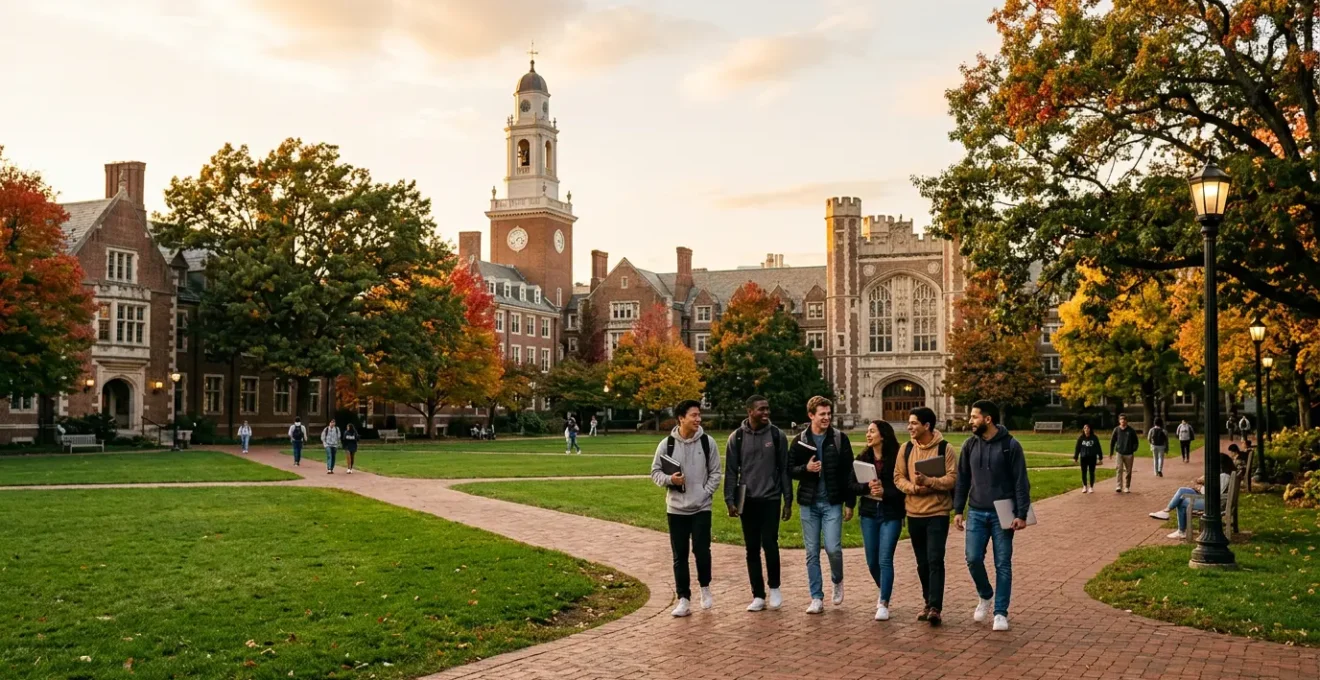
You think you’re going to America for your exchange year. You’re not. You are being sent as an envoy to a bizarre, self-contained ‘Campus Nation’ with its own laws, economy, and social codes. This is not a travel guide; it’s a diplomatic briefing. Forget what the official brochures say; mastering the unwritten rules of this bubble is the only way to thrive, not just survive.
Right then, you’ve done it. You’ve secured your spot for a year abroad in the United States. You’re dreaming of road trips, red solo cups, and an education straight out of a Hollywood film. I remember the feeling well. What the glossy university pamphlets don’t tell you, and what your well-meaning parents can’t possibly grasp, is the fundamental truth of the matter: you aren’t really going to ‘America’. You are being posted to a sovereign, autonomous state that just happens to be located on American soil. I call it the ‘Campus Nation’.
These sprawling university campuses are not like back home. They are all-encompassing ecosystems with their own police forces, economies, transport systems, and bewildering social hierarchies. The common advice—”get involved,” “be open-minded”—is dangerously simplistic. It’s like telling a fresh-faced diplomat to “just be friendly” at the UN. This guide is your secret briefing, the one I wish I’d had. We’re not just going to talk about making friends; we’re going to decode the very system that governs your life for the next year, from the barmy economics of campus food to the shocking reality of campus law enforcement. The goal isn’t just to survive your diplomatic posting; it’s to master it.
This briefing will provide the strategic intelligence you need to navigate the unique challenges and opportunities of your new environment. We’ll cover everything from housing and finances to security and the very real danger of the ‘campus bubble’, ensuring you can operate effectively within this strange new world.
Summary: The Brit’s Survival Guide to the American ‘Campus Nation’
- On-Campus Dormitories or Off-Campus Housing: Which Option Accelerates Social Integration?
- How to Navigate Complex University Meal Plans Without Wasting Thousands of Dollars?
- The Bubble Mentality Mistake That Prevents International Students from Exploring Real America
- Why US Campus Security Forces Operate Completely Differently to UK University Wardens?
- How to Utilise Exclusive Campus Amenities to Save Money on Premium Gym Memberships?
- When to Start Applying for Your US Social Security Number After Arrival?
- The Over-Committing Mistake That Ruins First-Year UK Student Grades
- How to Balance US University Academics with Extensive Campus Activities?
On-Campus Dormitories or Off-Campus Housing: Which Option Accelerates Social Integration?
Your first strategic decision upon arrival is where to live. In the UK, halls are a fun but temporary launchpad. In the US ‘Campus Nation’, the on-campus dormitory (or ‘dorm’) is the official embassy for new citizens. Opting for off-campus housing in your first year is a rookie error, akin to a diplomat choosing to live in a different country from their posting. You will be socially and logistically isolated. Dorms are not just buildings; they are structured integration programmes. They are run by ‘Resident Advisors’ (RAs), older students whose entire job is to force you to socialise through ‘floor meetings’, ‘ice-breakers’, and other cringe-worthy (but highly effective) events. This is your boot camp for American social life.
Living off-campus might seem cheaper or more ‘adult’, but you lose immediate access to the social fabric. The friendships forged in the chaotic, close quarters of a freshman dorm are the bedrock of your social network for the entire year. These are the people who will have spare meal swipes, notes for the class you missed, and a car to get to a proper supermarket. Resisting the dorm experience is to willingly choose exile. Embrace it as a mandatory part of your diplomatic acclimatisation. It’s noisy, it’s messy, but it’s the fastest way to build the alliances you’ll need to succeed.
Your Action Plan: Strategic Housing Timeline for Maximum Social Integration
- Weeks 1-2: Force yourself to attend every single dormitory floor meeting and RA-organised event. This is where initial alliances are formed.
- Month 1: Identify the key social hubs (common rooms, kitchens) and make your presence known during peak hours, typically 7-10 PM.
- Months 2-3: Join a residence hall committee or an intramural sports team based in your dorm. This deepens your connections beyond casual chats.
- Semester 2: Begin exploring off-campus housing options, but do so with the new group of friends you’ve made from within the dorm system.
- Summer before Year 2: Leverage university housing Facebook groups and your international student network to secure shared off-campus housing, transitioning from the ’embassy’ to a ‘local residence’.
How to Navigate Complex University Meal Plans Without Wasting Thousands of Dollars?
Welcome to the bewildering economy of the Campus Nation. The ‘meal plan’ is its central currency, and it’s designed to confuse you into losing money. Forget thinking of it as ‘paying for food’. This is a complex financial instrument, and you need to become a savvy trader. Most universities mandate a plan for first-year on-campus residents, presenting you with a tiered system of ‘swipes’ and ‘dining dollars’. A swipe gets you into the all-you-can-eat dining hall (the ‘caff’), while dining dollars work like a debit card at other campus eateries. The entire system is a masterclass in behavioural economics, preying on your fear of going hungry.
The sticker shock is real. A recent analysis shows the average cost for a low-tier meal plan is now over $5,656 for the academic year. The top-tier ‘unlimited’ plans sound great, but they are often a massive waste. Unless you are a competitive athlete eating six meals a day, you will not use all your swipes. Those unused swipes at the end of the week or semester? They vanish. Poof. That’s pure profit for the university. Your mission is to choose the lowest possible plan your lifestyle allows. You can almost always add more money later, but you can never get a refund for what you don’t use. It’s a one-way-bet, and the house always wins unless you play smart.
The key is to analyse the real cost per meal. A plan with fewer weekly meals might seem restrictive, but it forces you to be intentional and often has a much higher ‘per meal’ value when you do use it. This prevents the “I’ll just pop in for a banana” swipe that devalues your investment. The table below breaks down a typical structure, showing how the cost-per-meal often increases as the plan gets smaller, pushing you towards the bigger, more wasteful plans.
The following table, based on typical university pricing structures as analysed by financial experts, breaks down the real cost you’re paying. As this comprehensive breakdown of student spending shows, food is a major budget item that can be controlled.
| Meal Plan Type | Monthly Cost | Meals Included | Cost Per Meal | Best For |
|---|---|---|---|---|
| Unlimited | $625+ | Unlimited | $6-8 | Heavy eaters, athletes |
| 21 meals/week | $570 | 84/month | $6.78 | Traditional 3 meals daily |
| 14 meals/week | $475 | 56/month | $8.48 | Skip breakfast crowd |
| Block Plan (150/semester) | $400 | 37.5/month | $10.67 | Irregular schedules |
The Bubble Mentality Mistake That Prevents International Students from Exploring Real America
After a few months inside the Campus Nation, a dangerous psychological condition sets in: the Bubble Mentality. The campus is so convenient, so all-encompassing, that you start to believe it *is* America. With its own cinema, supermarket, hospital, and social scene, there’s functionally no reason to leave. This is a trap. Staying within the bubble means you’ll return to the UK having only experienced a sanitised, bizarrely homogenous theme park version of the United States. You’ll have met plenty of 19-year-old Ohioans, but you won’t have spoken to a single normal American adult. You’ll know every inch of the quad, but you won’t know how to catch a city bus.
Breaking the bubble requires a conscious, strategic effort. It means choosing inconvenience. It means taking the campus shuttle to its last stop just to see what’s there. It means finding the scruffy, family-owned coffee shop a mile off-campus instead of the polished Starbucks in the student union. Universities sometimes facilitate this with ‘Alternative Spring Break’ programs or local volunteer initiatives, which are excellent structured ways to see the world outside. However, the real work is personal. It’s about developing a ‘foreign policy’ for your diplomatic mission—one that prioritises regular excursions into the host country. Your goal is to have experiences that aren’t organised by the university, to meet people who have never heard of your school’s mascot. That’s where you’ll find the real America you came to see.
Why US Campus Security Forces Operate Completely Differently to UK University Wardens?
This is perhaps the most critical cultural difference you need to understand, as ignorance here can have serious consequences. In the UK, a university warden is a pastoral figure, someone who helps with lock-outs and tells you to turn the music down. They have no more legal authority than your nan. In the US Campus Nation, the campus police are not ‘security guards’. They are the state. In many cases, they are sworn law enforcement officers with full police powers, including the authority to carry firearms, make arrests, and lay criminal charges that will follow you for life. They are not your mates.
This is not a drill. A comprehensive legal analysis confirms that laws in nearly all 47 states with campus police authorise them to exercise powers even beyond the campus boundaries. Getting caught with an open container of alcohol by campus police isn’t a slap on the wrist and a call to your tutor; it can be a misdemeanour charge, a court date, and a mark on your permanent record that could impact future visas. They operate under a different legal framework and a different philosophy. Their primary role is law enforcement, not student welfare. Do not argue with them. Do not treat them casually. Be polite, be respectful, and understand that you are dealing with a real police officer, not a friendly chap in a high-vis jacket.
This table is not an exaggeration; it is a summary of the fundamental difference in authority you must respect.
| Aspect | UK University Warden | US Campus Police Officer |
|---|---|---|
| Primary Role | Pastoral care & welfare support | Law enforcement & security |
| Legal Authority | Administrative only | Sworn police or peace officers |
| Arrest Powers | None (calls local police) | Full arrest powers on campus |
| Weapons | None | Often armed (varies by state) |
| Jurisdiction | Residence halls only | Entire campus + adjacent areas |
| Legal Consequences | University disciplinary | Criminal charges & court |
How to Utilise Exclusive Campus Amenities to Save Money on Premium Gym Memberships?
Now for some good news from the ‘Campus Nation’. As a registered citizen, you are entitled to the state’s riches. Your student fees, which seem extortionately high, are funding a treasure trove of amenities and services that would cost a fortune in the outside world. The key is that they are often hidden in plain sight. Your student ID card is not just for entry; it is a key to unlocking thousands of dollars in value. The most obvious example is the Recreation Center. These are not your dreary local council gyms. We’re talking state-of-the-art facilities with Olympic-sized pools, climbing walls, and every fitness class imaginable, from spin to yoga. A private membership for this level of facility would easily cost over $150 a month.
But the value goes far beyond the gym. Your university likely has a license for you to download the entire Adobe Creative Suite, Microsoft Office, and even specialised engineering software like MATLAB for free. That’s hundreds, if not thousands, of pounds saved right there. The library isn’t just for books; it’s a gateway to streaming services like Kanopy (for classic and indie films) and academic databases that would otherwise be behind expensive paywalls. Furthermore, there are often free services for career counselling, mental health support, and even legal aid for tenants. One analysis suggests there’s at least $85+/month in hidden value for students who fully exploit these perks. Your mission is to audit every benefit your student fees cover and exploit them to the fullest.
Think of it as claiming your rightful citizen’s dividend from the Campus Nation’s treasury. Before you spend a single dollar off-campus, ask: “Can I get this for free on campus?” Nine times out of ten, the answer is yes.
Your Checklist: Complete Campus Resource Maximization Audit
- Software Access: Go to your university’s IT website and download all available software licenses, including Adobe Creative Suite, Microsoft Office, and any specialised academic software.
- Recreation Membership: Register for full access to the campus recreation center. Explore the schedule for specialised classes (yoga, spin, climbing) that are included in your fees.
- Media & Database Services: Log into the university library portal and create accounts for all provided streaming services (like Kanopy) and access major academic journal databases.
- Professional Services Utilisation: Locate the career center, mental health services, and student legal aid offices. Book an initial, free consultation even if you don’t have an immediate need.
- Facility Booking Privileges: Investigate how to book campus facilities for personal use, such as music practice rooms, 3D printing labs, or photography studios, which often have free or low-cost access for students.
When to Start Applying for Your US Social Security Number After Arrival?
Now we venture into the grand bureaucracy of the American state, a process that can make the British civil service look like a model of lightning-fast efficiency. If you are permitted to work on campus (and many J-1 and F-1 visas are), you will need a Social Security Number (SSN). This nine-digit number is the key to all adult life in America: opening a proper bank account, getting a mobile phone contract without a massive deposit, renting an apartment, and building a credit history. Getting it sorted promptly is not optional; it’s essential for your financial independence. However, the process is counter-intuitive.
Your first instinct will be to rush to the Social Security office on day one. Do not do this. This is the most common and frustrating mistake. The various government computer systems need time to talk to each other. You must wait at least 10 days after arriving in the US and after your university has validated your arrival in the SEVIS system. Applying before this 10-day window will result in an immediate rejection and will clog up the system for your re-application, delaying the process by weeks. The sweet spot is Day 10. Go to the Social Security office with your passport, I-20 or DS-2019 form, I-94 printout, and a letter from your university’s international office confirming your eligibility. It’s a game of bureaucratic patience, and timing is everything.
Your Action Plan: Critical SSN Application Timeline
- Days 1-9: Do nothing. This is a mandatory waiting period. Your arrival data is populating across government systems. Do not go to the SSN office.
- Day 10: This is your action day. Visit the local Social Security office with all required documents: passport, I-20/DS-2019, I-94 printout, and the eligibility letter from your International Student Office.
- Days 11-20: You should receive an acknowledgement. If you hear nothing, now is the time to politely follow up. Processing typically takes 7-14 business days.
- Weeks 3-4: Your SSN card should arrive by mail to the address you provided. Guard it with your life.
- Month 2 onwards: Use your new SSN to open a US bank account, apply for a state ID card (a useful form of local ID), and begin establishing a US credit history.
The Over-Committing Mistake That Ruins First-Year UK Student Grades
Upon entering the Campus Nation, you will be confronted with one of its most dazzling and dangerous features: the ‘Student Organization Fair’. It’s a massive hall filled with hundreds of tables, each representing a club or activity, from the Quidditch team to the pre-law society, all vying for your attention. The American university culture is one of hyper-involvement, and the pressure to sign up for everything is immense. This is a trap that ensnares countless bright-eyed international students. In the UK, you might join one or two societies. In the US, the expectation is to build a ‘resume’ of extracurriculars, leading to a fatal tendency to over-commit.
Joining ‘Greek Life’ (a fraternity or sorority), student government, or a competitive club sport isn’t a casual hobby; it can be a 15-20 hour per week commitment. That’s a part-time job you’re not getting paid for. Trying to juggle three of these while adjusting to a new academic system is a recipe for burnout and academic disaster. The key is to practice what I call ‘Strategic Decommitment’. It’s the art of being a discerning shopper at the activity fair. Your strategy should be to attend the initial meetings of many clubs but commit to a maximum of two: one that advances your professional or academic goals, and one that is purely for fun and social integration (like an intramural sport or a film club). Learning to say “no” is the most valuable skill you will learn in your first month.
Your Action Plan: The Strategic Club Shopping Method
- Week 1: Attend the student organization fair. Your mission is reconnaissance. Collect information from 10 or more clubs that genuinely interest you.
- Week 2: Attend the first meeting of your top 5-7 organizations. Your goal is to assess the actual time commitment and the group’s culture.
- Week 3: Narrow your list to three clubs. Attend their second meetings and, if possible, one of their social events to get a real feel for the members.
- Week 4: Make your final decision and commit to a maximum of two organizations. One should be career/academic focused, the other purely social or recreational.
- Ongoing: At midterms, re-evaluate your commitments. It is perfectly acceptable and strategically wise to step back from a club if your grades are suffering.
Key takeaways
- Treat the US campus as a self-contained ‘Campus Nation’ with its own rules, not just a university.
- Prioritise on-campus dorms for social integration and avoid the financial traps of oversized meal plans by choosing the smallest one possible.
- Actively fight the ‘bubble mentality’ by exploring off-campus America, and understand that campus police are real law enforcement, not pastoral wardens.
How to Balance US University Academics with Extensive Campus Activities?
The final piece of the puzzle is the academic system itself, which operates on a completely different philosophy to the UK model. British universities often front-load lectures and back-load assessment, with your entire grade resting on a few major essays or one terrifying final exam. This system rewards strategic cramming. The American system is the opposite; it is a game of continuous assessment and relentless engagement. From day one, you are being graded. There will be weekly quizzes, homework assignments, group projects, midterm exams, and, crucially, grades for ‘participation’. You cannot be a passive observer in an American classroom.
This is a huge adjustment. You cannot afford to fall behind, as each small assignment contributes to your final Grade Point Average (GPA), a number that governs your academic life. The most underutilised tool for navigating this is ‘Office Hours’. In the UK, a professor’s office hours are a mysterious, rarely used concept. In the US, they are a fundamental part of the educational contract. Your professors are contractually obligated to be in their office for you. Using these hours is not seen as needy; it is seen as being an engaged, serious student. Go to office hours in the first two weeks just to introduce yourself. Go before an exam to ask for clarification. Go after an exam to understand what you did wrong. This is how you build relationships, get crucial guidance, and show the ‘participation’ that professors are literally grading you on.
Your Action Plan: Office Hours Strategic Engagement Plan
- Weeks 1-2: Make a point to visit the office hours of every one of your professors. Introduce yourself, say you’re an exchange student, and that you’re looking forward to the class. That’s it.
- Before Midterms: Re-visit each professor, this time with a specific, prepared question about an upcoming assignment or how to best prepare for their exam.
- Post-Midterm: If your grade isn’t what you hoped, schedule an appointment to review your performance and ask for concrete strategies for improvement.
- Throughout the Semester: If a topic in a lecture is particularly interesting, pop into office hours to ask a thoughtful follow-up question or inquire about their research in the field.
- End of Semester: This is your chance to discuss potential advanced courses, or, if you’ve built a good rapport, to ask for a recommendation letter for future endeavours.
By treating your year abroad as a diplomatic mission to the strange and wonderful ‘Campus Nation’, you shift your perspective. You are not a tourist; you are an anthropologist and a strategist. By understanding its unique economy, legal system, and social codes, you can not only survive but truly thrive, returning to the UK not just with a better tan, but with a set of skills and experiences that go far beyond the classroom.