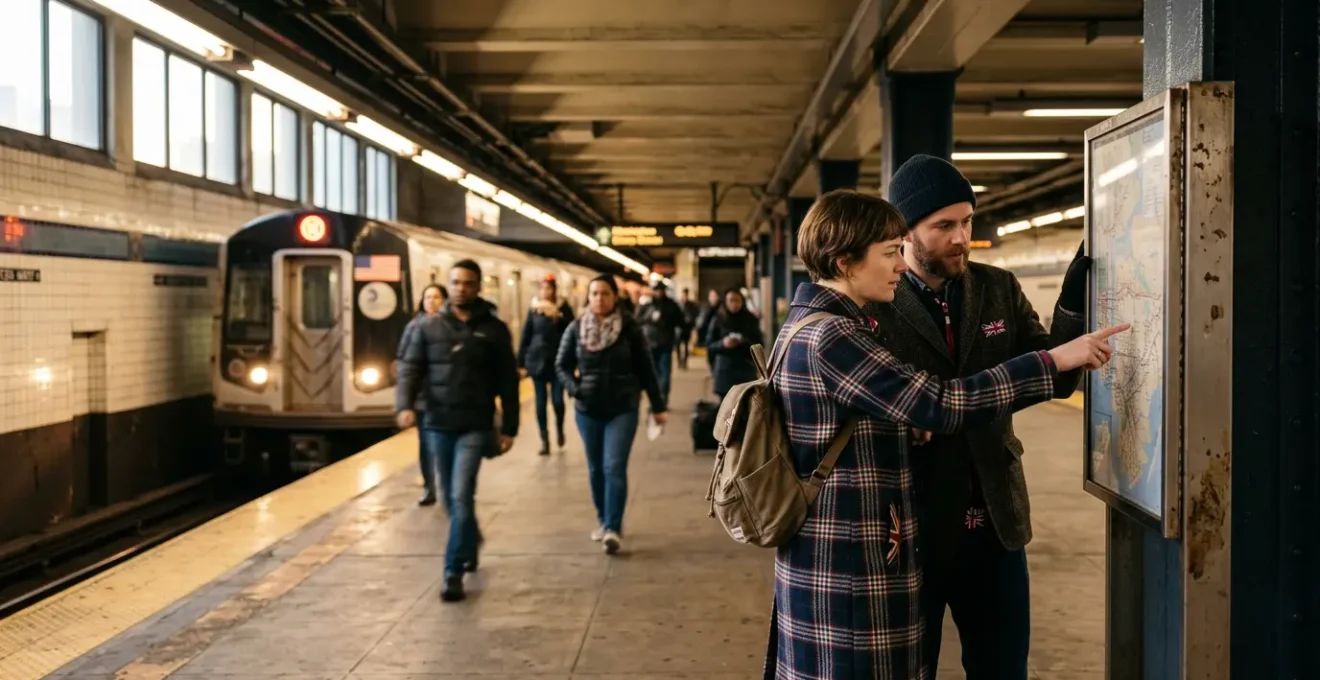
Contrary to popular belief, there is no single “safest” way to travel in American cities; the key is to abandon a fixed mindset and adopt a dynamic threat assessment model.
- Public transit reliability is not guaranteed, creating situational risks that require backup plans.
- Ride-sharing apps offer tracking benefits but introduce risks like imposter drivers, demanding strict verification protocols.
Recommendation: The safest choice is context-dependent. Your security depends on your ability to evaluate the time, location, and your personal situation to decide when to use public transit, when to verify a ride-share, and when to pay a “vulnerability premium” for a private car.
For a British tourist stepping into a major American metropolis, the first instinct is often to seek out the equivalent of the London Underground—a reliable, comprehensive, and generally predictable public transport network. This expectation, however, can be the first critical misstep in ensuring your personal safety. The reality of urban mobility in the United States is one of fragmentation, inconsistency, and what security professionals call “transit friction.” Unlike the integrated system of the Tube, US transit can vary dramatically from city to city, and even from one neighbourhood to the next.
Many guides will offer simplistic advice: “stick to official taxis” or “use ride-sharing apps for convenience.” These platitudes fail to address the complex, shifting landscape of urban risk. The truth is that the safest option is not a static choice but a dynamic calculation. Is a half-empty bus at 11 PM safer than a ride-share you didn’t properly verify? Is saving $40 on an airport transfer worth the risk of navigating a confusing transit hub while jet-lagged and laden with luggage?
This guide moves beyond generic tips. It provides a strategic framework for a dynamic threat assessment, teaching you not just *what* to do, but *how to think* like a security expert. We will dissect the specific risks associated with each mode of transport—from buses and subways to ride-shares and taxis—and equip you with the protocols to mitigate them. The goal is to empower you to make informed, security-first decisions that adapt to the time, location, and your specific circumstances, ensuring your visit to the US is memorable for the right reasons.
To help you master this new approach, this article is structured to address the most critical risks and decisions you will face. The following summary outlines the key areas we will cover, from the hidden dangers of public transit to the non-negotiable verification steps for private transport services.
Summary: Your Guide to Navigating US Cities Safely
- Why Relying Exclusively on American Public Buses Often Leads to Severe Delays?
- The Late-Night Subway Mistake That Puts Unwary Tourists in Extreme Danger
- Official Taxis or Ride-Sharing Apps: Which Is Genuinely Safer After Midnight?
- How to Spot Fake Uber Drivers Circling Busy American Entertainment Districts?
- When to Abandon Public Transit and Pay the Premium for a Private Transfer?
- How to Find Reliable Ground Transportation at Miami International Without Being Overcharged?
- How to Use Underground Transit Systems Safely During Peak Commuter Hours?
- How to Navigate Major US Metropolises Without Paying Extortionate Parking Fees?
Why Relying Exclusively on American Public Buses Often Leads to Severe Delays?
For visitors accustomed to London’s extensive bus network, the American equivalent can be a source of significant “transit friction.” The primary risk isn’t just inconvenience; it’s the danger that comes from being stranded due to unexpected delays or coverage gaps. Unlike a cohesive national system, US public transit is a patchwork of local agencies with varying levels of funding and efficiency. This results in routes that may not run late, have infrequent service, or simply don’t exist in the sprawling suburbs where many attractions or accommodations might be located.
This lack of comprehensive coverage is a structural issue. In fact, a staggering 45% of Americans lack access to any public transit, which underscores the system’s limitations. For a tourist, this means a bus that looks convenient on a map might be 30 minutes late, or the return bus might stop running an hour before you plan to head back. This unreliability can leave you in an unfamiliar area after dark, increasing your vulnerability.
The core security strategy is to never assume reliability. Always use a real-time tracking app like Transit or Citymapper before you even leave your hotel. Have a pre-defined “point of no return”; for instance, if the bus is more than 15 minutes delayed, you immediately switch to your backup plan. This plan must be ready to go: a ride-sharing app with your payment method pre-loaded, or the number of a reputable local car service. Relying solely on the bus system is a gamble you shouldn’t take.
The Late-Night Subway Mistake That Puts Unwary Tourists in Extreme Danger
At the end of a long day, the sight of a nearly empty subway car can seem like a lucky break—a quiet, private ride back to your hotel. This is one of the most dangerous assumptions a tourist can make. From a security perspective, an empty car is not an opportunity; it is a vacuum of safety. The presence of other everyday commuters—families, students, professionals—acts as a powerful deterrent to opportunistic crime. When you choose an empty car, you isolate yourself and become a prime target with no witnesses and no one to offer assistance.
The correct protocol is to always choose a car with other people in it, preferably the one closest to the conductor’s cabin (often near the middle of the train). This is a non-negotiable rule of late-night transit. If you find yourself on a platform and your only option is an empty car, the safer decision is to wait for the next train. Even if you feel anxious on a crowded platform, your safety is greater there than in isolation. As MTA Board Member Lisa Daglian advises on managing subway anxiety, even small physical actions can ground you.
If I feel real insecure, I’ll hug a column.
– Lisa Daglian, Executive Director of the Permanent Citizens Advisory Committee
This illustrates the mindset: control your environment actively. Stay on the platform where there is public visibility and CCTV coverage. Position yourself in a well-lit area, away from the platform edge, and board a car that offers the safety of numbers. Never trade the security of the crowd for the illusion of private space.
Official Taxis or Ride-Sharing Apps: Which Is Genuinely Safer After Midnight?
The choice between hailing an official, licensed taxi and ordering a car via a ride-sharing app like Uber or Lyft is a complex trade-off, especially after midnight. There is no single “safer” option; each has distinct advantages and vulnerabilities. An official taxi, such as a yellow cab in New York City, is part of a heavily regulated system. Drivers undergo stringent background checks, and their vehicles are often equipped with mandatory safety features. However, the transaction can lack the digital footprint that provides a sense of security for many.
Ride-sharing apps, conversely, offer a complete digital trip record. Your route is GPS-tracked, your driver’s details are logged, and you can share your trip in real-time with a contact. This traceability is a powerful deterrent. However, driver vetting processes can be less rigorous than for official taxis, and safety features like in-vehicle cameras are often left to the driver’s discretion. The following comparison, focusing on NYC as an example, highlights these differences.
| Safety Feature | Official NYC Taxi | Uber/Lyft |
|---|---|---|
| Digital Trip Record | Limited | Complete GPS tracking |
| Driver Background Check | Medallion system with strict licensing | Variable by state |
| In-Vehicle Camera | Mandatory in NYC | Driver discretion |
| Emergency Button | Physical panic button | In-app emergency feature |
| Trip Sharing | Not available | Real-time location sharing |
| Driver Verification | Visible medallion/license | PIN verification system |
The conclusion is that the safety of a ride-share is entirely dependent on your diligence in following situational awareness protocols. Before the vehicle even arrives, you must have a plan. The most critical step is verification: never get into a car without confirming the license plate, car model, and driver’s photo match what’s in your app. Ask the driver, “Who are you here for?” and make them say your name. Activating PIN verification adds another layer of security. While a taxi may feel more anonymous, the digital oversight of a properly verified ride-share offers superior protection after dark if, and only if, you execute these steps without fail.
How to Spot Fake Uber Drivers Circling Busy American Entertainment Districts?
Busy entertainment districts and major event venues are prime hunting grounds for imposter ride-share drivers. After a concert or game, crowds of people are on the street, staring at their phones, and often desperate for a quick ride home. This chaotic environment is exploited by criminals who pose as legitimate drivers to lure unsuspecting tourists into their vehicles. They will often pull up and say, “Are you waiting for an Uber? I’m here,” hoping you’ll accept out of convenience.
Falling for this is a critical security failure. The entire safety model of ride-sharing is predicated on getting into the specific car assigned to you by the app. Any deviation from this breaks the chain of digital trust. As security experts emphasize, your best defense is not physical but mental discipline. You must be resolved to follow the protocol, no matter how tempting a convenient offer may seem.
The primary defense is psychological: commit to waiting for your specific car, no matter the temptation of a driver who pulls up and claims to be ‘your Uber’.
– Security Expert Analysis, Urban Transportation Safety Guide
To operationalize this psychological defense, you must follow a strict pre-ride security checklist. This is not optional; it is a mandatory protocol for staying safe in these high-risk environments. The process begins before you even step outside.
Your Pre-Ride Security Protocol for High-Traffic Areas
- Request from a Safe Location: Request your ride while still inside the venue or a well-lit establishment, not on a dark street corner.
- Secure Driver Information: Take a screenshot of your driver’s name, photo, car model, and license plate number.
- Wait in a Secure Area: Wait for your ride in a well-lit area, preferably with other people around, until the app shows your car is arriving.
- Perform the 3-Point Check: Visually confirm the license plate, car make/model, and driver’s photo match the information in your app. This is non-negotiable.
- Verify Your Identity Securely: Never volunteer your name. Ask, “Who are you here to pick up?” Let the driver say your name first. Use PIN verification if the app offers it.
If any single point in this check fails—if the plate is different, the driver doesn’t match the photo, or they can’t name you—do not get in the car. Cancel the ride, report the issue in the app if necessary, and go back inside to a safe place to start again.
When to Abandon Public Transit and Pay the Premium for a Private Transfer?
There are moments when the most logical and cost-effective transit option is not the safest one. Recognizing these moments is a key skill. This is the concept of the “vulnerability premium”: the conscious decision to spend more money on a private car or licensed taxi service to directly reduce your exposure to risk. This isn’t about luxury; it’s a calculated security expense. A UK tourist, tired from a long flight and managing luggage in an unfamiliar airport late at night, is in a highly vulnerable state. Navigating a complex public transit system in this condition is a significant and unnecessary risk.
The decision to pay this premium should be based on a dynamic threat assessment of your situation. You can use a simple decision matrix to quantify your risk level. Assign points for each factor that increases your vulnerability. If your total score crosses a certain threshold, the decision to opt for a more secure, albeit more expensive, private transfer becomes clear.
| Risk Factor | Points | Example Scenario |
|---|---|---|
| Traveling Solo | +1 | No travel companion |
| After 10 PM | +2 | Late night hours |
| With Luggage | +1 | Suitcases or shopping bags |
| Non-Central Location | +2 | Outer boroughs or suburbs |
| Feeling Tired/Stressed | +1 | Jet lag or exhaustion |
| Language Barrier | +1 | Limited English proficiency |
| Score 4+ = Strongly consider a private transfer | ||
It’s important to put risk in perspective. Statistically, you are far safer on a bus than in a car regarding traffic accidents. In fact, car deaths are 50 times higher per 100 million passenger miles than for buses, according to National Safety Council data. However, our threat assessment is not about overall accident statistics; it’s about mitigating the immediate, situational risk of personal assault or robbery. Paying the premium is a strategic choice to control your environment when your personal risk score is high.
How to Find Reliable Ground Transportation at Miami International Without Being Overcharged?
Miami International Airport (MIA) can be an overwhelming environment for an arriving tourist, with a confusing layout and aggressive touts offering unofficial (and unsafe) rides. The key to a secure and fair-priced exit is to have a plan and execute it with focus, ignoring all unsolicited offers. Your strategy should begin before you even deplane.
The first step is to decide on your mode of transport—official taxi or ride-share—and know exactly where to find the designated pickup areas. Unofficial drivers prey on confused travelers in the arrivals hall. Under no circumstances should you accept a ride from anyone who approaches you inside the terminal. Official ground transportation is located exclusively in designated zones outside. Furthermore, with US public transit systems still recovering from the pandemic—nationally, bus ridership remained 25% below 2019 levels as of 2023—relying on a city bus connection from the airport can be less predictable than a UK traveler might expect.
For a smooth exit from MIA, follow this specific navigation protocol:
- Prepare In-Flight: Use the plane’s WiFi or your mobile data upon landing to load your destination into your chosen ride-share app. This gives you an immediate fare estimate to benchmark against other options.
- Official Taxis: Proceed to the Arrivals level (Level 1) and look for the official taxi queue. Only use clearly marked, official vehicles. Many zones like South Beach have fixed-rate fares; look for signage displaying these prices.
- Ride-Share Pickups: For Uber and Lyft, you must go to the designated pickup zones on the Departures level (Level 2). Follow the signs for “Ride App Pick-up.”
- Fare Verification: If a taxi driver quotes you a price that is more than 30% higher than your app’s estimate for a similar journey, it’s a red flag. Politely decline and seek another option.
By treating the airport exit as a tactical operation with clear objectives, you can avoid both overcharging and the significant safety risks posed by unauthorized drivers.
How to Use Underground Transit Systems Safely During Peak Commuter Hours?
While late-night travel presents risks of isolation, peak commuter hours on systems like the NYC Subway introduce a different threat model: the crush of dense crowds. The primary risks here shift from violent assault to theft, pickpocketing, and general chaos. However, it’s crucial to maintain perspective. As an NYPD data analysis highlights, millions of people use the system without incident, and violent crime is rare. In 2024, there were significantly more traffic fatalities in New York City than there were fatalities on the subway. The key is not to fear the crowd, but to navigate it defensively.
Defensive commuting is about maintaining control of your person and your belongings in a chaotic environment. It requires a set of ingrained habits that reduce your profile as a target. Tourists, often distracted by maps and new surroundings, are particularly vulnerable. Adopting the mindset and movements of a seasoned local commuter is a powerful protective measure.
Follow these non-negotiable rules for navigating packed trains and stations:
- Personal Space Management: Wear your backpack on your front, not on your back. Keep one hand on your bag or pocket containing valuables at all times.
- Platform Discipline: While waiting for the train, stand back from the platform edge. Crowds can surge, and a simple stumble can be catastrophic.
- Boarding and Alighting Etiquette: Always let passengers exit the train completely before you attempt to board. Once on board, move immediately to the center of the car to clear the doorway for others. Never block the doors.
- Situational Awareness: Keep headphones at a low volume or off entirely. Your ears are a critical tool for detecting potential trouble. Avoid being engrossed in your phone; keep your head up and be aware of who is around you.
By following these protocols, you blend in with the rhythm of the city and make yourself a less appealing target for petty crime. The crowd, when navigated correctly, becomes a form of camouflage rather than a threat.
Key Takeaways
- The safest transit option in the US is not fixed; it requires a dynamic threat assessment based on your specific time, location, and personal vulnerability.
- Adopt strict verification protocols for ride-sharing apps (3-point checks, asking “who are you here for?”) as they are your primary defense against imposters.
- Be prepared to pay a “vulnerability premium” for a private transfer during high-risk scenarios, such as arriving late at night, being alone, or carrying luggage.
How to Navigate Major US Metropolises Without Paying Extortionate Parking Fees?
For some tourists, particularly those exploring beyond a single city center, renting a car can seem like the best way to bypass the inconsistencies of public transit. However, this solution introduces its own significant challenge: the exorbitant cost and complexity of parking in major American downtowns, where daily rates can easily exceed $40. The security risk here is financial, but also involves the danger of having your car towed or ticketed due to confusing and strictly enforced local regulations.
A highly effective strategy used by American commuters is the park-and-ride model. This involves driving to a transit station in a less-congested suburban area, parking your car for a low daily fee, and taking a train into the city center. This hybrid approach gives you the flexibility of a car for regional travel while avoiding the stress and expense of downtown driving and parking.
Case Study: The Boston MBTA Park-and-Ride Model
Boston’s transit authority (MBTA), one of the oldest in the country, offers an excellent example. The system features over 40 stations with park-and-ride facilities in suburban areas. Visitors can park for a daily fee of around $5-$7 and then take the “T” (the local train system) directly into downtown Boston. This allows them to completely avoid the city’s notoriously difficult and expensive parking, which can cost eight times as much.
If you must park on the street, it is vital to learn how to decode American parking signs, which can be cryptic to an outsider. A simple misinterpretation can lead to a fine of $75 or more, or even your vehicle being towed. Here is a basic decoder for common US street parking rules:
- Red Curb: Absolutely no stopping or parking at any time. This is a tow-away zone.
- Street Cleaning Hours: A sign will specify days and times (e.g., “Mon 8am-10am”). Your car MUST be moved during this window.
- Time-Limited Parking (e.g., “2 Hour Parking 8am-6pm”): Parking is free and unlimited outside of these hours and on weekends unless otherwise posted.
- Permit Zone [Letter]: These spots are for residents only. Do not park here; you will be ticketed quickly.
- Metered Parking: Pay at the corresponding kiosk or via a mobile app. Often, you must place the receipt on your dashboard.
By adopting a park-and-ride strategy or by carefully learning these parking rules, you can enjoy the flexibility of a car without falling victim to the financial pitfalls of navigating a US metropolis.
By internalizing this security-first mindset—evaluating risk, having backup plans, and knowing when to pay a premium for safety—you transform from a potential target into an informed and confident traveler, ready to explore the United States safely and effectively.