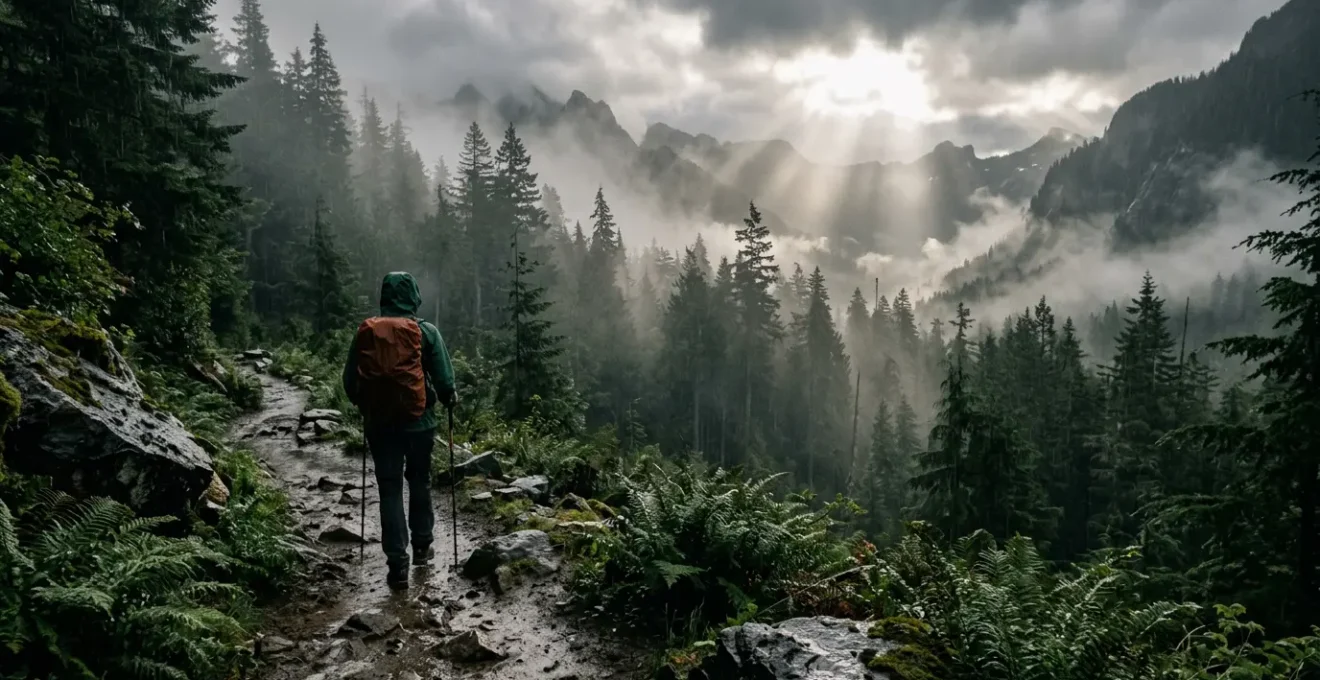
The greatest myth of wet-weather hiking is that you can stay perfectly dry; the reality is that all gear eventually fails under sustained assault.
- Success isn’t about a single “waterproof” jacket, but a complete moisture management system that handles rain from the outside and sweat from the inside.
- Preventing foot maceration and blisters is more critical than keeping your torso dry, requiring specific sock strategies and non-obvious footwear choices.
Recommendation: Stop chasing the fantasy of being 100% waterproof. Instead, learn to control dampness through dynamic layering, active venting, and a robust foot care protocol.
For any UK hiker accustomed to a persistent drizzle, the prospect of tackling an American national park might seem straightforward. Yet, the weather systems in places like the Pacific Northwest or high-altitude Rockies are an entirely different beast. We’re not talking about a gentle shower; we’re talking about atmospheric rivers, multi-day downpours, and conditions that can lead to catastrophic gear failure and genuine danger miles from any trailhead. The common advice—”get a good Gore-Tex jacket”—is dangerously simplistic. It ignores the other, more insidious source of wetness: the sweat you generate during a strenuous climb.
The truth that seasoned guides understand is that in extreme, multi-day rain, staying perfectly dry is an impossible goal. The objective shifts from “staying dry” to a more strategic concept: active moisture management. This means building a system of gear and techniques that controls water from the outside (rain) and moisture from the inside (perspiration) to keep you safe, warm, and functional. It’s a system where your socks are as important as your shell, and how you vent your jacket is more critical than its hydrostatic head rating. This article is not another list of jackets. It’s a strategic breakdown of the complete moisture management system you need to survive and thrive in America’s most demanding and beautiful wilderness.
To help you build this robust system, we will deconstruct the essential components, moving from your outer shell to the critical choices you make for your feet. This guide provides a clear path to understanding the gear and techniques required for your next demanding US adventure.
Contents: Your Guide to a Complete Waterproof System
- Gore-Tex Jackets or Traditional Ponchos: Which Protection Works Best in Heavy Rain?
- The Cheap Footwear Error That Causes Severe Blisters on Wet American Trails
- How to Layer Your Waterproof Gear to Prevent Sweating During Strenuous Climbs?
- Why Relying on Improvised Rain Protection Endangers Your Wilderness Hiking Safety?
- How to Re-Waterproof Your Old Hiking Boots Effectively Before Your US Departure?
- How to Roll and Compress Bulky Clothing for a Three-Week US Winter Holiday?
- Olympic National Park or Mount Hood: Which Rainforest Route Offers Better Trails?
- How to Explore the Pacific Northwest Rainforests Safely During the Damp Autumn Season?
Gore-Tex Jackets or Traditional Ponchos: Which Protection Works Best in Heavy Rain?
The debate between a high-tech hardshell and a simple poncho is the first layer of building your moisture management system. The choice isn’t about which is “better,” but which is the right tool for a specific situation. As Wilderness Scotland hiking guide Tim Willis rightly points out, “At some point, all gear will allow some water in; it’s just a matter of time.” Understanding the failure points of each option is key.
A modern Gore-Tex jacket is an engineering marvel. A long-term field test documented how waterproof-breathable technology evolved, but also confirmed that even modern materials can experience ‘wetting out’ during extended downpours. High-performance jackets with updated ePE membranes boast impressive lab results— recent tests demonstrate a 28,000mm hydrostatic rating—meaning they can resist a massive column of water before leaking. Their primary advantages are wind resistance and durability, making them essential for exposed ridges and alpine conditions where a flapping poncho would be a liability.
The traditional poncho, however, excels in one critical area where hardshells often fail: ventilation. Its open design allows for massive airflow, drastically reducing the buildup of internal moisture from sweat during humid, low-exertion hikes through dense, wind-protected forests. It also provides complete coverage for you and your backpack, a feature no jacket can offer. The following table breaks down the core trade-offs.
| Feature | Gore-Tex Jacket | Traditional Poncho |
|---|---|---|
| Wind Resistance | Excellent – fitted design | Poor – loose fitting |
| Ventilation | Limited – relies on membrane | Superior – open design |
| Pack Coverage | None – separate cover needed | Complete – covers pack |
| Durability | 5-10 years with care | 1-2 seasons typical |
| Weight Range | 200-600g | 200-600g |
Ultimately, for demanding US hikes, the expert’s choice is often not one or the other, but a system incorporating both. A lightweight, packable poncho can serve as a powerful supplement to a hardshell, deployed during relentless, non-windy downpours to give your primary jacket a chance to dry out.
The Cheap Footwear Error That Causes Severe Blisters on Wet American Trails
No piece of gear failure is more debilitating than compromised footwear. On a multi-day wet hike, the single greatest threat to your expedition isn’t a leaking jacket, but the catastrophic development of blisters caused by foot maceration—the softening and breakdown of skin waterlogged from sweat and penetrating moisture. The common mistake is buying cheap, non-breathable “waterproof” boots that trap moisture, effectively creating a swamp inside your shoe.
The solution is counter-intuitive: for sustained wet conditions, prioritize footwear that drains and dries quickly over footwear that claims to be “impenetrable.” This is why many long-distance hikers have abandoned heavy leather boots in favor of quick-drying trail runners with mesh uppers. A 2024 survey of Appalachian Trail thru-hikers revealed a sophisticated approach: 88% used a primary rain jacket, but many also carried ponchos, creating a dual system. This same logic applies to feet, where a system of quick-drying shoes and high-performance socks prevents the moisture buildup that leads to maceration.
Your sock system is your last line of defense. Never use cotton, which holds moisture against the skin. Instead, a rotation system using at least three pairs of merino wool socks is essential: one pair to wear, one pair drying on your pack or in your tent, and one clean, dry pair held in reserve in a waterproof bag for sleeping. This ensures you can put on dry socks every morning, a crucial step in preventing blisters. Preemptively applying Leukotape to known hot spots before you even start hiking can also be a trip-saver.
How to Layer Your Waterproof Gear to Prevent Sweating During Strenuous Climbs?
The most common failure of a waterproof jacket has nothing to do with the rain coming in, but with the sweat that can’t get out. During a strenuous climb, your body can produce over a liter of sweat per hour. If this moisture vapor cannot escape through your clothing layers, it will condense on the inside of your jacket, leaving you just as wet as if you’d worn no protection at all. This is where dynamic venting becomes the most important skill in your moisture management arsenal.
Effective layering is a three-part system: a moisture-wicking base layer (merino wool or synthetic), an insulating mid-layer (fleece or synthetic puff), and a waterproof/breathable outer shell. The goal is to actively manage these layers to regulate temperature and moisture *before* you get too hot or too cold.
As the illustration above shows, the system is designed to move moisture outward. However, even the most breathable membrane has its limits. Active, mechanical venting is non-negotiable. This means using your gear’s features—pit zips, main zippers, adjustable cuffs, and hem drawcords—to create airflow. Start your hike “cold,” knowing you will warm up. Be disciplined about stopping to remove a layer *before* you start to overheat, even if it feels inconvenient. The following protocol is what separates amateurs from experts on a tough ascent.
- Start of Climb: Open pit zips fully. Unzip the main zipper from the top and bottom to create a channel of airflow.
- During the Ascent: If you start to sweat, shed your mid-layer. Hiking in just a base layer under your vented shell is often the correct choice for steep climbs in the rain.
- On the Ridge: As you become exposed to wind, close the vents partially to balance protection with breathability.
- At Rest/Summit: Immediately put your insulating layer back on, even under your shell, to prevent rapid cooling as your body stops producing heat.
Why Relying on Improvised Rain Protection Endangers Your Wilderness Hiking Safety?
In a pinch, it can be tempting to think a cheap plastic poncho or even a trash bag is “good enough.” This is a critical and potentially life-threatening error. Improvised rain gear fails in two fundamental ways: it offers zero breathability and it lacks the durability required for wilderness travel. The result is a guaranteed soaking from your own sweat and a high likelihood of the gear ripping and leaving you completely exposed when you need it most.
The breathability issue is paramount. Wearing a non-breathable plastic layer during exertion is like hiking in a personal sauna. You will quickly become saturated with sweat, which chills you the moment you stop moving. This rapid cooling can be a precursor to hypothermia, even in moderate temperatures. Furthermore, this excessive sweating can accelerate dehydration, a condition that, according to some park service data, causes nearly 75% of hiking-related emergencies. Your body is working overtime to cool itself, and you’re losing vital fluids and salts with no benefit.
Secondly, improvised gear simply isn’t built for the rigors of the trail. A flimsy poncho will shred on the first encounter with a thorny bush or a scramble over abrasive rock. It will flap uncontrollably in the wind, acting as a sail and potentially unbalancing you on a narrow ridge. Purpose-built rain gear is designed with articulated joints, reinforced seams, and durable face fabrics to withstand this abuse. Relying on an improvised solution is placing a bet against the wilderness, and it’s a bet you are almost certain to lose.
How to Re-Waterproof Your Old Hiking Boots Effectively Before Your US Departure?
A trusty pair of broken-in hiking boots is an invaluable asset. But the factory-applied Durable Water Repellent (DWR) coating wears off over time, and the boot’s membrane can be compromised by dirt and oils. Simply spraying a new coating on a dirty, leaking boot is a waste of time and money. A proper restoration requires a diagnostic and systematic approach to bring your old boots back to life before you embark on a major US trip.
The process starts with a thorough cleaning and a leak test. Dirt and grime not only abrade the boot material but also clog the pores of a waterproof-breathable membrane, killing its performance. Use a specialized boot cleaner and a stiff brush, paying close attention to the seams and tongue gussets. Once clean, you can perform the “bathtub test” to pinpoint exactly where leaks are occurring, which will inform your treatment strategy.
The type of treatment depends entirely on your boot’s material. For full-grain leather boots, a wax-based conditioner is superior. It not only restores water-resistance but also nourishes the leather, preventing it from drying out and cracking. For synthetic or fabric/leather combination boots, a spray-on or paint-on DWR treatment is the correct choice. Applying the treatment when the boot is slightly damp can help it absorb more effectively. The final, and often skipped, step is crucial: many modern treatments require gentle heat to activate and bond to the fabric, followed by a full 24-hour curing period.
Your Action Plan: Pre-Trip Boot Restoration Protocol
- Leak Diagnosis: Perform the bathtub test—submerge your clean boots in 2 inches of water for 5 minutes. Watch for dark spots or water ingress to identify leak points.
- Deep Clean: Clean boots thoroughly inside and out with a specialized boot cleaner and brush to remove all dirt, grime, and old, failed treatments.
- Leather Treatment: For full-grain leather, apply a wax-based treatment with your fingers or a cloth while the leather is still slightly damp. Work it deeply into seams, stitching, and high-flex areas.
- Synthetic Treatment: For fabric or synthetic boots, apply a spray-on or paint-on DWR treatment in thin, even coats from about 6 inches away.
- Heat Activation: Use a hairdryer on a medium, low-heat setting for 2-3 minutes per boot to help the treatment bond to the material. Do not overheat or hold it too close.
How to Roll and Compress Bulky Clothing for a Three-Week US Winter Holiday?
Packing for a multi-week trip involving bulky waterproofs and insulated layers presents a significant challenge. The goal is not just to fit everything, but to pack it in a way that protects your gear and allows for efficient access on the trail. The key is a modular dry sack system. This involves compartmentalizing your gear into several smaller, water-resistant or waterproof stuff sacks within your main pack. This has two major advantages: it allows you to access one set of gear (like your lunch) without exposing your dry sleeping clothes to a downpour, and it makes packing your rucksack far more organized and efficient.
Compression dry sacks are invaluable for items like sleeping bags and insulated jackets, allowing you to reduce their volume significantly. However, a critical error is to over-compress your hardshell waterproof jacket. The waterproof-breathable membrane is a delicate structure, and aggressively creasing or crushing it can cause permanent damage, creating micro-cracks that will leak. Instead of jamming it into a tight compression sack, you should fold it carefully.
The correct technique for storing a hardshell is to follow the factory seams. Lay the jacket flat, zip it up, fold the arms inward, fold it in half vertically, and then loosely roll it from the bottom up into a cylinder. This minimizes stress on the membrane and seams. Store this roll in its own stuff sack or in an easily accessible outer pocket of your pack. This not only protects your expensive jacket but also ensures it’s the first thing you can grab when the weather turns.
Olympic National Park or Mount Hood: Which Rainforest Route Offers Better Trails?
The Pacific Northwest is home to some of the world’s most spectacular temperate rainforests, but not all rainforest trails are created equal. Choosing between a hike in Washington’s Olympic National Park (like the Hoh River Trail) and one on Oregon’s Mount Hood (like the trails near Timberline Lodge) requires understanding the profoundly different terrain and precipitation patterns, which in turn dictates your gear choices.
Olympic National Park is defined by its low-lying, incredibly dense river valleys. The trails are often characterized by deep, unavoidable mud, boggy sections, and numerous small stream crossings. The precipitation is a constant, humid drizzle that soaks everything over time. This environment demands maximum breathability in your gear and footwear with aggressive, deep lugs designed to shed mud. Full-length gaiters are not optional here; they are essential for keeping mud, water, and debris out of your boots.
Mount Hood, a dormant volcano, offers a different experience. While it receives plenty of rain, its trails are often on better-draining volcanic soil and rock. The terrain is more open and alpine, meaning you’ll encounter abrasive rock but also have more opportunities for gear to dry out in windy, exposed sections. The precipitation often comes in the form of more intense, intermittent alpine storms rather than a constant drizzle. This calls for a more durable, abrasion-resistant hardshell. A verified review for gear used in Olympic captured the feeling well, with one hiker noting their pants were “all day comfortable, and great in the colder morning temperatures and still great when it got sunny and warmer in the day,” highlighting the need for versatility.
| Factor | Olympic National Park | Mount Hood |
|---|---|---|
| Terrain Type | Deep mud, boggy sections, river crossings | Volcanic rock, better drainage, alpine meadows |
| Precipitation Pattern | Constant humid drizzle, 150+ inches annually | Intermittent alpine storms, 60-80 inches |
| Recommended Footwear | Tall waterproof boots with aggressive lugs | Waterproof trail runners acceptable |
| Essential Gear | Full gaiters, maximum breathability shells | Durable hardshells for abrasive terrain |
| Drying Opportunities | Limited – dense canopy blocks sun | Moderate – open alpine zones allow drying |
Key Takeaways
- Shift your mindset from “staying dry” to “managing moisture” from both rain and sweat; this is the core of an expert system.
- Foot care is paramount. A system of quick-drying shoes, merino wool socks, and pre-emptive taping is more critical than your jacket.
- Master dynamic venting. Use your gear’s zippers and layers to regulate temperature proactively, before you get too hot or too cold.
How to Explore the Pacific Northwest Rainforests Safely During the Damp Autumn Season?
Exploring the Pacific Northwest (PNW) during the autumn “rainy season” is a magical experience, but it demands a level of preparedness and a 24-hour moisture management strategy that goes far beyond simply owning a good jacket. Safety in these conditions, where Olympic National Park receives over 150 inches of rain annually, is an active, continuous process from the moment you wake up until you’re in your sleeping bag.
The day starts with a critical decision: what to wear. In the cool, damp morning air, the correct answer is almost always “less than you think.” Starting your hike in just your base layer, with your shell and mid-layer in your pack, prevents immediate overheating. As the day progresses and the rain begins, your strategy must be dynamic, constantly adjusting your layers and vents to match your exertion level and the changing conditions. The moment you stop for a break, you must immediately add an insulating layer to trap your body heat before it dissipates.
This management continues even after you reach camp. The first thing you must do is change out of all your damp hiking clothes and into a dry set of base layers reserved exclusively for sleeping. This single action is a crucial defense against hypothermia. You must then devise a system to dry your wet gear overnight. Hanging clothes on a line inside your tent’s vestibule allows them to air out. For critical items like damp socks or boot insoles, the expert’s trick is to place them inside your sleeping bag with you. Your body heat will work overnight to slowly dry them, ensuring you have a fighting chance for the day ahead. This is the reality of a multi-day trip in the PNW: a constant, strategic battle against the damp.
Now, equipped with this strategic framework for moisture management, you can pack not just gear, but a system. You understand the trade-offs, the techniques, and the mindset required to face down the worst weather America’s wild places can offer. Your next adventure awaits, and you’ll be ready for whatever the sky throws at you.